

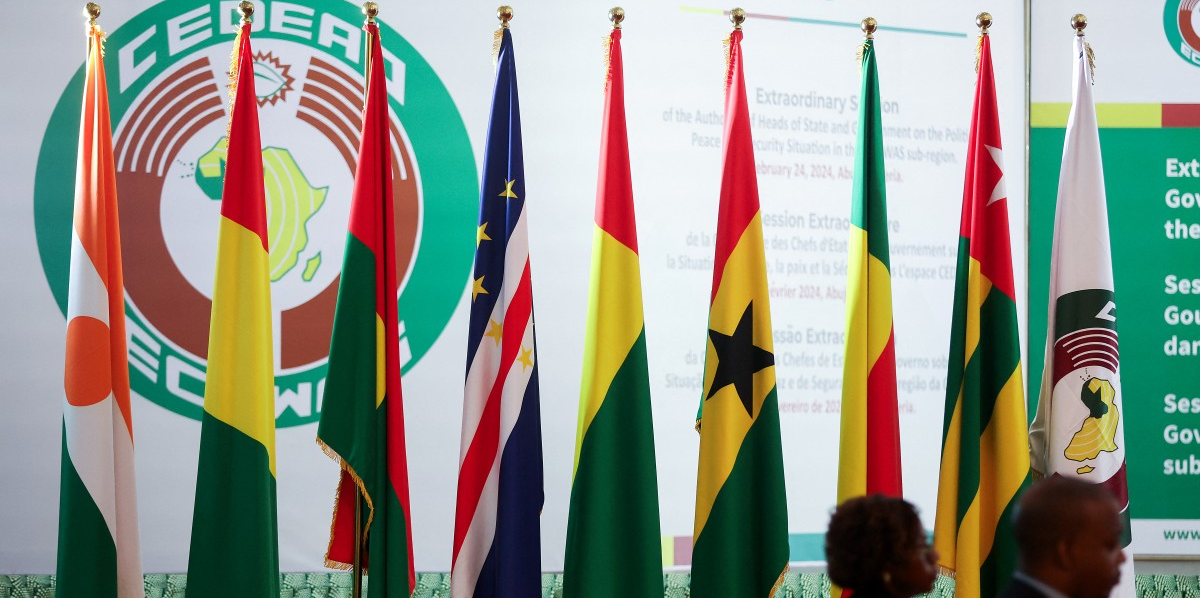
The President of the ECOWAS Commission, Dr. Omar Touray, has raised concerns over the growing threats of insecurity and democratic decline in West Africa, warning that both crises are undermining the sub-region’s long-standing vision of integration.
The News Chronicle gathered that Touray made the remarks at the Second Continental Edition of the African Public Square (APS) Conference, held on Friday in Abuja, under the theme “Future Proofing Regional Integration in Africa: ECOWAS @50.”
The African Public Square serves as a platform for intellectual discourse on peace, security, and development across the continent. The event, organised by the Amandla Institute and the African Leadership Centre, gathered leaders, policymakers, and scholars to explore how ECOWAS can reinvent its integration agenda amid mounting political and economic turbulence.
Represented by Amb. Abdel-Fatau Musah, ECOWAS Commissioner for Political Affairs, Peace and Security, Touray revealed that the commission had initiated a comprehensive internal dialogue to review its integration roadmap. According to him, the process is designed to be citizen-driven, culminating in a draft accord that will guide ECOWAS’ direction for the next 15 years.
“I would argue that we have a crisis of security, and then we have a crisis of democracy in West Africa today.
“We have to navigate between a lot that has been said about terrorism, violence, terrorism, and others.
“Democracy is also in crisis. It is in crisis today in West Africa and it doesn’t seem like leaders have learned their lesson,” he said.
He traced ECOWAS’s journey from its establishment in 1975, through post–Cold War instability, to its current struggles with internal democratic challenges. Touray cautioned that the global system was moving into what he called a “warm war” era — a period marked by new power shifts and strategic rivalries — urging the region to safeguard its collective interests through unity and foresight.
He lamented the growing wave of political exclusion in some countries, which he said had eroded democratic values and partly fueled the recent withdrawal of some Sahel nations from the bloc.
“Only renewed commitment to inclusivity, good governance, and dialogue can bring the estranged members back into the ECOWAS family.
“Today’s popular method of team capture is by member states eliminating dangerous opponents, whether political parties or candidates, from the electoral process,” he added.
Speaking at the event, former Ekiti State Governor and ex-Minister of Solid Minerals, Dr. Kayode Fayemi, blamed the sub-region’s deepening insecurity on governance failures rather than insurgency. He stressed that corruption, exclusion, and institutional decay had inflicted more harm on stability than armed groups ever could.
“West Africa’s escalating insecurity is rooted less in the gunfire of insurgents and more in the failures of governance that have eroded public trust, Kayode Fayemi, former governor of Ekiti State has said.
“What we face is not just a security deficit, it’s a governance deficit. Until we rebuild trust between leaders and citizens, insecurity will remain our daily reality,” he said.
Fayemi, who co-founded the Amandla Institute, observed that the resurgence of coups and violent extremism was a direct consequence of citizens’ disillusionment with democratic systems. He warned that military interventions, regardless of their motives, would not resolve deep-seated issues such as inequality, unemployment, and poverty.
He urged ECOWAS to back its rhetoric with tangible reform by adopting a human-centered security model anchored on justice, accountability, and inclusion. “Genuine stability will only emerge when citizens see democracy working for them, not against them,” he said.
Describing ECOWAS’s 50th anniversary as a “moment for deep reflection,” Fayemi commended the body’s early interventions in Liberia, Sierra Leone, Côte d’Ivoire, The Gambia, and Guinea-Bissau but warned that it risked alienating its people.
“ECOWAS must move beyond an elite-driven community of rulers to one that truly represents its people, particularly the youth and women. Overdependence on donor funding and stalled reforms threaten its long-term relevance,” he said.
Also speaking, Godwin Murunga, Executive Secretary of the Council for the Development of Social Science Research in Africa (CODESRIA), advocated for a shift from state-led integration models to people-driven initiatives.
Funmi Olonisakin, Vice President for International Engagement at King’s College London, emphasized the need for a “cross-generational pathway” to transformation. “With an average age of just 18, West Africa’s young population represents both a challenge and a reservoir of potential,” she said.


