

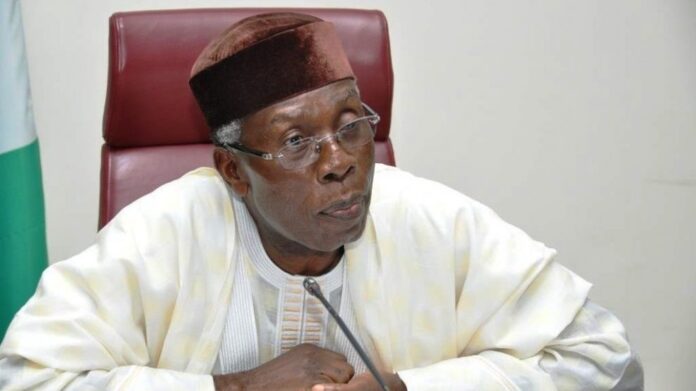
My late friend Chief Audu Ogbeh once described Nigeria Political Parties as “a rally without ideologies”. He was then the Chairman of the Nigeria Peoples Party, (NPP). Both of us had served as Ministers in Alhaji Shehu Shagari’s cabinet. We were also once detainees at the infamous Kirikiri Prison, somewhere in Lagos in the 1980s when the Shagari government was overthrown by the military. The civilian President had told us in the cabinet that there were only two parties in Nigeria, the Military establishment and the Civilians. The common denominator was that both hustled to control the levers of power, one by persuasion, the other by the power of the guns.
Both appreciations of the access to power are correct-the absence of ideologies. When there is no ideology, no structured rules of engagement, anything goes—including the idea that power is not served a la carte. You should rather grab it and run. To grab is to be physical, to run is to quickly disappear before you are overtaken by the opposition. Whether in the campaign ground or at the sanctuary of the Government house, the idea is to mask the ugly absence of a structured democratic pathway to power.
Go to any political rally in Nigeria today and you will see the same scene or scenario playing out. Drums. Dancers. Musicians. Praise singers. Crowds in colourful uniforms, dancing as if it is a festival. As if all is well with Nigeria. And someone had said that Nigerians must be the “happiest people in the world”. How ironic.
Yet too often, behind the dancing, there are thugs, broken chairs,burnt posters, convoys attacked, there are the wounded, ambulances and body bags. Yet the next day there will be repeat performances. Truth be told: Our political system does not reward policies that discuss or focus on issues . It rewards rather performance and intimidation. This is beyond perception.
Yet Nigerians, no doubt, care about the issues and want debates on electricity, on schools, on hospitals, on jobs, on security. Our politicians put these matters on the back burner . The front burner belongs to dancing, singing and violence.Dancing is therapeutic and makes some participants deny the reality of governance-that it is a serious affair.That is why we dance instead of debate.It is an escape, a short pathway of winning election by denial -via through mobilisation , rather than by persuasion.
In a healthy democracy, you win by persuading undecided voters that your ideas are better.In Nigeria, you win by mobilising your own supporters and demobilising your opponent’s supporters.
Dancing mobilises very well. A big, dancing crowd on television looks like a victory secured, even if no one in that crowd can tell you the candidate’s manifesto. It creates energy, belonging, momentum. And optics matter.Violence also demobilises well. If you attack your opponent’s rally, burn his billboards, block his convoy, his supporters will be afraid to come out on election day.Policy cannot do either job as quickly. A lecture on power sector reform will not fill a stadium. A song will. A threat will empty the opponent’s stadium.
These are reasons why this strategy succeeds: For many politicians, violence is not an accident. It is a weapon.The average Nigerian voter rarely asks about policy. He rather asks about what he will get from a rally. He is aware that the State is the biggest source of power, contract and money, and his take in all these displays is also extractive: that if he must survive he must be close to power. The Igbo aphorism bears out -Onye eghu na eso bu onye ji igu eghu na ata. (The goat follows the person with the leaves it chews to avert hunger).
That unfortunately is also the bane of our democratic practice-the weaponization of hunger and poverty. What do you expect in a country where the resources of the land is in the hands of about two percent of the its affluent citizens- where about 160 million Nigerians are said to be in the poverty silos. The average voter may not be enamoured by the man with a brilliant manifesto but who does not give shishi. The rally is not a job interview. It is a display of power — who can fill the stadium, who can distribute rice, wrappers, trycycles,Keke-na pep,and cash.In this system the candidate is a benefactor to be celebrated. The proverbial goat to be followed.
In countries where a teacher, a farmer, or a trader can survive without a governor’s favour, voters can afford to ask about policy. In Nigeria, survival often depends on being close to power, so voters ask about patronage, not programmes..When there is no ideology, where nothing fundamentally separates the various parties, apart from identity politics of religion, tongues and tribes, what is there really to debate? Where there is no lingua franca-the tongue that is beyond tongue and tribe-there is no nation to fight for. That is why music, masquerade and dance continue to matter-to drown the voices of those who may have something to say.
In Britain, Labour and Conservative parties genuinely disagree on issues , ranging from tax, health, and immigration. In America, Democrats and Republicans disagree on abortion, guns, and healthcare. In Nigeria, the disagreement is mostly: “It is our turn to chop.”
A hungry man at a rally is not waiting for a 10-point economic plan. He is waiting for who will give him transport money, a bag of rice, and a good show. Politicians know this. They hire musicians because musicians draw crowds. They hire thugs because thugs protect the crowd — and intimidate the opposition and the other crowd.
The politician who brings a professor to explain a fiscal policy will get an empty stadium. It is not only because some of the egg heads may have been compromised but also because the politician who brings a popular musician and shares money will get a fuller stadium.And which one do you think our people will perceive as the “ strong candidate”?
But the most important reason why this show of shame and abuse of a soi- disant political system persists is impunity. There is no punishment for Violence, No reward for Ideas.In Nigeria a politician who sponsors violence is rarely punished. A politician who presents a brilliant policy paper is rarely praised.Until violence becomes expensive, through arrest, prosecution, and disqualification, and competence becomes rewarding, dancing and thuggery will remain cheaper than ideas. Relying on foreign umpires to sanitize the system for us is a pipe dream.
IS Nigeria Alone -An exception? The answer is Yes and No.
Yes, because everywhere, every clime has spectacles. Trump rallies in America bring music, dancing, chants, and insults. Lula and Bolsonaro rallies in Brazil have samba and carnival energy. Modi rallies in India have drums and massive crowds. Kenya rallies have music and dance.Politics everywhere needs theatre and human beings respond to rhythm, crowd, and emotion.We cannot completely throw emotion out of the window.
But our practice and performance are not at the same par or level as above.
In the countries mentioned above spectacle and performance do not drown debates. .Politicians do not go to Charttam House to seek approval.
In America, after the rally, there is a televised debate where you must answer questions on inflation. In Britain, the Prime Minister must face Prime Minister’s Questions every week. In India, the press will tear apart a manifesto.
In Nigeria, where journalists interrogate individuals or party representatives and tear apart manifestoes or programs there are hardly any consequences for empty promises, for budgets un- implemented, for policy somersaults. Serious countries punish politicians for these infractions, Nigeria hardly do.
.WHAT TO DO?
NIGERIANS WILL NOT STOP DANCING.IT IS PART OF OUR CULTURE.
As Poet Leopold Sedar Senghor of Senegal said in one of his poems “we are a dancing people who till the Earth with our feet” . We will not stop dancing. And we should not. Dancing is part of who we are. Our politics should have joy, music, and culture.But dancing must not replace debate .
Let our political parties have ideologies, not in the negative Marxist definition of it, nor in its Napoleonic variant, nor as just a slogan. but in its positive pragmatic sense., to wit: “A more or less set of ideas that provide the basis for organised political action, whether this is intended to preserve ,modify or overthrow the existing system oof power”. This is ideology as defined by Andrew Heywood in his book: Political Ideology: an Introduction. A party must stand for something, publish a manifesto, and be judged by it.Heywood is a British political theorist, born in in1952, He is our contemporary and still matters.
Secondly, debates must be compulsory in this country and must be held here. It must not be out sourced. The INEC and the media must organise presidential, governorship, and senatorial debates that no serious candidate can dodge. A candidate who cannot defend his ideas in the public domain should not lead the public.Third, violence must be punished. The Electoral Act must bite and not just bark. Thuggery must lead to disqualification and jail, not to governorship.Nigeria deserves better than a democracy of dancers and thugs.In all these who is to be held accountable :”the voter or the leader? Listen to this and know why we must judge those who hold power more seriously than those who obey power. Pulitzer Prize-winning historian, Barbara Tuchman wrote—“power breeds folly, that the power to command frequently causes failure to think, that the responsibility of power often fades as its exercise augments..”. That is the paradox of power.and that is why we all must dance with caution.


