


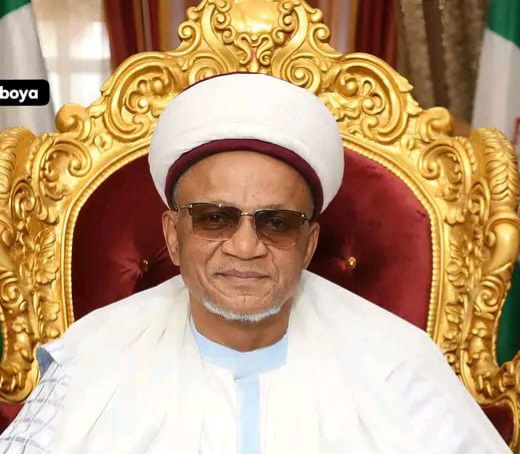
There are kings who inherit a throne.
And there are kings who are prepared for a throne long before they ever sit on it.
Yahaya Abubakar belongs to the second kind.
He did not stumble into royalty. Royalty was woven into his blood, discipline was beaten into his character in the barracks, and destiny merely waited for the right hour to call both together.
1. Born Inside Royalty, Not Beside It
He was born on 12th September, 1952, in Bida, into the Usman Zaki Ruling House— not as an outsider admiring the palace from afar, but as a child of the palace itself.
His father was the late Alhaji Abubakar Saganuwa Nakordi Nupe, brother to the 11th Etsu Nupe, the late Malam Musa Bello. (May Almighty ALLAH Grant Them Aljannah Firdaus, Ameen Ya Hayyu Ya Qayyum)
His mother was the late Hajiya Habiba Bantigi Ndayako, daughter of the 9th Etsu Nupe, and sister to the 12th Etsu Nupe, the late Alhaji Umaru Sanda Ndayako. (May Almighty ALLAH Grant Them Aljannah Firdaus, Ameen Ya Hayyu Ya Qayyum)
Think about that for a moment.
On his father’s side, a brother to a King. On his mother’s side, a daughter to a King and sister to a King. He was not just born a prince. He was born at the very crossroads where two royal rivers meet.
Yet, he never carried himself like a boy waiting for a crown. He carried himself like a boy preparing for duty.
He began with Islamic studies, then Bida East Primary School and Sabongida Primary School between 1957 and 1965, then Government College, Sokoto, and Kano Commercial College.
2. The Soldier Who Chose The Hard Road
In 1972, when many young princes would have chosen comfort, Yahaya Abubakar chose the Nigerian Defence Academy, Kaduna, as a member of the 14th Regular Course. He was commissioned into the Nigerian Army Armoured Corps as a Second Lieutenant on 13th December, 1975*.
That single decision changed everything.
For the next 30 years, he did not live as a prince. He lived as a soldier.
He trained in Nigeria, the United States, India and Egypt. He rose from Young Officer’s Course (Armour) to Tank Technology, to Staff College, to the National Defence Course in Egypt.
He was:
– ADC to the GOC, 4 Infantry Division
– Commanding Officer, 231 Tank Battalion and 212 Tank Battalion
– Commanding Officer, NIBATT 27 ECOMOG, Liberia, August 1996 – July 1998
– Deputy Commandant, Depot, Nigerian Army, Zaria
– Commander, Multinational Joint Task Force (MNJTF), Lake Chad Region, August 1999 – January 2002*
– *Director, Peacekeeping Operations, Army Headquarters
– Director, Foreign Operations, Defence Headquarters, Abuja
In Liberia, under ECOMOG, he did not just wear a uniform. He carried Nigeria’s flag into a foreign war to bring peace to another people’s country. In Lake Chad, he commanded soldiers from different nations. In Abuja, he directed Nigeria’s peacekeeping for the whole world.
He retired as a *Brigadier General* in September 2003 — with the Forces Service Star, Meritorious Service Star, ECOMOG Medal and many other honours.
In his own words, he later said: _“I put off the uniform and then put on the agbada and turban.”_
But the truth is deeper: He never really put off the soldier. He only changed his battlefield.
3. The Day Bida Held Its Breath
On 1st September 2003, the 12th Etsu Nupe, Alhaji (Dr.) Umaru Sanda Ndayako, passed on. Nupe land mourned.
Ten days later, on 11th September 2003*, the soldier was called. He was appointed the 13th Etsu Nupe by the administration of the late Governor Abdulkadir Abdullahi Kure. He was formally presented with the First-Class Staff of Office on 11th July, 2004.
He was the 13th to rule, and he ascended in his 13th month of waiting? No — he ascended as the 13th, and he would go on to become the longest-reigning Etsu from his Usman Zaki house.
It was not an accident. It was preparation meeting providence.
Before the throne, he was already Kusodu Nupe — a title that kept him close to his people even while he was in uniform. He never lost touch with his roots.
4. The Game Changer: A Soldier’s Discipline, A Father’s Heart
Most traditional rulers rule with tradition. Etsu Yahaya rules with tradition _plus_ strategy.
In 23 years on the throne — he marked 23 years and his 74th birthday on 11th September, 2026 — he has turned Bida Emirate into what many describe as one of the most efficiently run kingdoms in Nigeria.
His reign has four pillars that no other write-up has put together like this:
A. PEACE AS A MILITARY DOCTRINE
In 18 years of his early reign, there was no reported case of sectarian violence in his domain. That is not luck. That is a former peacekeeping commander applying peacekeeping at home.
B. UNITY AS A NATIONAL PROJECT
He did what politicians could not do. He united Nupe people across Niger, Kwara and Kogi States. Through the Annual Nupe National Day on 26th June — the day Nupe warriors defeated the British Constabulary at Ogidi in 1896 and seized the Union Jack — he turned history into identity.
He brings together the Etsus of Patigi, Agaie, Lafiagi, Lapai, Tsaragi, Tsonga, Kupa-Abugi and Bassa-Nge, not as rivals, but as brothers under one cultural roof.
C. EDUCATION AS AN OBSESSION
He did not just talk about education. He built structures for it:
– Bida Emirate Education Fund
– Committee for the establishment of a private university — which gave birth to Edusoko University, Bida
– Chancellor of Obafemi Awolowo University, Ile-Ife
– Chancellor of Ambrose Alli University, Ekpoma
He believes, as one tribute put it, that the greatest investment any society can make is an investment in its people.
READ ALSO: Nasarawa’s Mararaba Flyovers Near Completion as Triacta Fixes March 2027 Deadline
D. AGRICULTURE AS ECONOMICS, NOT SLOGAN
Nupe land was already the food basket of Niger State. He turned it into an industry. Through EDU-Soko Farms Limited, covering over 30,000 hectares, and his encouragement of rice, yam and maize farmers, rice mills sprang up across the kingdom.
He did not just bless farming. He invested in it.
5. The King Beyond Bida
Look beyond Bida and you will see why Nigeria respects him:
– Chairman, Niger State Council of Traditional Rulers
– Chairman, Coordinating Committee, National Council of Traditional Rulers of Nigeria
– Chairman, Abuja National Mosque Management Committee
– Commander of the Federal Republic (CFR), conferred in 2004
He chairs the National Mosque in Abuja — the architectural landmark of the capital — yet he is also the father who opens his palace door to the poorest farmer in Bida. He unites Christians and Muslims in his domain with the same calm he once used to command multinational troops.
That is the paradox that makes him unique: A General who is gentle. A King who is accessible. A Traditional Ruler who thinks like a modern strategist.
6. The Foundation That Will Outlive Him
In 2024, he launched the Etsu Yahaya Abubakar Foundation (EYAF) — a platform for humanitarian interventions, education, health, youth empowerment and social development.
Kings build palaces. Great kings build institutions that will serve people after they are gone.
This is his masterstroke. The Foundation ensures that even in 100 years, a child in Bida who never met him will still benefit from him.
7. Why History Will Call Him Different
Other Etsus preserved the throne.
Yahaya Abubakar _modernized_ the throne without breaking it.
He took a kingdom founded on cavalry and swords, and gave it universities, farms, foundations, peace, and global recognition — without losing its turban, its drums, its brass works, its masquerade, its dignity.
He is the Soldier-King.
The man who commanded tanks in Liberia, commanded multinational forces in Lake Chad, and now commands the love of millions of Nupe people across the world — not with orders, but with humility.
Long live the 13th Etsu Nupe.
Long live Alhaji (Dr.) Yahaya Abubakar, CFR.
The King who first learned how to serve, so that he could learn how to rule
Ibrahim Umar Bida
+234 803 753 1703
+234 810 667 8918
iumarbida088@gmail.com