

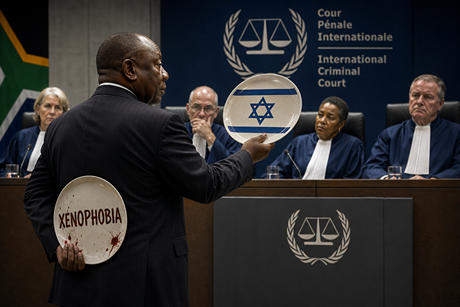
In December 2023, South Africa walked into the International Court of Justice and accused Israel of genocide against Palestinians in Gaza. The case was hailed by many across the globe as a moral landmark where a former victim of a brutal, internationally condemned system of racial oppression standing up for another people it saw enduring something comparable. Pretoria framed the case in the language of universal human dignity; that international law must protect the vulnerable regardless of who violates it or who is watching.
Yet, South Africa’s own record at home has become impossible to ignore. In the same years that its lawyers have stood at the Peace Palace invoking the sanctity of civilian life and the moral duty to prevent atrocity, mobs inside South Africa’s own townships and informal settlements have been hunting down African migrants, torching their shops, driving them from their homes, and in a number of documented cases, killing them. The gap between the principle Pretoria champions abroad and the practice it tolerates at home is the subject worth examining honestly.
South Africa’s history of violence against African and Asian migrants living within its own borders is not new; it stretches back at least to 1995, and blew up in 2008, when a wave of attacks left more than sixty people dead, many burned alive, in scenes that shocked the continent.
Organised anti-migrant movements, most visibly Operation Dudula, which has since registered as a political party, and a newer formation called March and March, have spent 2025 and 2026 organising demonstrations that repeatedly tipped into vigilante violence. Researchers tracking the pattern through the Xenowatch monitoring project recorded 406 verified xenophobic incidents between 2022 and 2025, resulting in 75 deaths, with a further 22 verified incidents in just the first five months of 2026 alone. Fourteen of those 2026 incidents were violent attacks that followed anti-migrant protests, leaving at least four people dead and hundreds displaced.
The violence in 2026 has been especially brazen. Two Mozambican men were killed in late May in Mossel Bay, where more than fifty shacks in an informal settlement were burned, and Mozambique’s government said five of its citizens had died in what it called xenophobic attacks. A Malawian man was killed by a mob in an informal settlement near Durban, an attack that forced hundreds of migrants to flee into churches and mosques for safety. Foreign-owned shops have been looted and burned in Johannesburg, Pretoria, and Durban. One anti-migrant coalition even circulated an unofficial deadline demanding that undocumented foreigners leave the country by the end of June 2026 or face the consequences, a threat serious enough that thousands of migrants began fleeing preemptively, even after the government publicly disavowed any such deadline as having no legal force.
Perhaps most damning is what researchers describe as the state’s posture toward all of this. Some officials have downplayed the killings and destruction as ordinary criminality rather than confronting them as targeted, identity-based violence, and vigilante groups have continued blockading public health clinics and denying migrants access to medical care across several provinces even after courts issued interdicts against them and police leadership pledged to intervene. President Cyril Ramaphosa has condemned the violence, albeit somewhat sheepishly and pretentious, blaming opportunists exploiting genuine economic grievances, and police have increased deployments in high-risk areas. But condemnation from the top has coexisted, on the ground, with police who in some documented cases have refused to even take statements from victims.
Here is the uncomfortable juxtaposition. At The Hague, South Africa’s argument is that the world has an obligation to protect civilians from mass violence, displacement, and dehumanisation, regardless of nationality, and that failing to act against such violence is itself a form of complicity.
This is not a claim that the two situations are morally or legally equivalent in scale; the war in Gaza and South Africa’s domestic vigilante violence are different in character, context, and death toll, and collapsing that distinction would itself be dishonest. The point is narrower and, in some ways, more damning: the principle South Africa asked the world’s highest court to enforce, that no population’s suffering is less worthy of protection than another’s, is a principle its own government has struggled to enforce inside its own borders. A state that stakes its international moral authority on universal human dignity opens itself to the fair question of whether that dignity is extended universally, or selectively, to strangers in Gaza but not to strangers in Soweto.
What can fairly be said, however, is that South Africa’s moral authority as distinct from its legal argument is weakened by the gap between what it demands of Israel and what it has failed to secure for the migrants inside its own borders. Moral suasion depends on more than the letter of the law; it depends on a country appearing to live by the standard it invokes. Until Pretoria confronts the xenophobic violence in its own townships with the same urgency and moral clarity it brought to The Hague, that gap will remain fair game for critics, and rightly so.


