

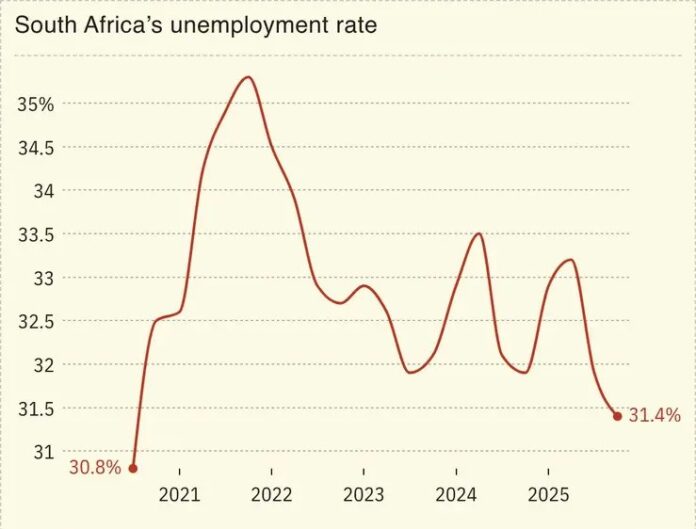
South Africa’s unemployment crisis has reached another disturbing milestone. The country’s official unemployment rate rose to “33.6 per cent in the second quarter of 2026”, up from 32.7 per cent in the first quarter, according to Statistics South Africa.
The latest figures are not merely another set of statistics to be filed away in government reports. They should provoke a serious national conversation about the causes of unemployment, the country’s economic direction and, importantly, the dangerous tendency to blame fellow Africans for a crisis that is fundamentally more complicated than the presence of foreign nationals.
For years, one of the recurring narratives surrounding South Africa’s unemployment crisis has been that foreigners, particularly other Africans, are taking jobs that should belong to South Africans. Nigerians, Ghanaians, Zimbabweans, Mozambicans, Malawians and other African nationals have frequently been portrayed by sections of the public as competitors for scarce employment opportunities. That narrative has often provided a convenient scapegoat.
But there is now an awkward question that South Africans, policymakers and indeed the entire country must confront: “If foreigners are supposedly stealing South African youths’ jobs, why is unemployment rising even as hostility against foreign nationals intensifies, and many of them have either left or reduced their economic activities in the country?” In other words, “who is now stealing the jobs?” The foregoing questions may sound provocative, but they are necessary.
According to the latest figures reported by Reuters, the number of unemployed people in South Africa increased from 8.137 million in the first quarter to 8.481 million between April and June. That means an additional 344,000 people joined the ranks of the unemployed in just three months.
Even more troubling is that employment declined in seven of the 10 sectors monitored by Statistics South Africa. Community and social services recorded the largest job losses, followed by mining, agriculture and manufacturing.
These are not sectors under which employment problems can simply be blamed on a Nigerian or Ghanaian trader, a Zimbabwean or Tanzanian construction worker, a Malawian gardener or a Mozambican informal-sector operator.
Without any iota of exaggeration, the figures expose a deeper structural problem. South Africa has an economy that is struggling to generate enough jobs for its rapidly expanding working-age population. The official unemployment rate has remained above 30 per cent for more than five years, making it one of the highest in the world. The expanded unemployment rate, which includes people who have stopped actively looking for work, climbed even further to 43.8 per cent. That is a crisis of enormous proportions.
Yet, for too long, public discourse has sometimes reduced this complex economic problem to a simplistic contest between South Africans and foreigners. The logic is dangerously flawed. A foreign national cannot “steal” a job that does not exist in the first place. Where a company is not expanding, where factories are closing, where mines are shedding workers, where businesses are struggling with costs and where investment is inadequate, removing foreigners does not automatically create employment. It merely changes who gets blamed.
This is where South Africa’s current experience should serve as a warning against scapegoating. There is nothing wrong with demanding that the government enforce immigration laws. There is nothing wrong with insisting that employers comply with labour regulations. There is nothing wrong with ensuring that foreigners working in South Africa have the necessary permits and that businesses employ people legally. But there is everything wrong with turning foreigners into convenient explanations for structural economic failures. The latest unemployment figures make that distinction particularly important.
If foreign nationals were truly the principal cause of South Africa’s unemployment problem, one would reasonably expect unemployment to fall significantly as foreigners are pushed out of economic spaces. Instead, the unemployment rate has risen from 32.7 per cent to 33.6 per cent. That should make the scapegoating narrative increasingly difficult to sustain.
It also raises another uncomfortable question: “Could South Africans, through xenophobic hostility and an increasingly hostile business environment, be chasing away some of the very economic actors who create employment and stimulate commerce?” This question should not be dismissed as an attempt to blame South Africans for their own unemployment. It is an invitation to examine consequences.
Businesses need customers, workers, suppliers, investors and predictable operating environments. Entrepreneurs, irrespective of nationality, contribute to economic activity when they open shops, establish companies, rent premises, employ workers, purchase goods and services and pay taxes.
Foreign Africans are not simply consumers of economic opportunities. Many are also participants in economic production. Some operate restaurants and shops. Some work in construction. Some are artisans. Some are employed in factories, farms and domestic services. Others run technology, logistics, transportation and professional businesses.
Where they employ South Africans, their businesses become part of the employment ecosystem. Driving such entrepreneurs away may therefore have consequences beyond the immediate target.
A foreign-owned shop that closes is not necessarily a South African job created. A foreign-owned business that leaves the country does not automatically translate into a South African-owned business taking its place. A foreign professional who leaves does not necessarily create an opening for an unemployed graduate. The economy does not work that mechanically.
The South African government therefore needs to look beyond the politics of blame and confront the uncomfortable fundamentals of the labour market. Why are businesses not creating sufficient jobs? Why are seven of the 10 monitored sectors shedding employment? Why are manufacturing and mining, historically important sources of employment, struggling? Why is youth unemployment so persistent? Why are young Black South Africans, particularly women, disproportionately affected? These are the questions that deserve the country’s attention.
Blaming foreigners may be politically attractive because it provides a visible target. Structural economic reform, by contrast, is much harder. It requires investment, policy consistency, infrastructure, education, skills development, industrial expansion, energy security, effective policing, efficient regulation and confidence in the economy. It requires politicians to explain why economic growth has not translated into sufficient employment. It requires employers to examine whether their businesses can expand. It requires educational institutions to confront the mismatch between qualifications and labour-market demands.
Still in the vein of the foregoing view, it requires society to recognise that unemployment is not necessarily caused by the person standing next to an unemployed South African. There is also an important distinction between “illegal immigration” and “African immigration”. The former is a matter of law and governance. The latter is a broad category encompassing millions of people whose circumstances differ enormously.
A country has every right to determine who enters, works and resides within its territory. But enforcing immigration law should not become a licence for collective punishment, harassment or violence against people because they happen to have been born elsewhere on the continent.
Indeed, South Africa’s economic problems cannot be solved by attacking other Africans. If anything, such hostility risks weakening the country’s standing within the very continent whose economic integration it needs.
South Africa remains one of Africa’s largest and most industrialized economies. Its future prosperity is tied to regional trade, investment and cooperation. The African Continental Free Trade Area (AfCFTA) is built on the recognition that African economies can create greater prosperity by trading with one another rather than retreating into economic nationalism. Afrophobic rhetoric runs in the opposite direction.
The irony is particularly striking when one considers the scale of South Africa’s unemployment crisis. At “33.6 per cent”, the official unemployment rate is far too high to be explained by the presence of foreign nationals alone. The expanded rate of “43.8 per cent” makes the argument even harder to defend.
Nearly half of the broader labour force being unemployed or underutilized is evidence of a national economic emergency. And emergencies demand serious solutions.
South Africa must therefore resist the temptation to confuse the symptoms of its economic crisis with its causes.
Foreign nationals may be present in the labour market, but their presence does not explain why investment is insufficient, why industries are shedding jobs, why infrastructure constraints persist, why businesses struggle to expand or why millions of young people cannot find work. Those are policy and economic questions. They require policy answers.
The irony of the present situation should not be lost on anyone. For years, some South Africans have been told that foreigners are taking their jobs. Yet, as the foreign scapegoat is pushed out of town, unemployment continues to rise. So, once again, “who is now stealing the jobs?” Perhaps the answer is that nobody is stealing them. Perhaps too few jobs are being created in the first place. And perhaps that is the uncomfortable truth South Africa must confront.
The country’s unemployment crisis is too serious to be reduced to a xenophobic slogan. The unemployed South African youth does not need another foreigner to blame. He or she needs an economy capable of creating opportunities.
South Africa does not need to choose between protecting its citizens and respecting fellow Africans. It can do both. It can enforce its immigration laws without dehumanizing immigrants. It can prioritize citizens in legitimate ways without turning foreigners into enemies. It can fight illegal employment without encouraging xenophobic violence.
And, most importantly, it can create an economic environment in which there are enough productive opportunities for everyone who is legally entitled to participate.
Without a doubt, the latest “33.6 per cent unemployment rate” should therefore be treated as a wake-up call. This is as It is a reminder that unemployment is not solved by chasing foreigners from the streets. It is solved by building industries, attracting investment, supporting businesses, developing skills, improving infrastructure and creating an economy in which work grows faster than the number of people searching for it.
Until South Africa confronts those realities, the scapegoat will simply keep changing. Today it may be the Nigerian. Tomorrow it may be the Zimbabwean. The next day, perhaps another African. But the unemployment figures will remain. And that is because the real enemy is not the fellow African looking for a livelihood. The real enemy is an economy that is failing to create enough livelihoods in the first place.


