

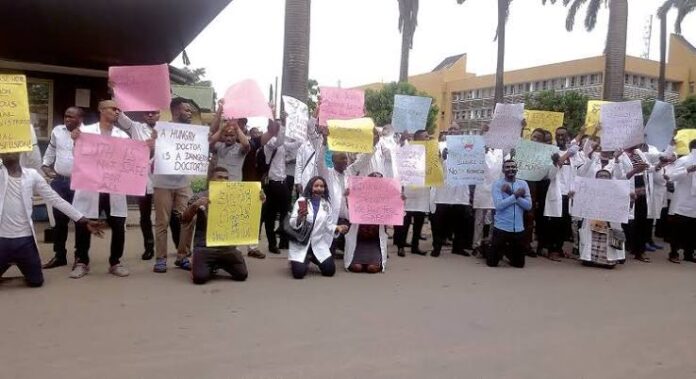
Resident doctors at the Lagos University Teaching Hospital (LUTH) have continued their industrial action over unresolved welfare concerns, insisting they will not resume work until concrete steps are taken to address their demands.
The prolonged strike has increased pressure on consultants and affected the delivery of healthcare services, particularly for patients requiring admission and continuous in-hospital care.
Speaking on the development, the Chief Medical Director of LUTH, Prof. Wasiu Adeyemo, said the hospital management had engaged all labour unions to resolve the issues.
According to him, doctors are not the only category of staff required to be on call, adding that there is no law mandating hospitals to provide meals for health workers on duty.
“There is no law that states food should be provided, but we are committed to providing a conducive working environment,” Adeyemo said.
The CMD explained that management had secured accommodation for on-call staff and, after reviewing the cost of utilities, agreed to install electricity meters for the facility.
“I pay about N300,000 for electricity,” he said, while highlighting the financial burden of maintaining such facilities.
However, the Assistant General Secretary of the Association of Resident Doctors (ARD), LUTH chapter, Dr. Akintomide Akinyemi, said the welfare issues predated the current administration and had persisted for a long time without adequate resolution.
He maintained that the strike would continue until management implemented tangible measures to address the doctors’ concerns.
Also speaking, Prof. Babawale Bello, Consultant and Deputy Chairman of the Medical Advisory Committee, said the absence of resident doctors had placed enormous pressure on consultants who were now handling additional clinical responsibilities.
According to Bello, patients requiring admission and round-the-clock hospital care have been the worst affected by the industrial action.
The resident doctors reiterated that they would only return to work after seeing concrete actions on their welfare demands, while the hospital management expressed optimism that ongoing discussions would lead to a resolution of the dispute.


