

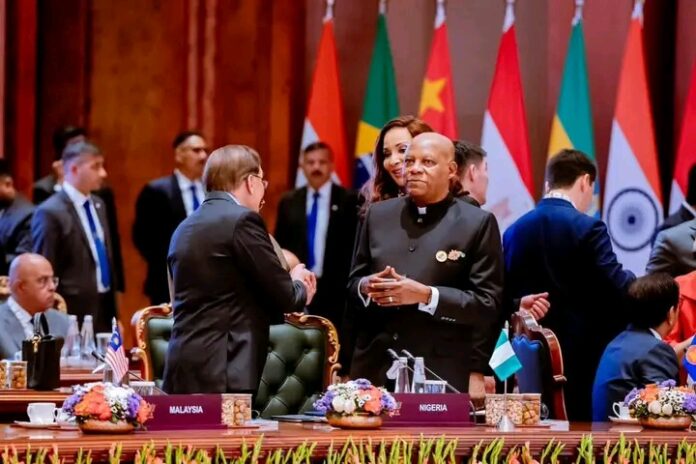
President Bola Ahmed Tinubu has called for an urgent reform of global governance structures and international financial institutions, saying the existing system must reflect current economic and demographic realities.
Tinubu made the call on Sunday while addressing the 18th BRICS Leaders’ Summit in New Delhi, India. His speech was delivered on his behalf by Vice President Kashim Shettima.
The President said Nigeria supports a more representative, equitable and responsive global governance architecture, including reforms to the United Nations Security Council and the international financial system.
He said BRICS had strengthened the voice of the Global South and provided an opportunity to promote a more inclusive international order.
Tinubu urged BRICS countries to move beyond dialogue and commitments towards practical cooperation that delivers measurable development outcomes.
He also positioned Nigeria as a gateway to Africa’s growing market under the African Continental Free Trade Area (AfCFTA), urging international investors to take advantage of opportunities in the country.
According to him, Nigeria’s economic resilience strategy under the Renewed Hope Agenda focuses on strengthening macroeconomic stability, diversifying production, improving infrastructure and human capital, attracting investment and promoting private-sector-led growth.
The President called for deeper BRICS cooperation in trade, agriculture, food security, energy, infrastructure, manufacturing, healthcare and critical minerals.
He particularly highlighted technology transfer, local value addition, industrial development and job creation as key areas of partnership.
Tinubu also identified Nigeria’s youthful population as a major economic asset, noting that young Nigerians are contributing to the country’s innovation and digital economy.
He called for increased cooperation in artificial intelligence, digital public infrastructure, fintech, telecommunications, cybersecurity, biotechnology and advanced manufacturing.
The President said initiatives such as 3MTT, Project BRIDGE and national artificial intelligence programmes would help expand digital skills, entrepreneurship, research and technology-enabled businesses.
He added that Nigeria was seeking partnerships that would promote infrastructure, connectivity, energy, agriculture, healthcare, education and industrialisation, backed by development finance.
On climate change, Tinubu advocated affordable climate finance, technology transfer and capacity-building for African countries, while supporting cooperation in renewable energy, gas, clean technologies, climate-smart agriculture and sustainable infrastructure.
“Our partnerships must create jobs, expand trade, transfer technology, and strengthen our nations’ productive capacity,” Tinubu said.
He added that Africa must move “from the margins of global development to the frontiers of global growth and innovation.”
Earlier, Indian Prime Minister Narendra Modi, who opened the summit, said confidence in BRICS among countries of the Global South was increasing because their voices were being heard and their experiences respected.
Modi said BRICS’ strength lies in its diversity and cooperation, noting that the bloc’s activities now extend beyond governments to entrepreneurs, farmers, researchers, women and young people.


