

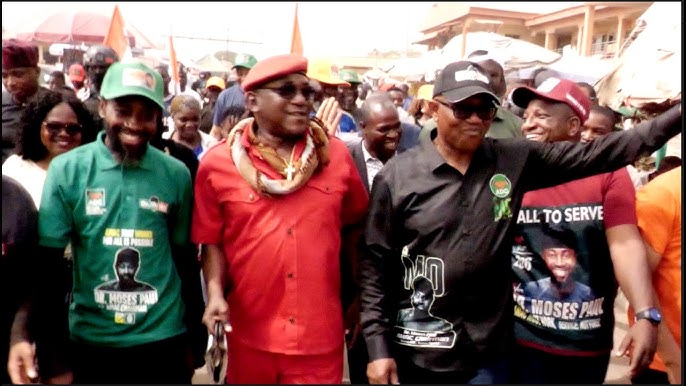
Something shifted in Karu–Nyanya.
It was not just another political gathering. It was not rented enthusiasm. It was not noise for television cameras.
When Peter Obi stepped into Karu–Nyanya alongside Solomon Dalung, the atmosphere carried a different energy — the kind that tells you a movement is maturing.
Abuja politics felt it.
The crowd was not there for spectacle. They were there for direction. Traders, youths, professionals, artisans — faces that represent Nigeria’s silent majority — stood shoulder to shoulder, not asking for handouts, but listening for hope anchored in structure.
Peter Obi spoke in his familiar tone — data-driven, disciplined, focused on governance. No drama. No theatrics. Just accountability, production, and measurable leadership.
Dalung followed with fire — reminding Nigerians that democracy is not sustained by fear, but by courage and vigilance.
What happened in Karu–Nyanya was more than a rally. It was a signal.
A signal that the African Democratic Congress (ADC) is no longer whispering as an alternative — it is speaking clearly as a credible option in Nigeria’s political equation.
And here is the deeper implication:
When suburban Abuja communities begin to gather organically, when conversations move from “who is spending money” to “who is offering competence,” then politics begins to change character.
Karu–Nyanya was not just lit by speeches.
It was lit by expectation.
Across Nigeria, citizens are watching closely. The hunger is not just for change — it is for credible change. And moments like this reinforce one truth:
Movements are not built overnight. They are built meeting by meeting, ward by ward, community by community.
Abuja has heard the sound.
The rest of Nigeria is listening.
Linus Anagboso (#BIGPEN)
Publicity Secretary, ADC Anambra South


