

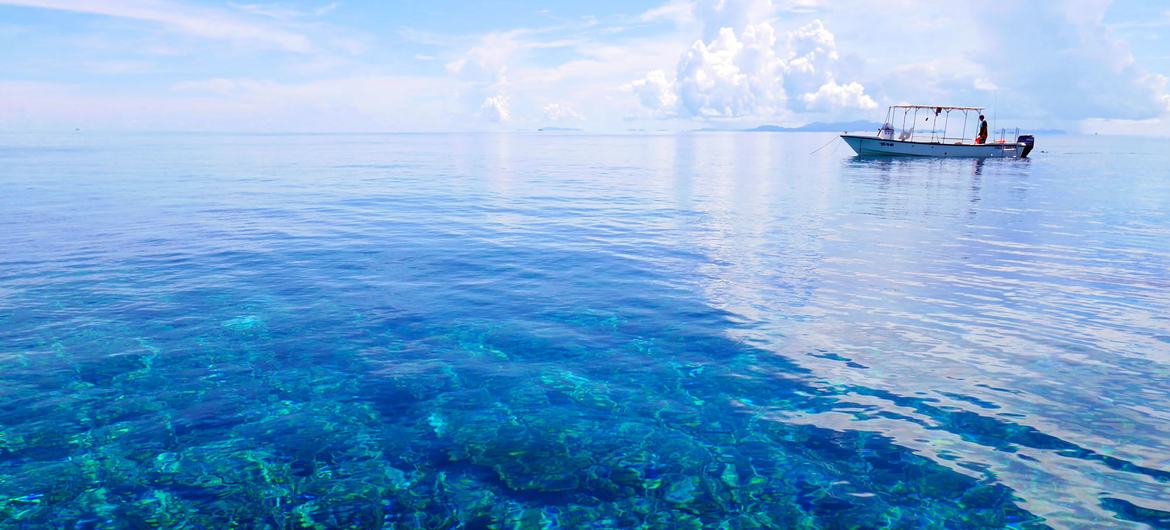
The global community on Wednesday June 8 celebrated the annual ritual tagged ‘world ocean day’. The celebration was first declared in 1992 following the United Nations, UN Conference on Environment and Development in Rio de Janeiro. The purpose of the Day is to inform the public of the impact of human actions on the ocean, develop a worldwide movement of people who want to look after oceans, and unite the world’s population on a project for the sustainable management of the world’s oceans.
World Ocean Day also seeks to promote knowledge about the world’s oceanic system and how they’re at increasing risk from climate change; from rising pollution, acidification of ocean water, rising average temperatures, to a reduction in ocean biodiversity while bring to the fore the role of the oceans in our everyday life and inspiring action to protect the ocean and sustainably use marine resources. During this year’s celebration, the United Nations noted: “The Ocean connects, sustains, and supports us all. Yet its health is at a tipping point and so is the well-being of all that depends on it.
While the world celebrates, enough evidence however, reveals that our care for the ocean and the environment not only runs contrary to the above dictates and demands but remains a direct opposite.
Out of many examples, there are two compelling developments that in my views rendered or better still qualified this year’s event more as a day of deeper reflection than that of celebration.
First is the alarming/freighting report that plastic pollution has become endemic in recent times. A reports revealed that about 500 billion plastic bags are produced every year, with more plastic produced in the last decade exceeding that of the last century; that about 1 million plastic bottles are purchased every minute in addition to the world’s usage of 500 million plastic bags each year, with at least 8million tonnes of plastics ending up in the ocean- an equivalent of a full garbage truck every minute.
The second is Nigeria specific and has to do with unimaginable volume of crude oil that are daily, in the name of crude oil exploration and exploration emptied into the ocean surrounding the country resulting in pollution, degradation and destruction of aquatic lives.
According to latest data from the National Oil Spill Detection and Response Agency (NOSDRA), that recorded a total of 4,486 cases of oil spill, amounting to 242,193 barrels of oil, from 2015 to 2021. The reported figure of oil spill cases is equivalent to 38.5 million litres of crude loss, representing an average of about 62 cases and 3,362 barrels of oil spills in a month, per data from NOSDRA’s satellite website on April 16.
Making it a reality to worry about is that the same way rivers, lagoons, seas and oceans are daily polluted by human human activities, even so has the land and forests not been spared of pollution and degradation and outright destruction.
For too long, humans have been exploiting and destroying the planet’s ecosystems. Every three seconds, a report noted, the world loses enough forest to cover a football pitch and over the last century, we have destroyed half of the wetlands.
Also lamentable is the awareness that as much as 50 per cent of the world’s coral reefs have already been lost and up to 90 per cent of coral reefs could be lost by 2050, even if global warming is limited to an increase of 1.5 degrees Celsius. Ecosystem loss is depriving the world of carbon sinks, like forests and wetlands, at a time when humanity can least afford it. Global greenhouse gas emissions have grown for three consecutive years and the planet is one place for potentially catastrophic climate change. We must now fundamentally rethink our relationship with the living world, with natural ecosystems and their biodiversity and work towards its restoration.
If all these are challenges, the issue of climate change resulting from human activities is a crisis. As another report indicates that today’s climatic warming – particularly the warming since the mid – 20th century—is occurring much faster than ever before and can’t be explained by natural causes alone.
Putting it more plainly, humans—more specifically, the Greenhouse gases (GHG) emissions we generate, were reported to be— the leading cause of the earth’s rapidly changing climate. Greenhouse gases play an important role in keeping the planet warm enough to inhabit. But the amount of these gases in our atmosphere has skyrocketed in recent decades. According to the Intergovernmental Panel on Climate Change (IPCC), the concentration of carbon dioxide, methane, and nitrous oxides “have increased to levels unprecedented in at least the last 800,000 years.”
The burning of fossil fuels like coal, oil, and gas for electricity, heat, and transportation is the primary source of human-generated emissions. A second major source is deforestation, which releases sequestered carbon into the air. It’s estimated that logging, clear-cutting, fires, and other forms of forest degradation contribute to 20 per cent of global carbon emissions. Though our planet’s forests and oceans absorb greenhouse gases from the atmosphere through photosynthesis and other processes, these natural carbon sinks can’t keep up with our rising emissions. The resulting buildup of greenhouse gases is causing alarmingly fast warming worldwide.
To further explain the challenge we currently face; ‘ it was noted that as the earth’s atmosphere heats up, it collects, retains, and drops more water, changing weather patterns and making wet areas wetter and dry areas drier. Higher temperatures lead to melting of ice which in turn leads to sea rise, floods and storms and other disasters. The changes in weather patterns, drought and flooding affect livelihoods’.
As to what should be done to this appalling situation, the UN Secretary-General has made climate action a major part of his global advocacy, calling on all member states to double their ambition to save our planet.
While this is ongoing, we are all called to adjust in psychological, social, or economic systems in response to actual or expected climatic stimuli and their effects or impacts. We need to bring in changes in processes, practices, and structures to moderate potential damages or to benefit from opportunities associated with climate change. In simple terms, countries and communities need to develop adaptation solution and implement actions to respond to the impact of climate change that is already happening, as well as prepare for future impact.
Very important also, the key for the solution to the climate change problem rests in decreasing the number of emissions released into the atmosphere, also reducing the current concentration of carbon-dioxide by enhancing sinks (eg increasing the area of forests). As individuals, we must learn more about global warming and how it is affecting us and the community. Make demands to the leaders through advocacy and other actions-leaders at all levels have roles to play related to adaptation and mitigation.
As to Nigeria as nation, it has become eminently desirable that it takes a cue from countries like China, Germany, and Rwanda who are among the world’s leading recyclers of waste and cutting down the use of plastic.
Nigeria must move from the open landfills in every state of the country that has become eyesores to generating wealth from the recycling of these wastes.
Arresting these monster will also requires the Federal Government to among other things embrace, and work towards total remediation through ecological rehabilitation and environmental resuscitation of the Niger Delta region, adopt a coherent and friendly oil and gas policy that comprehensively enumerates oil companies responsibilities to the environment and host communities, focus on environmental protection and pollution control.
In the same line of thinking, the nation policy makers must depart payment of lip service to, and but activate positive action that will appreciate the 2030 sustainable agenda which has partnership and collaboration at its centre.
Utomi is the Programme Coordinator (Media and Public Policy), Social and Economic Justice Advocacy (SEJA), Lagos. He could be reached via;jeromeutomi@yahoo.com/08032725374.


