

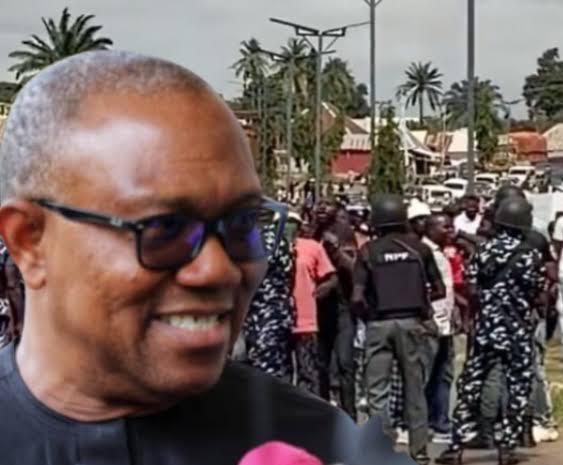
The blockade of the convoy of the Nigeria Democratic Congress (NDC) presidential candidate, Peter Obi, in Benue State has been condemned as an undemocratic act, raising fresh concerns over political tolerance and the safety of opposition politicians ahead of the 2027 general elections.
Obi’s convoy was blocked by youths along the Makurdi-Gboko federal highway near the Nigerian Air Force Base in Makurdi on Tuesday while he was travelling to Yelewata to commiserate with families affected by the 2025 attacks in the community.
The incident resulted in the closure of the highway and disruption of movement for other road users, according to reports.
The development has triggered a political dispute, with Obi alleging that the youths were thugs mobilized to prevent him from accessing Yelewata, while the Benue State Government has denied any involvement and accused him of failing to follow the required protocol for his visit.
However, the controversy over who organized the blockade has not diminished concerns about the broader democratic implications of physically preventing an opposition presidential candidate from moving freely within the country.
Minister of Aviation and Aerospace Development, Festus Keyamo, described the incident as unacceptable, saying such conduct should not be part of Nigeria’s democracy. He urged political actors and their supporters to channel their grievances through the ballot box rather than resorting to violence or physical obstruction during campaigns. The minister said anyone dissatisfied with a candidate should wait until election day and express that opposition through voting.
“Whoever is angry at any candidate of any political party should display the anger with the ballot paper on voting day by a simple thumbprint, not by violent acts during campaigns,” Keyamo said.
His intervention has added weight to growing concerns that the incident could be an early warning sign of the type of political hostility that may accompany the 2027 electoral contest.
Obi, who described the blockade as “ridiculous” and “very worrisome,” said he intended to visit Yelewata, console families affected by the killings, and show solidarity with the victims.
He warned young Nigerians against allowing themselves to be used as instruments of political violence. “This rascality cannot be allowed,” Obi said, appealing to the police and other security agencies to intervene.
He argued that Nigeria could not continue along a path where political disagreements were settled through intimidation and violence.
The reaction from another presidential candidate, Seyi Makinde, was equally strong. Makinde condemned the obstruction and argued that Nigerians have a constitutional right to move freely within the country to undertake legitimate activities.
He rejected the argument that a political candidate requires permission from a state government before entering the state, insisting that roadblocks and the use of thugs against opposition candidates have no place in a constitutional democracy.
He called for a full investigation by the police and prosecution of those found responsible. But the Benue State Government has maintained that it neither authorized nor participated in the blockade.
The Commissioner for Information and Culture, Solomon Iorpev, said Governor Hyacinth Alia was not officially informed of Obi’s visit and argued that the former Anambra governor should have notified the state government so that adequate security arrangements could be made. Iorpev said it was risky for a high-profile political figure to enter the state without notifying the state authorities.
The commissioner, however, said the government did not know the identity of those who blocked Obi and challenged those alleging government involvement to provide evidence. He added that the government was investigating the incident and would make its findings known.
The government had earlier described allegations that it sponsored the blockade as unfounded, insisting that Governor Alia’s administration did not engage or deploy thugs as instruments of governance or security.
There is, however, a significant point of contention over whether Obi’s team informed security authorities about the visit. A letter reportedly obtained by Benue Today shows that the NDC notified the Benue State Police Command on September 7, a day before the visit, informing the command of Obi’s planned arrival and requesting security cover for him and his entourage.
The letter stated that Obi was scheduled to visit Yelewata to meet families affected by the 2025 massacre, pay his respects to victims and lay a wreath. It reportedly bears a received stamp from the Benue State Police Command.
The document does not establish whether a separate notification was sent directly to the Benue State Government, leaving the dispute over administrative protocol unresolved.
But even if Obi or his party failed to notify the state government, critics argue that such an administrative disagreement should not translate into a physical blockade.
The appropriate response to a protocol breach would ordinarily be communication between the relevant authorities and security agencies, not the use of youths to prevent an opposition politician from accessing a community. That is where the incident assumes a larger democratic significance.
Nigeria’s Constitution guarantees freedom of movement, while democratic politics presupposes that political parties and candidates can travel, campaign, meet citizens and present their programmes without intimidation.
A roadblock mounted to prevent an opposition candidate from reaching a community therefore raises concerns that go beyond the immediate dispute between Obi and the Benue State Government.
It raises the question of whether political disagreement is gradually being allowed to become a justification for denying opponents their basic democratic rights. That should worry Nigerians ahead of 2027.
The country’s political history is littered with examples of young people being mobilized for political violence, often with consequences that extend far beyond election periods.
If supporters of one political camp are allowed to physically prevent another candidate from entering a community today, there is little guarantee that the same tactics will not be deployed against candidates of other parties tomorrow. Democracy cannot function that way.
Given the foregoing backdrop, it is germane to opine that political opponents should be defeated through arguments, policies, mobilization and ultimately the ballot box. They should not be stopped at roadblocks.
The Benue incident is therefore a matter that deserves a thorough and impartial investigation, not merely another round of accusations between political camps. The authorities must establish who organized the blockade, who participated in it, whether any political actors were involved and why the security agencies could not prevent the obstruction of a major federal highway. More importantly, those found culpable should be held accountable irrespective of their political affiliation.
The 2027 election is still months away, but the political temperature is already rising. The events in Benue should serve as a warning to political parties, governments, security agencies and their supporters that Nigeria’s democracy cannot afford a return to the politics of intimidation.
Against the backdrop of the foregoing, one cannot but opine that disagreement is democratic. Protest is democratic. Voting against a candidate is democratic. But physically preventing an opposition candidate from moving because of his political identity is not.
Whatever the outcome of the investigation into the Benue incident, one principle should remain non-negotiable: “political differences must be settled through democratic means, not roadblocks, thuggery or violence.”


