

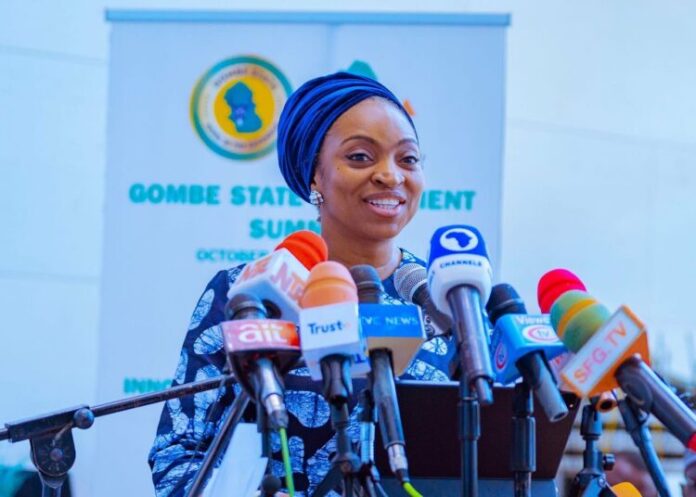
The Minister of Industry, Trade and Investment, Dr Jumoke Oduwole, has assured Nigerians that the country’s critical mineral resources will not be given away under the recently signed framework with the United States.
Oduwole gave the assurance while speaking on Arise Television’s Morning Show monitored by The News Chronicle on Tuesday, explaining the scope of the Nigeria-US critical minerals framework and the government’s position on the agreement.
“The U.S. have a list of 60 minerals that they’re trying to secure globally. Nigeria has about 26 of those minerals, so there’s nothing anybody’s going to take away from us without it being on our own terms,” she said.
The minister clarified that the framework signed between Nigeria and the US was a Memorandum of Understanding (MoU) and was not legally binding.
“For the Critical Minerals framework, it’s an MOU. When you sign MOUs, first of all, they’re intentions – they are not legally binding,” Oduwole said.
She explained that the framework was intended to provide a basis for further cooperation between both countries rather than constitute a detailed agreement transferring ownership or control of Nigeria’s mineral resources.

According to her, Nigeria is seeking to use the partnership to develop infrastructure, improve energy supply and establish a complete value-addition chain for its mineral resources.
She said the government would not be satisfied with exporting minerals in their raw form, stressing the need for Nigeria to process its resources domestically and derive greater economic value from them.
Oduwole cited lithium processing and battery manufacturing as examples of areas Nigeria could develop as part of efforts to deepen its mineral value chain.
“So, I can tell you broadly what the content of the framework is about. It’s a framework. It’s not a specifically detailed provision at this time, and it’s an MOU. It’s not legally binding, but this is how countries negotiate. This is how, at the government-to-government level, we operate.
“We’re not giving anything. We’re not letting go of anything, and we don’t need to be afraid. We don’t need to be reactive,” she said.
READ ALSO: Zuckerberg Loses $12.2bn As Meta AI Spending Sparks Investor Fears
Oduwole said Nigeria had about 26 of the 60 critical minerals the US was seeking to secure globally, making the country a potential participant in the evolving global critical minerals supply chain.
She stressed that any future negotiations must protect the interests of Nigerian businesses and ensure that the country maximised the economic benefits of its mineral resources.
The minister noted that Nigeria had been slow to participate in the global critical minerals and rare earths supply chain, while countries such as South Africa, Zambia, the Democratic Republic of Congo and Sierra Leone had been mining and developing their mineral resources for years.
She said developing formal mining operations and local processing could also create employment opportunities for young Nigerians, particularly in communities affected by insecurity.
According to her, sustainable economic opportunities in such communities could help reduce restiveness by providing residents, especially youths, with alternative means of livelihood.


