

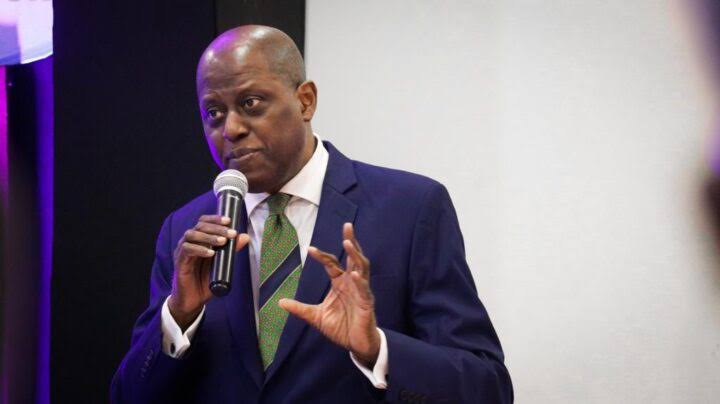
The Central Bank of Nigeria (CBN) governor, Olayemi Cardoso, argues that the recent introduction of the central bank’s bank recapitalization scheme is to blame for the surge of foreign investments into the nation.
Cardoso made this statement on Wednesday during a ceremony in Abuja, pointing out that the rise in foreign exchange profits in the nation is directly related to the increase in foreign direct investments.
Speaking on behalf of John Simeon Onoja, acting director of Financial Policy and Regulations, Cardoso said that one of the factors guiding the capitalization was the knowledge that banks would require liquidity to increase lending to pertinent industries.
“The impact of the capitalisation programme, we all know, is that it is definitely going to increase the lending capacity of the banks because liquidity definitely is going to empower them to lend more to the relevant sectors.”
“Certainly, foreign investment will expand. We are already seeing them; foreign direct investments are flowing in. Banks can attest to that. We can see that many of them are bringing a large amount of forex into the economy, which will have a beneficial impact on the liquidity situation in the forex market,” he continued.
He mentioned that several banks have started issuing common shares, making public offers, rights issues, private placements, mergers, and acquisitions in order to fulfil the requirements for recapitalisation. He also mentioned that banks that are unable to match the existing capital category are free to downgrade.
The National Bureau of Statistics (NBS) reports that foreign investments into the nation increased to $3.38 billion in the first quarter (Q1) of 2024 from $1.09 billion the previous quarter. The largest investment, $2.08 billion, or 61.5% of the total, went into a portfolio.
Cardoso pointed out that a national bank can become a regional bank and still provide excellent service to the Nigerian populace.
“This is to remind us that the purpose of the stress test, which is often conducted by the Central Bank of Nigeria, is to determine how financial institutions will respond to shocks at various economic levels. And we do that, and we provide the findings. Decisions are made based on management results to ensure that financial institutions can survive if the economy experiences various shocks,” he added.
In order to guarantee that illicit monies are kept out of the system, Cardoso further stated that continual efforts are being made to impose appropriate purchasing conditions for new shareholders.
“The equity market is already experiencing a surge, and this activity is expected to further intensify trends and activities within the capital market.”
The CBN issued new minimum capital standards for banks in March 2024, setting N500 billion as the minimum capital base for commercial banks with international authorisation.
The foreign banks Access, First Bank, FCMB, GTCO, First Bank, Fidelity, Zenith, and UBA now have a combined capital of roughly N1.3 trillion, and they would need at least N2.2 trillion to meet the new capitalisation standards, according to Afrinvest’s 2024 Nigerian Banking Report.
The difference between N1.6 trillion and N2.2 trillion for the following national licenced banks: Ecobank, StanbicIBTC, Citibank, Keystone Bank, Standard Chartered, Sterling, Union Bank, Unity Bank, Polaris, Wema Optimus, and Premium Trust bank.
Ike Chioke, CEO of Afrinvest Group, stated during the report’s presentation that the disparity highlights the difficulty of the weak growth Nigeria’s economy has seen during the last 20 years, from 2004 to 2024.
He predicted that mergers and acquisitions, as well as the downgrading or upgrading of bank licenses, would soon occur in the sector.
Chioke emphasised that for the country to reach its $1 trillion economic target, all other economic sectors must be forced to expand in tandem with the banking industry.
“When you want to think about growing the Nigerian economy to $1 trillion, it’s not just the banks that will need to grow. All other facets of the economy must expand in tandem with it.”


