

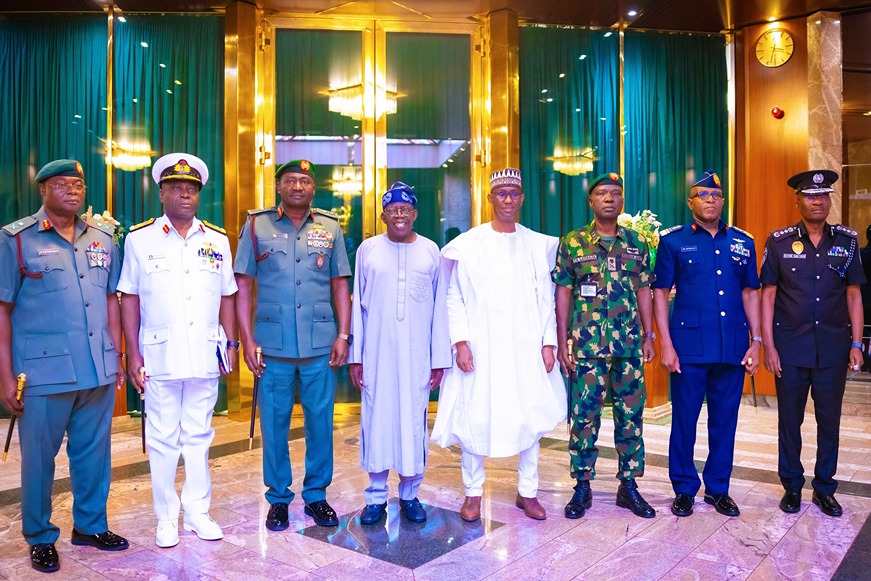
Insecurity across African States is one of the many factors responsible for the stunted economic growth and development in the continent. Terrorism, banditry, ethnic conflicts, farmer-herder conflicts, and the likes, are some of the issues constituting insecurity in many countries in Africa. In all of this, Nigeria, as a country in West Africa, has had her fair share of these problems as adumbrated;
A beleaguered Nigeria is faced with different categories of security crises, and all these could be attributed to one major factor; the failure of leadership to address underlying issues and deliver good governance! For example, the immediate past administration failed woefully to deliver on its promise to contain the menace of insecurity, hence the exacerbation of the five major security threats bedevilling Nigeria: Jihadism, farmer-herder conflict, banditry, separatist insurgency and oil militancy. In other words, not one region amongst the six geo-political zones is spared; insecurity proliferates across all regions in the country.
Meanwhile, the new administration of President Bola Ahmed Tinubu has, under the same party, APC, promised to tackle the security issues and ameliorate the sickly state of the Nigerian economy. At the beginning of his campaign, Mr Tinubu unveiled the party’s new slogan, ‘‘renewed hope’’ promising to exterminate the incessant activities of the non-state actors to provide an enabling environment that is conducive, safe and secure for foreign and local investments. Apparently, this may not have been an easy task as the administration’s score card, after over 100 days in office, has not been impressive.
As a matter of fact, since the announcement of the removal of the fuel subsidy during his inaugural speech, the cost of commodities skyrocketed, making the economic situation very unbearable as the condition of living for an average citizen worsened. Fuel now sells at a cost that the average minimum wage earner cannot afford. Transportation of persons and commodities is difficult due to the fuel situation in the country; perishable farm products cannot be conveyed to the marketplace for consumers to buy due to the high cost of transportation, hence, most of these products go bad and become a great loss to the farmers. Many families now must depend on the support of their loved ones who work and live abroad to survive. Unemployment is expected to hit at 37% as projected by the Nigerian Economic Summit Group (NESG).
As the new president, apart from the internal problems Mr Ahmed Tinubu is currently facing, he is also contending with external issues, especially as the newly appointed leader of the Economic Community of West African State (ECOWAS). It is a general knowledge that most francophone countries in West Africa are faced with a new threat of military coup de ’tat, an existential threat to democracy in Africa:
The Niger Republic democratic government was recently overthrown by the army in a coup. The ousted President, Mr Mohamed Bazoum has been held in detention by the coup plotters since July 2023 when the military took over. In a similar fashion, President Roch Kabore of Burkina Faso was ousted by his country’s army in January 2022. Same wave of coup d’état experienced in Mali when the then President, Mr Ibrahim Boubacar Keita was overthrown in August 2020. A successful coup d’état was carried out in Chad in April 2021, while Guinea and Sudan also had a similar experience same year; September 2021 and October 2021 respectively. Moreover, Gabon is the latest African State where a military coup has taken place. Suddenly, in August 2023, the army announced the takeover from the incumbent President Ali Bongo who had ruled the country for 14 years. Generally, since 2010, there have been over 40 coups and attempted coups in Africa with 20 occurring in West Africa and the Sahel.
Apparently, the common denominator upon which the coup plotters predicated their main reason for hijacking a democratic process is, corruption and lack of good governance. The danger in this trend not only lies in the fact that the affected African countries could be thrown back into the medieval age but also the fact that it aligns with the principles of the contagion theory. In other words, the tendency for the ‘wildfire’ to continue to spread becomes the reality of the rest of African States where democracy has survived or is still seemingly surviving. This is a threat that only the African leaders can either eschew or embrace; they have both ‘the knife and the yam’. Something must be done to discourage unconstitutional military takeovers in Africa. Therefore, as the new leader of ECOWAS, uneasy lies the head that wears the crown, President Tinubu should be ready to demonstrate his readiness and willingness to change the current ugly narratives, especially where West Africa, as a subregion, is concerned.
Internally, insecurity in Nigeria is a multi-faceted and complex issue that encompasses several factors. As earlier highlighted above, Jihadism is apparently becoming the most prevalent security challenge confronted by many African States, and by extension, the Nigeria state. It is as though Nigeria is becoming a breeding ground for terrorism. As at the end of 2020, according to the United Nations (UN), Boko Haram attacks had claimed the lives of close to 400,000 people while millions have been displaced from their homes. The Nigerian economy has suffered a great setback due to activities of Boko Haram terrorists who are determined to establish Islamic caliphate, even as the group promotes and spreads jihadist ideology in northern Nigeria.
Furthermore, infiltration and activities of the jihadist terrorist group known as the Islamic West African Province- ISWAP, have greatly complemented Boko Haram insurgency, especially in recent years. Research shows that ISWAP has now surpassed Boko Haram in terms of population, notoriety and capacity. For example, ISWAP has engaged more deeply in the functions of the state within the territories it has control over, substituting the government in activities such as compulsory tax collection or payments (this is referred to as Zakat in Islamic term), implanting its own health care and justice systems and so on. This has been the case in many of the hinterlands in the northern region of the country. This is clearly exemplifying the nature, size and, particularly, the seriousness of the issues at hand.
Secondly, banditry is a plague on Nigeria’s economic fabric. With activities such as kidnapping, arson, cattle-rustling, rape, sex-slave, human trafficking, killings, armed robbery, looting, illegal arms dealings, etcetera, one might question the safety and security of the Nigerian socio-economic space. For example, kidnapping of school children from their classrooms and boarding facilities is gradually becoming the norm in Nigeria. Available records indicate that close to 3000 students may have been kidnapped since 2020 till date, and these victims would only be released after paying ransom! To no surprise, no region in northern Nigeria is spared where abduction for ransom is concerned. Unfortunately, the victims are mostly women and children. And in some cases, bandits would keep their young female victims as sex-slaves.
Recently, Katsina state governor, Dikko Radda while reacting to the state of insecurity in the country, publicly remarked, ‘‘terrorists freely buy weapons such as AK-47 and RPG in the market and that individuals should be allowed to do so to protect themselves’’. If the Chief Security Officer of a state could make his frustration public in this manner, this is not only indicative of how helpless and vulnerable ordinary citizens have become but also indicative of the fact that possible sinister phases lie ahead. However, this is not to exclude the southern parts of the country from the list of troubled regions, as a matter of fact, kidnapping is fast becoming a lucrative industry for criminal elements in the Nigerian society, they now see kidnapping as a ‘trade’ or an avenue for quick and easy money.
Moreover, Mr Tinubu will also have to contend with the incessant farmer-herder conflict. This poses serious threats to food security in the country. Even though there is a long history of disputes between nomadic animal herders and farmers in Nigeria, this problem is now further exacerbated by climate change. In other words, the farmers and herders contend over ‘shrinking’ land, water and grazing routes, hence, many have been killed in clashes over these limited resources. In recent times, for example, Adamawa, Plateau, Zamfara, Taraba and Benue states have experienced more devastation vis-a-vis farmer-herder conflicts in Nigeria. Over 700 deaths have been recorded in Benue alone not counting other pockets of violence in other states due to similar issues. If a state like Benue, which is considered the food basket of the nation, because of its significant contributions to Nigeria’s economy through food production, is experiencing incessant unrest due to farmers-herders conflict, then the looming threat to food security in the country is real, hence this must be addressed promptly, and with all seriousness!
Finally, for quite some time, different separatist groups have sprung up in Nigeria. Some are claiming to have been marginalised, especially where the distribution of the country’s resources is concerned. Others complained about lopsidedness in political offices, segregation, neglect, etcetera. Most of these agitations have been aired in the various public fora by leaders of the members of these groups. Previous administrations endeavoured to address these problems but to no avail. For example, IPOB (The Indigenous People of Biafra), MEND (Movement for the Emancipation of Niger Delta), AR (The Arewa Republic), OPC (Odua People’s Congress) and others remain a security threat to the unity and peace of the nation.
Tackling these problems would require a visibly clear demonstration of good governance vis-a-vis accountability, responsiveness, responsibility, sincerity, truth, empathy, determination, integrity and character, a strong political will, respect for the rule of law and a full sense of loyalty to the people.
’Tunde Adeparusi, a UK-based independent researcher in criminology, wrote in via tunde.adeparusi@gmail.com


