

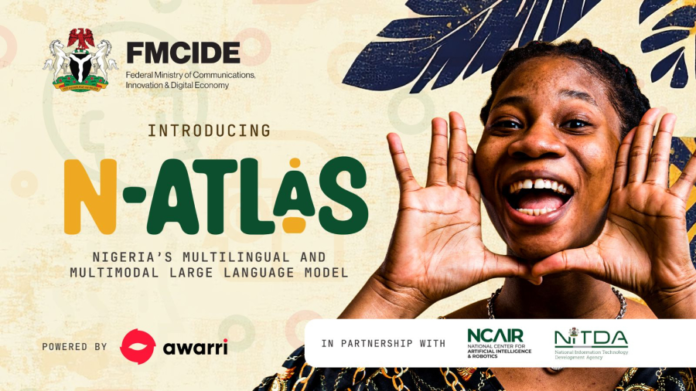
Minister of Communications, Innovation and Digital Economy, Dr. Bosun Tijani, has launched the Atlas Network, a continental artificial intelligence (AI) initiative aimed at accelerating the development of indigenous large language models tailored to Africa’s unique needs.
Tijani unveiled the initiative on Wednesday in Abuja during the opening of the Ordinary Session of the Conference of Plenipotentiaries organized by the African Telecommunications Union (ATU).
He said the Atlas Network builds on Nigeria’s Atlas Project, described as Africa’s first government-led open-source large language model unveiled during the United Nations General Assembly.
According to the minister, the initiative will unite governments, researchers, academic institutions, innovators and technology partners to ensure Africa’s languages, cultures and indigenous knowledge are adequately represented in emerging AI technologies.
Tijani expressed concern that fewer than two per cent of African languages are currently supported by modern AI systems despite the continent accounting for nearly one-tenth of the world’s languages.
READ MORE: Egyptian Pharmaceutical Firm Plans Drug Manufacturing Plant in Abia
“This is our opportunity, not simply to adopt artificial intelligence, but to help shape its future for Africa and from Africa,” he said.
He acknowledged the support of the Global System for Mobile Communications Association (GSMA) and Awari in developing the initiative and urged all ATU member states to join the Atlas Network in building Africa’s AI ecosystem.
Speaking at the event, Awari Co-founder and Chief Executive Officer, Mr. Sailas Adekunle, said Atlas Mojo evolved from Nigeria’s N-Atlas project, showcasing Africa’s growing capacity to develop globally competitive AI technologies.
He explained that the project has expanded from a national initiative into a continental platform through partnerships with GSMA and other collaborators.
Adekunle said the name Atlas stands for African Tongues and Languages at Scale, while Mojo, derived from a Swahili word, symbolizes unity.
“What started in Nigeria proved that an African startup can build technology with global significance. Today, developers are already using N-Atlas to create digital tools that solve local problems, and Atlas Mojo takes that vision to the continental level,” he said.
He added that the initiative would empower African developers to build AI applications using homegrown technologies instead of relying solely on foreign AI platforms.
According to him, dependence on external AI systems often results in African data being exported to train overseas models, limiting value creation on the continent.
“This initiative is about building an African AI ecosystem where value stays in Africa, our developers have the right tools, and our technologies reflect the realities of African communities,” he said.
Adekunle disclosed that more than 5,000 developers have already built solutions using the N-Atlas platform.
Also speaking, GSMA Senior Director of Public Policy and Communications, Ms. Caroline Mbugwa, described Atlas Mojo as a strategic platform that would enable Africa to shape the future of AI rather than simply consume it.
She said the initiative aligns with Tijani’s vision of a pan-African approach to AI development and is being built through collaboration among GSMA, Awari, Zindi, Power AI and Mozisha.
According to her, Nigeria, Kenya, Namibia and Togo are the founding member countries supporting the initiative, with more African nations expected to join.
“The call to action is for more countries to embrace Atlas Mojo and work together to build a truly pan-African AI platform that reflects Africa’s diversity,” she said.
Mbugwa noted that GSMA research identifies digital literacy as one of the biggest barriers to digital and mobile adoption across Africa.
She said enabling AI systems to operate in local languages would promote digital inclusion and expand access to technology for millions of Africans.
“When people can interact with AI using their own languages, we remove barriers to digital participation and accelerate economic opportunities across the continent,” she said.
She urged governments, research institutions, technology companies and innovators to support the initiative.
The Atlas Network is expected to accelerate the development of locally relevant AI models, strengthen Africa’s digital economy and preserve the continent’s rich linguistic and cultural heritage.
SOURCE: NAN


 initiative aimed at accelerating the development of indigenous large language models tailored to Africa's unique needs.)