

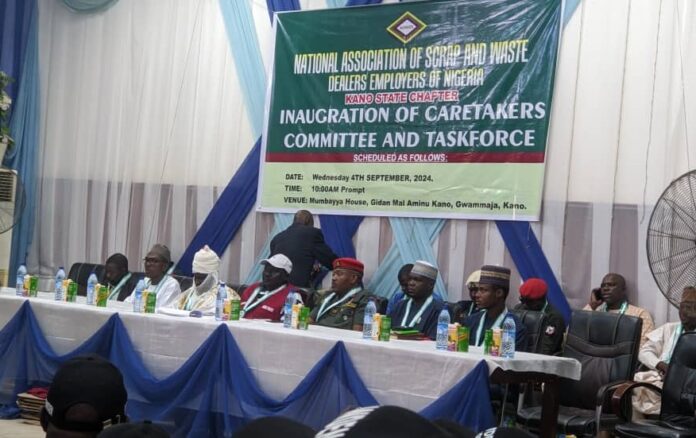
The National Association of Scrap and Waste Dealers Employers of Nigeria (NASWDEN) has directed its members to commence an industrial action on October 1 over alleged irregularities in the scrap-metal industry.
The association’s National President, Abdulfatah Adisa-Ogunwale, gave the directive in a statement made available to journalists by the Deputy National President, Aminu Hassan-Soja, in Kano on Friday.
According to the statement, the decision followed what the association described as persistent anomalies, irregularities and grievances affecting scrap-metal dealers and their businesses.
NASWDEN said the strike would involve the suspension of scrap-metal supplies to iron-smelting companies producing iron rods and other steel products from non-ferrous and scrap metals.
 National Association of Scrap and Waste Dealers Employers of Nigeria (NASWDEN)
The association said the industrial action would commence on October 1 and run until October 15.
It, however, warned that the strike could continue indefinitely if no satisfactory Memorandum of Understanding (MoU) was reached with the affected iron and steel companies.
The association identified several issues behind the planned action, including what it described as unannounced reductions in scrap-metal prices.
It said dealers could lose between N3 million and N6 million on a single truckload following sudden price reductions.
NASWDEN also alleged that some companies imposed deductions of between one and five per cent under what they referred to as “Extra Dust”, describing the practice as an additional financial burden on its members.
READ ALSO: School Deaths and Narco Killings: The UN and US Crimes in International Law
The association further raised concerns over the alleged increasing involvement of foreigners in the scrap-metal business.
It claimed that some foreigners were establishing dumpsites and scrap-collection centres across the country, thereby creating difficulties for indigenous Nigerian scrap dealers.
NASWDEN also alleged that some iron companies purchase scrap metals from unregistered or uncertified agents and dealers.
The association warned that such practices could encourage the circulation of vandalised public and private property through the scrap-metal market.
It therefore called for stronger regulation and verification of scrap dealers, agents and collection centres to ensure that materials supplied to the steel industry were obtained through legitimate channels.
The association appealed to relevant government agencies, stakeholders in the iron and steel sector and the public to take note of the planned industrial action and support efforts to resolve the issues through constructive engagement.


