

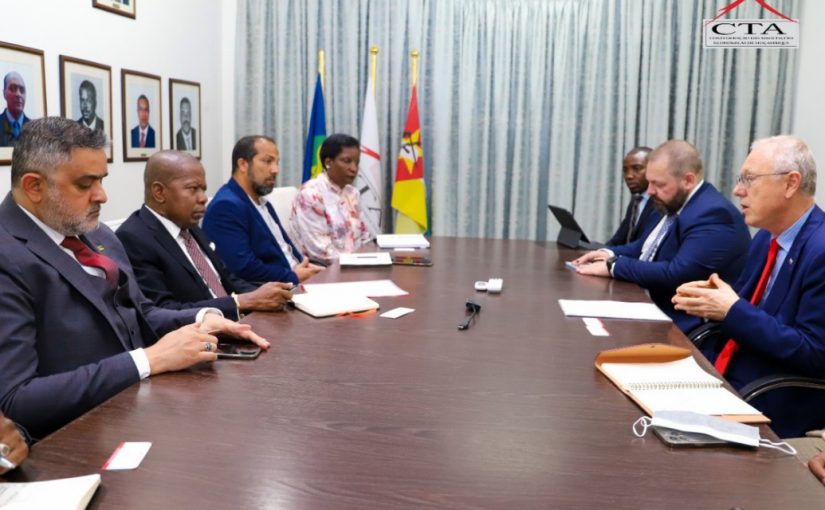
Mozambique risks destabilizing its economy and further loosing western development finance if it goes ahead to purchase sanctioned oil from Russia. With the return of western development finance institutions such as the International Monetary Fund, World Bank and the USAID, and currently showing tremendous support for sustainable development projects and programmes, Mozambique would have to stay focused and stay clear from the complexities and contradictions of the Russia-Ukraine crisis.
Mozambique needs to seriously concentrate on and pursue its plans of exporting of liquefied natural gas (LNG), extracted from the Coral South field, off the coast of Palma district, in the northern province of Cabo Delgado, possibly starting this October. It marks an economic turning point and opens a new chapter for its revenue sources.
According our research, Mozambique will become the first country in East Africa to export LNG. It will be produced on a floating platform, belonging to a consortium led by the Italian energy company, Eni. The platform, built in a Korean shipyard, arrived in Mozambican waters in January, and is now anchored in Area Four of the Rovuma Basin, some 40 kilometres from the mainland.
This is the first deep-water platform in the world to operate at a water depth of about two thousand meters. The Coral South project is expected to produce 3.4 million tons of LNG per year over its estimated 25-year lifespan. A second project is planned for Area One of the Rovuma Basin, where the operator is the French company TotalEnergies. The planned LNG plants for this project, are onshore, in the Afungi Peninsula of Palma district. The jihadists seized Palma town in March 2021, and TotalEnergies withdrew all of its staff from the district. Subsequently the Mozambican defence and security forces and their Rwandan allies drove the terrorists out of both Palma and the neighbouring district of Mocimboa da Praia.
Current global economic situation is changing, competition and rivalry for markets also at its height. During the past months, Russia has cut its export of gas as a reciprocal action against European Union members and has redirected its search for new clients in the Asian region. It has already offered discounted prices to China and India, and now looking beyond to Africa.
United States Special Envoy to the United Nations, Thomas-Greenfield, has made one point clear in her speeches with African leaders that “African nations are free to buy grain from Russia but could face consequences if they trade in U.S.-sanctioned commodities such as oil from Russia.”
“Countries can buy Russian agricultural products, including fertilizer and wheat,” Linda Thomas-Greenfield said. But she added that “if a country decides to engage with Russia, where there are sanctions, then they are breaking those sanctions. We caution countries not to break those sanctions because then … they stand the chance of having actions taken against them.”
Russian Ambassador to Mozambique, Alexander Surikov, after a meeting with the Confederation of Economic Associations of Mozambique (CTA), had proposed that the Mozambican authorities could buy Russian oil in roubles, after Moscow presented the option to Maputo. Ambassador Surikov further expressed Russian companies’ continuing interest in investing in Mozambique. Likewise, the possibility was raised of Russia opening a bank in Mozambique focused on supporting bilateral trade and investment.
The United States has imposed sanctions on Russian banks including the VTB, Alfa-Bank and Sberbank. It implies that Mir Card system for payments and transfers, and financial transactions are impermissible by Russian banks in Africa.
Russia previously had VTB bank in Maputo, later involved in opaque deals. It was a financial scandal involving three fraudulent security-linked companies, and two banks – Credit Suisse and VTB of Russia, relating to an illicit loan guarantees issued by the government under former President Armando Guebuza. Until today, it is popularly referred to as “Hidden Debts” scandal involving US$2.7 billion (€2.3 million), the financial scandal that happened in 2013.
In the aftermath, financial institutions exited, projects abandoned and this southern African country has struggled to rebound economically. Now they are returning with new financial assistance programmes that would promote sustainable and inclusive growth and long-term macroeconomic stability.
In the context of the current cereal crisis, one other issue that the ambassador raised was how Mozambican companies could have direct access to Russian wheat suppliers. In this regard, it was not clear how Russian wheat would enter the market and how it would be paid for because Mozambique uses principally the US dollar in its foreign transactions, and Russia cannot conduct transactions using the US currency due to the sanctions imposed following the invasion of Ukraine.
“The rouble and the metical are worthy currencies that do not need the benevolence of some other countries that control the international system,” the Russian diplomat explained, adding that Moscow wanted to strengthen cooperation with Maputo.
Nonetheless, Minister of Mineral Resources and Energy of Mozambique, Carlos Zacarias, admittedly the possibility of buying Russian oil in roubles. “I am sure that we will study and verify the feasibility of this offer from Russia. If it is viable, for sure Russian oil will be acquired in roubles,” Carlos Zacarias said.
Mozambique’s receptivity to the Russian proposal stems from the fact that the world is experiencing a peculiar moment, characterized by great volatility in oil prices on the international market as a result of the Russia-Ukraine war. As the situation unfolded, Mozambique was among the countries that abstained on two resolutions that were voted on by the General Assembly of the United Nations.
The Mozambican Liberation Front (Frelimo, the ruling party) was an ally of Moscow during the time of the former USSR, and received military support during the struggle against Portuguese colonialism and economic aid after independence in 1975. Mozambique and Russia has admirable political relations. Mozambique has to focus on trade and economic development with external partners. According to data provided by CTA, the annual volume of economic transactions between Mozambique and Russia is estimated to be, at least, US$100 million (€98.5 million at current exchange rates).
Experts aptly point to the fact that there is tremendous opportunity window for Mozambique. With partners including ExxonMobil Corp., China National Petroleum Corp. and Mozambican state-owned Empresa Nacional de Hidrocarbonetos, Mozambique has to move towards its own energy development. These past few years, experts have also reiterated that the state authorities adopt a suitable mechanism, map out strategies and utilize financial support for its sustainable development for the country.
Mozambique has considerable gas resources, the right decision is to move toward both an onshore concept and an offshore concept. The ultimate goal has to establish connectivity between its resource exploration and national development. The idea is to foster economic relations based on its domestic development priorities. And consequently, it has to determine influential external investment partners ready to invest funds and, in practical terms, committed to support sustainble development in the country.
The Mozambique LNG offshore project, valued at around US$20 billion, aims to extract about 13.12 million tonnes of recoverable gas over 25 years and generate profits of US$60.8 billion, half of which will go to the Mozambican state. The process to achieve this task has started and would generate 14,000 possible jobs in phases – first creating 5,000 jobs for Mozambicans in the construction phase and 1,200 in the operational phase, with a plan to train 2,500 technicians and so forth. These projects also have a great capacity to create indirect jobs, with foreign labour decreasing throughout the project and Mozambican labour increasing. Most of these jobs are expected to be provided by contractors and subcontractors.
Several corporate projects came to a halt due to armed insurgency in 2017 in Cabo Delgado province. The entry of foreign troops to support Mozambican forces mid-2021 has improved the security situation. Since July 2021, an offensive by government troops was fixed, with the support of Rwandan and later by the Standby Joint Force consisting forces from members of the Southern African Development Community (SADC).
Cabo Delgado province, located in northern Mozambique, is rich in natural gas. Although the gas from the three projects approved so far has a destination, Mozambique has proven reserves of over 180 trillion cubic feet, according to data from the Ministry of Mineral Resources and Energy. With an approximate population of 30 million, Mozambique is endowed with natural resources. It is a member of the Southern Africa Development Community (SADC) and the African Union.


