

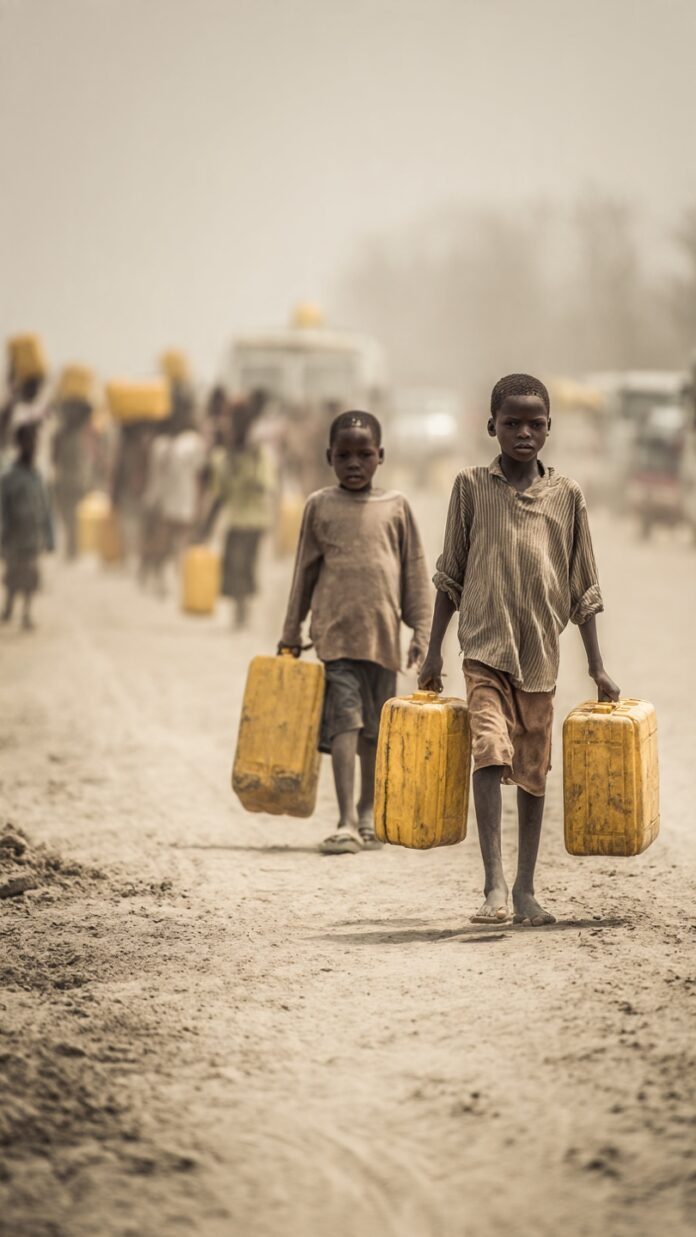
Over 161 million Nigerians live with water that can kill. From Kano’s dry pipes to Lagos’ salty boreholes, families pay with time, money, and children’s lives. Girls miss school hauling jerry cans. Babies die from diarrhea after one sip of contaminated water. ODIMEGWU ONWUMERE examines in this report that floods poison wells. Droughts empty them. The article traces that billions have been budgeted, yet taps stay empty while disease spreads. Behind the grief, the United Nations and its partners are drilling solar boreholes, training local technicians, and pushing climate-smart water systems into the hardest-hit communities. The fight is not over, but for the first time in years, hope is being piped into Nigeria’s thirst
Amina is eight and already tired. Before the sun rises over Hotoro in Kano she balances a yellow jerry can on her head and walks two kilometers down dusty streets. The public pipe in her neighborhood has not brought a drop in fifteen years. She will miss first period at school again. If the water she fetches from the solar borehole is dirty, she will spend the night doubled over with stomach cramps. Amina is not unlucky. She is ordinary. More than 161 million Nigerians, nearly seven out of every ten people, rely on water sources that are unsafe to drink. For them, turning on a tap is not routine. It is roulette.
Across the country, 57 million people lack any safe water supply and 15 million still draw directly from rivers, ponds, streams and irrigation canals. Only 26.5 percent of Nigerians have access to improved drinking water and sanitation. Experts have said.
Over 86 percent lack a safely managed drinking water source. That means the water most families use has been touched by hands, animals, waste, and flood before it reaches their cups. About 70 percent of water is contaminated at the point of consumption.
The result is measured in small coffins. Health experts estimate more than 70,000 children under five die every year from diarrheal diseases tied to unsafe water and poor hygiene.
UNICEF says roughly 100,000 Nigerian children die annually from water-related illnesses. In Borno alone, a 2026 cholera outbreak has killed at least 90 people and infected more than 12,000. In schools, only 11 percent have basic water, sanitation and hygiene facilities. In health centers, just 6 percent meet the same standard. A child with cholera is treated in a clinic where the water used to wash his hands may be what made him sick.
Open defecation is still practiced by 46 million people, 33 million of them in rural areas. When rain comes, waste flows straight into streams and boreholes. When rain fails, wells dry up and water tables fall so low that communities dig twice as deep as they did a decade ago.
Nigeria lives in two extremes at once: drought and flood. The Federal Government has classified 132 local government areas as high flood-risk zones for 2026, and 33 states plus the FCT face extreme flood risk.
Floods overflow drains, destroy treatment plants, and push fecal matter into groundwater. Droughts shrink what little water exists. Climate change has made both worse.
Walk through Kano and the contradiction bites. The city needs about 700 million liters of water daily, but most of its 22 treatment plants are idle. Only the 95-year-old Challawa plant is running. Musbahu Sani has lived in Hotoro for fifteen years and has never seen public water. He buys from borehole owners. In Gama, Ado Fela spends N1,200 every day on vendors, N70 to N100 per jerry can, just to cook, bathe, and clean.
“We have learned to live with this,” he says, but his voice carries the exhaustion of someone who should not have to. In Lagos, surrounded by water, demand is 720 million gallons per day while only 10 percent of residents get municipal supply.
In Ojota, Makoko, Ajegunle, and Agege, families rely on boreholes, wells, and sachet water that costs too much and often harms skin. In Port Harcourt, neighborhoods like Rumokoro and Eagle Island have non-functioning water stations.
A gallon from vendors costs N100 to N120, and landlords who can afford boreholes raise rents, pushing low-income families further out.
In Maiduguri the heat is merciless. Some areas like old GRA still get treated water for N300 a month, but newly built estates near Njimtilo get nothing. Muhammad Bashir Bukar spends about N21,000 monthly on private “Moya” vendors. When there is no electricity, prices double.
Drilling a borehole costs between N3 and N5 million, far beyond what most can pay. An engineer estimates one million people live around Njimtilo and need at least one million gallons daily, but the state corporation cannot meet it.
The 2024 floods ravaged 70 percent of Maiduguri and surrounding areas, contaminating water and forcing families into crowded sites where sanitation barely existed.
The burden falls hardest on women and girls. They spend hours each day searching for water, time stolen from work, rest, and caring for children. Girls miss school. Children under five, whose bodies cannot fight dehydration, die in numbers that should shame a nation.
In the northeast, Borno, Adamawa and Yobe face conflict and displacement on top of thirst. At least 75 children face death every day there without urgent care. Violence destroys farmland, floods wash away crops that could have fed 13 million people for a year, and soaring food prices mean parents watch their children waste away.
In the northwest, armed violence displaces hundreds of thousands, and water points become targets. In the Middle Belt, clashes between farmers and herders kill and displace more, leaving wells destroyed and families on the move.
State assemblies have issued emergency directives to fix boreholes. Communities organize. In Kano, SUBEB reports 5,884 out of 8,782 schools now have some WASH facilities, though many are still inadequate.
The Federal Government and partners held the 2026 Annual Water Quality Conference in Abuja to draft climate-adaptation policies and launch a Nigerian Water Quality Handbook. Parents cut other expenses to buy water. Children learn to wash hands with limited soap. The fight continues in kitchens and classrooms, even when budgets fail.
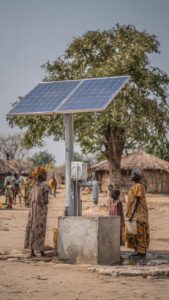
That fight now has weight behind it. The United Nations and its agencies have moved from statements to concrete action on the ground. UNICEF Nigeria, working with the Borno State Rural Water Supply and Sanitation Agency and funded by IHS Towers, delivered six solar-powered boreholes in Maiduguri Metropolitan Council and Jere after the 2024 floods. Each borehole provides 22,000 liters of clean water daily, collectively serving nearly 12,000 people, including children, schools, mothers in health centers, and families rebuilding after displacement. The goal was urgency and long-term impact, because contaminated water after floods increased the risk of cholera and other illnesses exponentially.
Across the northwest, UNICEF and USAID are investing $10 million to improve WASH services in Kebbi, Sokoto and Zamfara, targeting more than 300,000 people. The program builds community-centered systems to deliver, operate, and manage sustainable water services in rural areas, and helps rebuild dilapidated infrastructure.
In Kebbi, UNICEF and the state government awarded a N199 million contract for solar-powered boreholes and sanitation facilities in all primary health centers. In Kano and Jigawa, UNICEF with UK support invested £19 million under the CRIPS programme to deliver 84 climate-resilient health and education facilities, and the initiative is expanding to Bauchi, Gombe, Kaduna and Katsina.
UNICEF is also piloting sanitation financing in three states, training 90 sanitation entrepreneurs to provide improved toilets to households, while the Federal Ministry of Water Resources and the Central Bank signed agreements with 42 microfinance institutions to offer low-interest loans for sanitation upgrades. The ASWA III programme, launched with the Government of the Netherlands, aims to reach 360,000 people in Adamawa and Kaduna with climate-resilient WASH services over three years, focusing on gender equity and menstrual health for 120,000 women and girls.
The Federal Ministry of Water Resources and Sanitation, in collaboration with UNICEF and UNESCO, has constructed and rehabilitated over 6,700 water schemes, providing safe drinking water to more than 32 million Nigerians. Solar-powered boreholes and reticulation systems have been prioritized for underserved communities. Under the Clean Nigeria: Use the Toilet Campaign, more than 5,200 public sanitation facilities have been built and 162 local government areas certified open defecation free. World Bank funding is also supporting Ekiti, Rivers and Bauchi with direct investment, while nine other states get technical assistance for emergency works and network expansion.
UNICEF’s broader push is for climate-resilient infrastructure because the old designs cannot survive Nigeria’s new weather. The Federal Ministry of Water Resources and Sanitation, working with UNICEF, launched a comprehensive programme to redesign WASH facilities to meet global standards while being climate-resilient, gender-appropriate, and inclusive of people with disabilities.
The redesign is urgent: the north faces worsening drought and falling groundwater, while the central and south suffer irregular rainfall and flash floods. Practical interventions already exist: solar-powered systems that work during outages, groundwater systems that replace drying surface sources, and improved sanitation that reduces disease risk.
WaterAid Nigeria is pushing gender-responsive policies, arguing that achieving universal water and sanitation by 2030 is impossible without prioritizing women and girls. Women must have meaningful representation in water governance so their voices shape policies and investments. KSrelief signed an agreement to drill 78 solar-powered wells across ten Nigerian states, expected to benefit over 730,000 people. These wells are about more than infrastructure, organizers say. They are about health, dignity, and long-term resilience.
The United Nations Office of the Special Adviser on Africa, with UNICEF, UNESCO, UN Habitat, AUDA-NEPAD and the African Development Bank, is consolidating recommendations through the Africa Dialogue Series 2026, linking water security to Agenda 2063. Nigeria is also leading continental talks as the African Union named water and sanitation its 2026 Theme of the Year, with Nigeria hosting consultations to develop a 2026-2033 implementation plan for Africa Water Vision 2063.
•Onwumere writes from Rivers State.


