

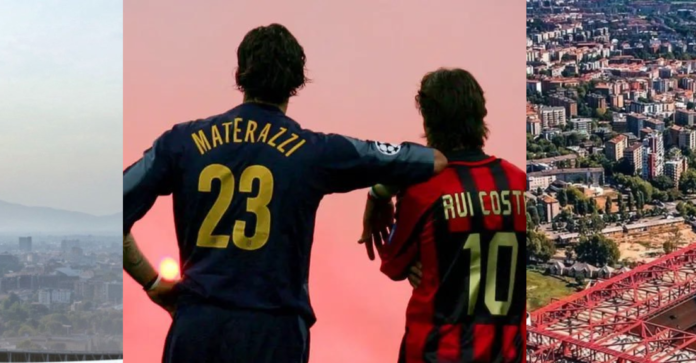
On 16 December 1899, an Englishman named Herbert Kilpin and a group of English and Italian football enthusiasts founded the Milan Foot-Ball and Cricket Club, now known as AC Milan. One of the club’s key founding figures was Alfred Edwards, who became its first president.
Kilpin had a particular vision for his team. Red would represent fire; black would strike fear into their opponents. His famous declaration was that they would be “a team of devils”. More than 125 years later, Milan still wear those colours.
But here is where the story gets interesting. AC Milan eventually gave birth to its own greatest city rival.
On 9 March 1908, a group of members broke away from Milan after disagreements over the club’s direction, particularly its approach to (not recruiting) foreign players. They wanted a club open to footballers of different nationalities and not just Italians, so they formed Football Club Internazionale Milano.
The name said it all: Internazionale, a club for the international community. The man closely associated with its founding was Giorgio Muggiani, an artist who designed the original crest and helped establish the club’s black-and-blue identity. The colours were inspired by the night sky and stars.
Think about that for a moment. Two of Italy’s biggest football institutions emerged from the same club, in the same city, because their founders disagreed about what a football club should represent.
One wore red and black. The other chose blue and black. And then, somehow, they ended up playing their home matches in the same stadium. A rivalry that never needed two homes
The rivalry between AC Milan and Inter is known as the Derby della Madonnina, named after the golden statue of the Virgin Mary that stands atop Milan’s famous cathedral, the Duomo.
It is a battle for the pride of Milan. But unlike many great football rivalries, the two clubs do not have separate stadiums.
In 1926, Milan president Piero Pirelli oversaw the construction of San Siro, originally built specifically for AC Milan. Designed by architect Ulisse Stacchini and engineer Alberto Cugini, it opened on 19 September 1926 with a friendly between Milan and Inter.
Inter won 6–3.
Imagine attending the opening of your club’s new stadium only to watch your city rivals score six goals. Inter had not even moved in permanently, and they were already giving Milan a reason to be annoyed. 
Milan initially owned the stadium, but the city of Milan acquired it in the 1930s. Inter continued playing at the Arena Civica until 1947, when they moved into San Siro as well.
And that is how the arrangement that still defines Milanese football began: two rival clubs, one stadium, one pitch, two very different identities.
But how do two rivals share one stadium? Quite simply, they coordinate their fixtures.
The Serie A schedule is arranged so that Milan and Inter do not ordinarily play separate home matches at San Siro on the same day. One club hosts while the other plays away, allowing the stadium to serve both teams throughout the season.
They have their own dressing-room arrangements, supporters’ traditions and designated ends of the stadium. Inter’s hardcore supporters traditionally occupy the Curva Nord; Milan’s are associated with the Curva Sud.
On one weekend, the stadium might be filled with blue and black. The next, red and black takes over. The advertising, shirts, flags and atmosphere change, but the concrete, the stands and the pitch remain the same.
And when the clubs meet in the derby, one becomes the designated home side while the other is technically the away side. Both are playing in their own stadium.
READ ALSO: Bayern Munich Target Odegaard as Arsenal Face Fight to Keep Captain
That is part of what makes this rivalry so unusual. Imagine Arsenal and Tottenham sharing the Emirates, or Liverpool and Everton taking turns at Anfield. It sounds absurd, but it has been normal life for Milan and Inter for generations.
There is also a practical side to the arrangement. A major stadium costs an enormous amount to build, maintain and operate. Sharing one historic ground has allowed both clubs to use the same infrastructure while preserving their separate identities. The arrangement has endured through decades of football, changes of ownership and countless battles for domestic and European honours.
It does not mean the clubs are friends. On the pitch, they are rivals. Off it, they have had to cooperate on the business of maintaining and replacing their shared home.
The name on the stadium tells another story
San Siro is named after the Milanese district in which it stands. In 1980, the stadium was officially renamed Stadio Giuseppe Meazza in honour of one of Italian football’s greatest players.
Meazza made his name at Inter, where he spent much of his career, but he also played for AC Milan. He was a two-time World Cup winner with Italy, lifting the trophy in 1934 and 1938.
It is rather fitting that a stadium shared by two fierce rivals bears the name of a footballer who represented both.
The ground became known as La Scala del Calcio, the Scala of football, a reference to La Scala, Milan’s celebrated opera house. It has hosted World Cup matches, European Cup and Champions League nights, major concerts and some of the most memorable occasions in Italian football.
For supporters, San Siro is not merely somewhere to watch a match. Its towers, spiralling access ramps and enormous stands have become part of the identity of both clubs. But even places that feel permanent eventually face change.
Inter and Milan are not the only Italian rivals who share a ground.
In Genoa, Genoa CFC and Sampdoria both play at the Stadio Luigi Ferraris. Sampdoria was founded in 1946 through the merger of two Genoese clubs, and the Ferraris has been shared by Genoa and Sampdoria since that year. The arrangement makes the Derby della Lanterna another example of two local rivals playing their home football at the same venue.
So the shared-stadium idea is not exclusive to Milan.
What makes San Siro particularly fascinating is the scale and stature of its tenants. Inter and AC Milan are two of the most recognisable clubs in world football, with enormous international followings and rich European histories. They are not merely two local sides making the best of limited facilities. They are major football institutions sharing one of the sport’s most iconic grounds.
Their arrangement has also survived for nearly eight decades. The stadium has witnessed league titles, European triumphs, painful defeats and countless derbies, all while changing allegiances from one home fixture to the next.
That is what makes this story so special: the rivalry is fierce, but the home is shared.
But even great thing comes to an end
In November 2025, Inter and AC Milan completed the purchase of San Siro and the surrounding land from the City of Milan, laying the groundwork for a new stadium project. Yesterday, the clubs unveiled their plans for their future home: Generali Stadium.
The new stadium is targeted to open for the 2031/32 season, subject to the necessary approvals. Construction is expected to begin in 2028, with the project designed to keep both clubs in the San Siro area while the new ground is built. The current plan is for the old stadium to be largely demolished once the new venue is ready.
Here is what the new home is expected to offer:
Capacity – Approximately 71,500 seats, slightly below San Siro’s current capacity.
Architects – Foster + Partners and MANICA, led by Norman Foster and David Manica.
Design – A striking concrete X-frame structure inspired in part by Milan’s architectural heritage, topped by a sweeping double-curved roof.
Atmosphere – Two seating tiers will form a continuous 360-degree bowl, with steep sections behind the goals reaching inclinations of up to 37 degrees to bring supporters closer to the action.
Roof and sustainability – Photovoltaic technology will be integrated into the roof, alongside acoustic and other sustainability features.
Beyond football – The wider 281,000-square-metre development is planned to include public spaces, green areas, retail and leisure destinations, creating a district intended to remain active beyond matchdays.
Naming rights – The stadium will carry the Generali name. ESPN reported a deal worth €650 million over 20 years, with Generali also becoming the official insurance partner of both clubs.
The ambition is not simply to build a newer stadium. It is to create a modern venue that can generate more commercial opportunities, offer supporters a better matchday experience and help both clubs compete financially with Europe’s biggest teams.
The design also attempts to preserve what made San Siro special: the intensity of the Curvas, the closeness of the supporters to the pitch and the feeling that the crowd is part of the match itself.
Of course, a design can promise an atmosphere but only the supporters can deliver it.
There is something wonderfully ironic about this entire story.
AC Milan was founded in 1899. Inter was born nine years later after a disagreement among Milan members. The split created one of football’s most famous rivalries, yet the two clubs have spent decades sharing the same stadium.
They have fought for the same trophies, divided the city into two colours and given the world some unforgettable football. Yet every season, they have returned to the same patch of ground.
Soon, the spiralling towers and familiar concrete of San Siro may become memories. The new Generali Stadium will take its place, bringing a different design, new commercial ambitions and another chapter in Milanese football.
But the most unusual part of the story will survive.
Chukwukamso A Okoye


