

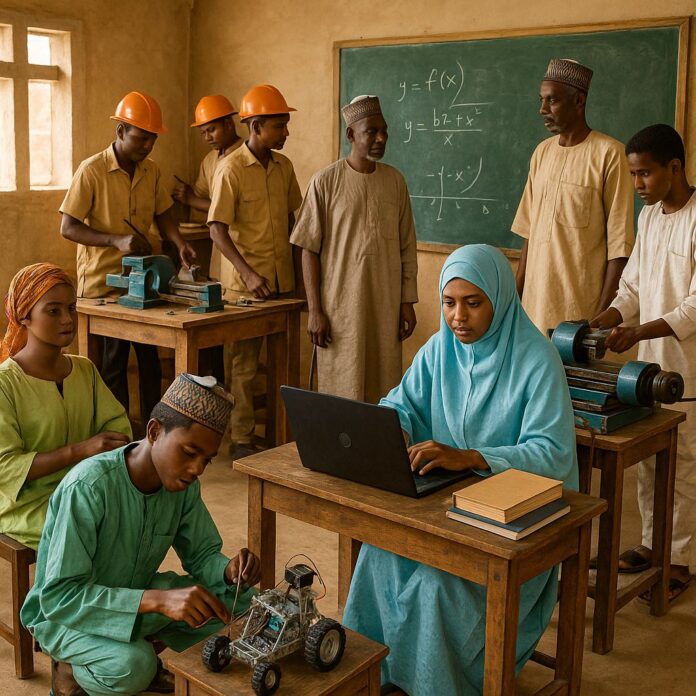
Maintenance Culture is What is Needed in Northern Nigeria — A Critical Analysis Through the Lens of Human Capital Development.
For years, conversations on Northern Nigeria’s development have been dominated by one recurring phrase:
“What we lack is maintenance culture.”
While this observation may hold some truth, since infrastructure decay, abandoned projects and institutional wastage plague the region, it barely scratches the surface of our crisis. Nigeria’s North does not merely suffer from poor maintenance of roads, schools, hospitals or industries. We are confronted with a more fundamental deficit, the absence of a well-developed, well-educated, well-skilled human capital base.
The world is governed not by land mass, oil wells, or mineral deposits, but by brains, skills, knowledge, innovation and enterprise. If maintenance culture is important, human capital development is the engine that sustains everything that must be maintained.
Without trained minds, nothing can be built. Without skilled hands, nothing can be maintained. Without creative thinkers, nothing can evolve.
How the West Built Themselves — Not by Resources, But by People
Western societies were not built on gold or oil; they were built on education, research and skill development.
Three historical facts illustrate this:
1. Post-WWII Europe (The Marshall Plan).
After World War II, Europe was in ruins, infrastructure destroyed, economies collapsed. But rather than merely rebuild structures, they invested in universal education, vocational training, scientific research, and industrial skills. Germany, whose cities were flattened, emerged within 20 years as a global industrial powerhouse, not because of resources, but because of trained citizens.
2. United States and the Knowledge Revolution.
The U.S. economy became the world’s largest not through agriculture or land, but through universities, technology, innovation, and skilled labour. Silicon Valley is not built on mineral deposits, it is built on brains, engineers, inventors and knowledge workers.
3. East Asian Miracle (Japan, South Korea, Singapore, China).
These economies transformed from poverty to global relevance by prioritizing:
• Compulsory literacy
• Industrial and technical training
• Innovation-driven entrepreneurship
• Apprenticeship and skills transfer
South Korea invested in education, not oil, and within 50 years went from war-torn poverty to producing Samsung, Hyundai and LG, global brands worth more than the GDP of most African countries.
Their secret was simple:
They trained their people before they built infrastructure, and after training them, they empowered them to maintain, innovate and expand it.
The Most Relevant African Example: The Igbo Model After the Civil War
When the Biafra War ended in 1970, many Igbo people lost everything, properties, bank accounts reduced to £20, no compensation, no reconstruction grants. They had zero infrastructure, no industries, and a devastated economy.
Yet today, the Igbo are among Nigeria’s most productive economic groups, driving:
• Trade and manufacturing
• Transport and logistics
• Technology and small-scale industry
• Apprenticeship and business succession models
How did they do it?
They turned human beings into their primary resource.
Instead of waiting for government projects, they built the most sophisticated private apprenticeship system in West Africa, the Igba-Boi. A boy works under a master entrepreneur for 5–7 years, learns trade, negotiation, logistics, accounting, risk discipline, and upon completion is settled with capital to start his own business.
It is not oil money. Not government allocation. Not foreign aid. Just human capital multiplied through skill, mentorship and trust.
This is how people rise even without infrastructure. Infrastructure without people collapses, but people without infrastructure can rebuild.
The North Today — Rich Land, Untapped People
Northern Nigeria has enormous potential:
The largest agricultural zone in West Africa. Minerals worth billions (gold, lithium, limestone, iron ore). Millions of energetic youth. Strategic borders for trade into Niger, Chad and Cameroon. Solar energy corridors suited for industrial power. Yet poverty and insecurity dominate because the human capacity to convert potential into prosperity is weak.
A society where millions lack: relevant education, modern agricultural skill, industrial and business training, digital and technical competence, innovation culture, entrepreneurial mentorship, cannot maintain infrastructure, even if built in gold.
Our crisis is not the absence of things to maintain, it is the absence of people skilled enough to maintain them.
What Northern Leaders Must Do — A Strategic Call
If we truly want development, we must adopt human capital development as a cardinal regional priority. This means:
1. Prioritise Education Reform: Modernize Almajiri system into structured learning + vocational integration. Invest in teachers, curriculum, tech, science and digital literacy. No child should finish primary school without a skill.
2. Build a Northern Apprenticeship Economy:
Modelled after the Igbo Igba-Boi system. Youth should be attached to craftsmen, businesses, farms, technology hubs. After training, they must be capitalised to start up.
3. Industrial Agriculture Training: Move from traditional farming to mechanised commercial production. Turn raw produce into finished goods through local processing industries. Train youths in irrigation, solar farming, animal husbandry, logistics, export.
4. Train for the Fourth Industrial Revolution: Digital skills = the new gold. Coding, robotics, AI, fintech, cybersecurity — these skills can transform the North faster than crude oil transform.
5. Private Sector Must Lead: Businessmen, industrialists, philanthropists must see that empowering humans is more profitable than building monuments. A trained child is wealth; an untrained child is a future tragedy.
Final Message: Walls Do Not Build Nations — People Do.
Maintenance culture is important, but it is secondary. The foundation of any civilisation is human beings who can think, create, build and maintain. If the North fails to train its citizens, it will continue to depend on others.
If the North chooses human capital as its priority, it can rise faster than history expects.
Nations are built by minds, not by structures. Give the North people, and they will build everything else.


