

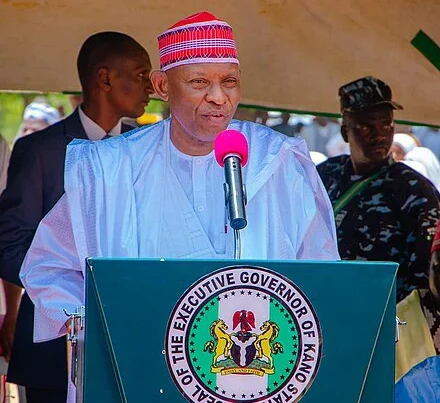
Kano State is heading into a major political crisis following strong indications that Governor Abba Kabir Yusuf is set to defect from the New Nigeria People’s Party (NNPP), a move that has triggered deep divisions within the state’s political leadership.
The tension heightened after Mustapha Kwankwaso, Commissioner for Youth and Sports and son of NNPP national leader and former governor Rabiu Musa Kwankwaso, reportedly began withdrawing from his official duties.
Although he has not formally resigned, multiple sources confirmed that he has cleared his personal belongings from the ministry, signaling a likely exit from the state cabinet.
Governor Yusuf’s anticipated defection widely believed to be to the All Progressives Congress (APC) has been strongly opposed by Rabiu Kwankwaso, who remains the dominant figure within the NNPP in Kano.
In response, Kwankwaso has reportedly transformed his Miller Road residence into a strategic meeting point, holding consultations with loyal members of the Kwankwasiyya movement who have vowed to remain in the NNPP.
Sources revealed that a “loyalty register” has been opened at Kwankwaso’s residence, where political appointees and elected officials are being asked to openly declare their allegiance.
Several senior government officials have reportedly pledged loyalty to Kwankwaso and rejected the governor’s planned move.
Among them are Yusuf Kofar-Mata, Commissioner for Science and Technology; Adamu Aliyu, Commissioner for Humanitarian Affairs; Ibrahim Umar, Commissioner for Internal Security; and Hamza Kachako, Commissioner for Mineral Resources.
Others said to have aligned with Kwankwaso include the Head of Service, Abdullahi Musa; Executive Secretary of the Kano Scholarship Board, Musa Danzaki; and Hamisu Dogonnama, Managing Director of the Kwari Textile Market.
The political split has also affected the National Assembly and the Kano State House of Assembly.
Senator Rufa’i Hanga (Kano Central) and House of Representatives members Mukhtar Yarima, Abdulkarim Ado, and Sani Wakili are reported to be standing with Kwankwaso.
At the state level, lawmakers Yusuf Aliyu and Zakariyya Ishaq have also refused to follow the governor, while the lawmaker from Madobi Local Government Area remains undecided.
Despite this resistance, insiders claim Governor Yusuf still commands the support of the majority of NNPP lawmakers in the state assembly.
More significantly, all 44 local government chairmen, their deputies, and most ward executives are said to have aligned with the governor and are preparing to move with him to the APC.
The development represents a dramatic break in Kano’s political history. For decades, Governor Yusuf was regarded as Rabiu Kwankwaso’s closest political ally. Many of his commissioners, including his son Mustapha, were longtime associates of the former governor.
Supporters of Governor Yusuf argue that the defection is aimed at freeing the administration from excessive political control and allowing the governor to govern independently.
However, Kwankwaso loyalists see the move as a profound betrayal and the collapse of one of Nigeria’s most influential political alliances.
As Kano braces for the official announcement, political observers say the unfolding events could reshape power dynamics in the North-West and significantly influence the 2027 general elections. All attention is now focused on when Governor Abba Kabir Yusuf will for
mally declare his new political home.


