

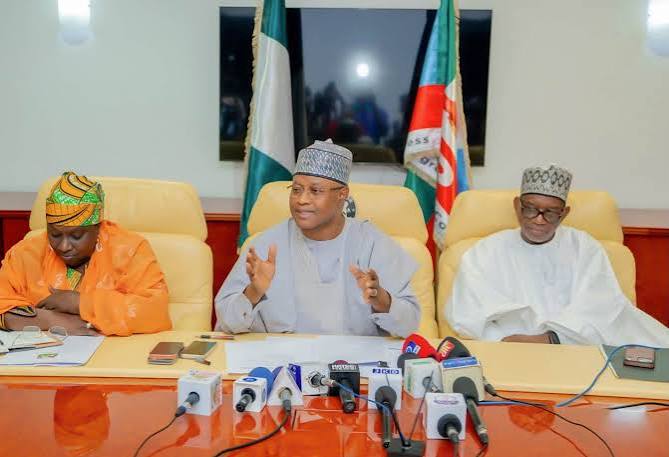
Kaduna State’s Internally Generated Revenue (IGR) rose from N58 billion before 2023 to N85 billion in 2025, the outgoing Executive Chairman of the Kaduna State Internal Revenue Service (KADIRS), Jerry Adams, has said.
Adams attributed the growth to Governor Uba Sani’s political will, improved tax administration and stronger compliance among residents and businesses.
He spoke at the ongoing 160th meeting of the Joint Revenue Board in Kaduna.
According to him, the state generated N62 billion in 2023, then increased collections to N71 billion in 2024 and N85 billion in 2025.
“In 2025, we recorded an annual revenue of N85 billion, with an average monthly collection of N7 billion,” Adams said.
He said the state was currently on course to generate N120 billion annually, with average monthly collections approaching N10 billion.
Adams described the revenue growth as steady and sustainable, attributing the improvement to stronger collaboration between KADIRS, government ministries, departments and agencies (MDAs), as well as other stakeholders.
He also credited Sani’s administration for allowing KADIRS to operate without interference.
The outgoing chairman recalled that KADIRS recorded its highest annual collection of N59 billion in 2022, averaging N4.8 billion per month between 2019 and 2023.
He noted, however, that the 2022 figure was boosted by back-duty recoveries, the sale of government properties and other one-off revenue sources.
According to him, that model became unsustainable by early 2023, forcing KADIRS to rethink its approach.
“We could no longer keep squeezing the same familiar taxpayers a little harder each year and call it strategy,” he said.
KADIRS Expands Tax Base, Digitises Collections
Adams said the agency subsequently shifted its focus from repeatedly targeting existing taxpayers to expanding the state’s overall tax base.
He said KADIRS digitised its operations through the PAYKADUNA portal and Project C.R.A.F.T. to improve transparency and block revenue leakages.
According to him, the initiatives created a centralised system for collecting state revenue and reduced the gaps associated with informal, cash-based transactions.
The service also recruited more personnel, equipped staff with better working tools and approved promotions for workers whose career progression had stalled.
Adams said KADIRS further strengthened staff capacity through training and opened three additional area offices, increasing the total number to 37.
He said the new offices had made tax services more accessible while enabling the agency to identify and bring more taxable activities into the revenue system.
The agency, he added, also deepened collaboration with the Joint Revenue Board, Nigeria Revenue Service and Nigerian Financial Intelligence Unit.
Adams said data-sharing arrangements with the institutions had helped KADIRS identify taxable activities that previously escaped the tax net.
Tax Compliance Rises From 30% to 65%
Adams, who is the APC running mate for the 2027 governorship election, said improved tax compliance reflected growing trust between taxpayers and government.
“When we began, compliance across the state stood at a modest 30 per cent. Today, it has risen to approximately 65 per cent,” he said.
He stressed, however, that the progress should not be credited to KADIRS alone, describing it as a collective governance achievement involving government agencies, taxpayers and other stakeholders.


