

Mr Joel Odigie, General Secretary of ITUC-Africa, disclosed this in a statement made available to newsmen on Sunday.
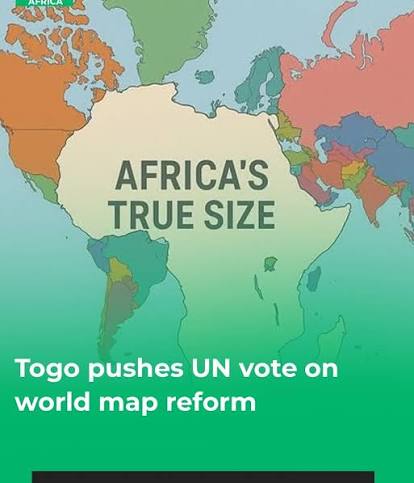
Odigie said the UN General Assembly had adopted a resolution promoting the Equal Earth map projection, which more accurately represents Africa’s geographical size and significance.
He said Togo spearheaded the resolution with the support of the African Union, securing overwhelming backing from UN member states, with 164 countries voting in favor.
According to Odigie, Togo’s leadership demonstrated that African countries could shape global debates and institutions when they acted with unity, confidence and determination.
“ITUC-Africa commends the Government and people of Togo for the Pan-African spirit, determination and leadership demonstrated in advancing this historic and important initiative,” he said.
Odigie said the widespread use of the Mercator projection had for centuries visually diminished Africa while disproportionately enlarging parts of Europe and North America.
He argued that the distortion extended beyond cartography because maps shape education, public perceptions, policymaking and views of political and economic power.
“Correcting this longstanding distortion is therefore an important act of historical and representational justice for Africa and its peoples,” he said.
Odigie said Africa’s actual geographical size reflected its enormous potential, including its growing population, strategic resources, productive capacity and expanding workforce.
He urged Africans to use the development as a catalyst to recognize their collective strengths and channel them towards shared development and prosperity.
The ITUC-Africa general secretary also called for stronger regional integration, saying the African Continental Free Trade Area (AfCFTA) must move beyond agreements and declarations to deliver tangible benefits to workers and ordinary Africans.
“Africa needs greater regional integration, increased intra-African trade, improved infrastructure and freer, safer mobility for workers and people,” he said.
He urged African governments to remove administrative, transport and financial barriers that continue to fragment economies and restrict cooperation across the continent.
Odigie said the campaign to correct Africa’s map should also prompt a broader conversation about the ownership and control of the continent’s land, minerals, energy, technology, finance and productive assets.
He noted that Africa continued to experience widespread inequality despite its abundant resources, with millions of workers facing unemployment, informal employment, poor wages and limited social protection.
“The energy and unity demonstrated through the ‘Correct the Map’ campaign must now embolden a broader Pan-African agenda for structural transformation,” he said.
Odigie urged African leaders to reduce dependence on raw-material exports, develop regional value chains, and strengthen productive capacity through accountable and democratic governance.
He said Africa’s true size should ultimately be reflected not only on global maps but also in its influence and the living standards of its people.
“Ordinary people must experience the dividends of African integration and transformation through decent work, living wages, universal social protection and quality public services,” he said.
Odigie congratulated Togo, the African Union and other stakeholders that championed the resolution, describing the achievement as a significant Pan-African victory.
“Africa has been restored to its proper scale on the map. The greater task is ensuring its workers and peoples occupy their rightful place,” he said.


