

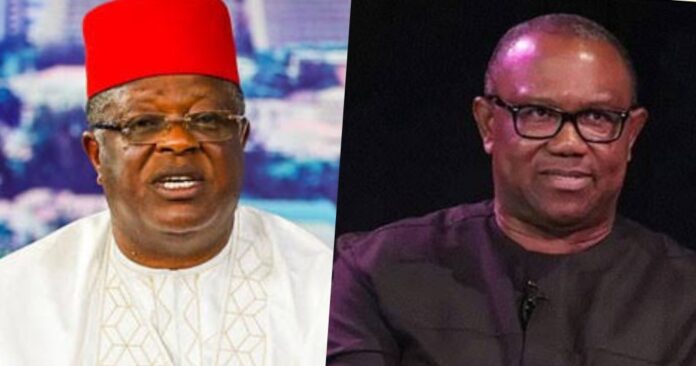
The Minister of Works, Dave Umahi, has said the people of the South-East never agreed to support a four-year presidential term for the region, in reference to the presidential ambition of the Nigeria Democratic Congress (NDC) candidate, Peter Obi.
Umahi made the remark during an interview with Arise Television monitored by The News Chronicle aired on Friday, arguing that Obi should have consulted him and other political stakeholders in the South-East before making such a commitment.
He said the decision had implications for his political future, Ebonyi State and the entire South-East region.
“Igbos should be president and it’s four years while others are doing eight years. Who in South-East reached that agreement with our brother Peter Obi to say that you will go for us?” Umahi asked.
The minister said there were three presidential candidates of South-East extraction and argued that Obi should have consulted regional stakeholders before making decisions on behalf of the zone.
“There are three presidential candidates from the Igbo extraction, you can’t play politics in the South-East without consulting people like us. He should have come because my future is also involved, the future of my state and brothers are also involved,” he said.
Umahi added that South-East political leaders needed to discuss whether supporting another region’s presidential candidate would improve the zone’s chances of securing the presidency in the future.
READ ALSO: Nigeria urges Strategic Partnerships to Boost Africa’s Global Influence
“So we will sit down and discuss, is it the best time for us to look for this, do we support another region so that when it’s our turn, the region will support us? If I was contesting that would have been done,” he said.
He further argued that if the presidency were to be zoned to the South-East, other states in the region should have an opportunity to produce the president, citing Ebonyi, Enugu, Imo and Abia.
He also referenced former President Nnamdi Azikiwe, who hailed from present-day Anambra State, while questioning whether other states in the region should be given the opportunity to produce a president.


