

There is absolutely nothing wrong with the concerns being expressed by many people in the Southeast region about the performance and priorities of the South East Development Commission (SEDC) over a year after it was created.
This is according to the Executive Director, Rule of Law and Accountability Advocacy Centre, RULAAC, Okechukwu Nwanguma, who spoke exclusively to The News Chronicle correspondent in Awka on Tuesday.
Recall that the Board of the SEDC was inaugurated by President Bola Tinubu in February 2025, and people of the region have expressed concerns that a year plus after, there are no visible impacts, except tours, conferences, and symposia by the members of the Board.
Critics have also condemned what they identified as misplaced priorities in the Commission’s 2026 budget of N140 billion.
They cited bogus allocation for some areas including- Media, PR, and Branding: N2.3 billion, Foreign and Local Travels: N2.6 billion, Operational Vehicles: N4.1 billion, Regional Security Operations: N2.5 billion to N3.5 billion, Climate Sustainability and Green Economy: N500 million.
According to Nwanguma, a regional intervention agency established amid widespread infrastructure deficits, insecurity, unemployment, economic stagnation, and feelings of marginalization naturally carries very high expectations.
He maintained that more than a year after inauguration, citizens are justified in questioning why there are no tangible projects and measurable impacts.
Describing a budget as a statement of priorities, Nwanguma observed that when significant allocations are made to media, branding, travels, vehicles, and conferences at a time when communities are struggling with dilapidated roads, erosion, youth unemployment, insecurity, poor healthcare, and collapsed industries, it creates the impression that bureaucracy and image management are being prioritized over development delivery.
“Even if some of these expenditures may be administratively necessary for a new institution, the optics are poor, especially in a region where public trust in government agencies is already fragile.
“For instance, allocations running into billions for media, public relations, travels, and operational vehicles will naturally attract criticism if there are no corresponding visible flagship projects in infrastructure, industrialization, education, technology, agriculture, or social investment. Citizens expect development commissions to be project-driven institutions, not conference-driven agencies. People want to see roads being reconstructed, erosion sites tackled, industrial clusters revived, skills acquisition centres functioning, and support reaching local businesses and vulnerable communities,” he said.
The rights activist acknowledged that new institutions often require an initial period of institutional setup, staffing, policy planning, stakeholder engagement, and intergovernmental coordination before large-scale project execution begins.
He, however, said the challenge for the SEDC is that it has not sufficiently communicated a clear roadmap with timelines, benchmarks, and visible pilot interventions that reassure the public that the foundation phase is leading somewhere concrete.
Nwanguma noted that the allocation for regional security operations, if transparently managed and tied to lawful, rights-respecting community safety initiatives, may be defensible given the severe insecurity affecting the Southeast.
He also said climate sustainability should not be dismissed outrightly because erosion and environmental degradation are major existential threats in the region, but insisted that the expenditures must be tied to practical, community-level interventions rather than abstract policy rhetoric.
“Ultimately, the legitimacy of the SEDC will not be determined by press conferences, international trips, or branding campaigns, but by visible improvements in the lives of ordinary people. The Commission must urgently shift toward transparency, measurable development outcomes, citizen engagement, and prudent spending. Otherwise, it risks being perceived as another bureaucratic structure consuming public funds without delivering meaningful transformation,” Nwanguma posited.
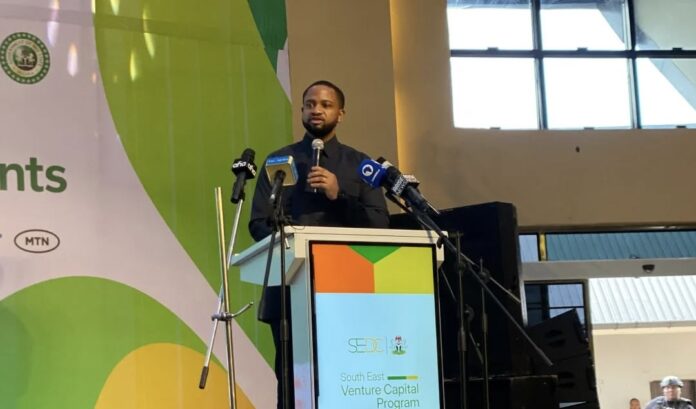
Meanwhile, in what seems to be its first response to criticisms of idleness, the SEDC on Tuesday held the South East Digital Economic Summit (SEDES), with the launch of the Venture Capital Investment programme.
Reacting to criticisms at the summit, the Managing Director of the SEDC, Mr Mark Okoye said the Commission is building a brand new region that did not exist before February 12, 2025.
He explained that the Venture Capital Investment programme is one of the 8 intervention areas which the Commission has developed based on its sustained interaction with stakeholders in the region.
“The easiest thing to have done was to start up one small project here and there, but we spent the 9-12 months listening to the people. We had a draft plan which we kept presenting before different stakeholder groups- the private sector which employs over 8 million people, the faith based and civil society organizations, 120 government agencies, the five southeast state governments, which we met with over three times, and over 5,000 members of the diasporan community.
“So, essentially what we have is about 8 intervention areas and we are today kicking off the Venture Capital Programme.
“70 percent of the regions are young people but the beauty about the Southeast region is that those young people have the skills, the commitment, the hard work and the right culture to actually want better and do more.
“I am confident that we have millions of vibrant young people with the right capacity to drive economic growth, but we cannot harness them unless government catalyzes that opportunity for them.
“With the launch of the programme today, we are aiming to put $500,000 of equity in investments into 30 start-ups in the Southeast. This is not grant, not empowerment, but a merit-based, transparent, governance-secured process that is an investment into each of these start-ups, thereby giving them the opportunity to grow bigger,” Okoye revealed.


