

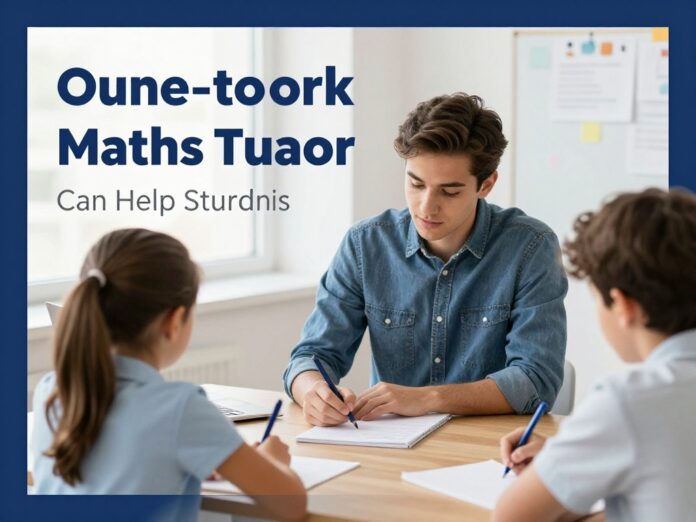
Mathematics can become challenging when students struggle to understand a particular concept. A student may understand basic calculations but find algebra confusing. Another may be comfortable with fractions but struggle with geometry or word problems. These difficulties can affect confidence and make later topics harder to learn.
In Malaysia, students study mathematics across different school levels and follow different learning requirements. Classroom lessons provide essential guidance, but teachers may not always have enough time to address every student’s individual difficulties.
One-to-one maths tutoring offers a more personalised approach. It allows students to ask questions, practise difficult concepts and receive feedback at their own pace. With consistent guidance, they can work towards a stronger understanding of mathematics.
Why Do Students Find Some Maths Topics Difficult?
Mathematics is a connected subject. Many advanced topics depend on skills learned earlier. When students miss an important concept, they may struggle to understand the next lesson.
For example, a student who has not mastered fractions may find algebraic fractions difficult. Similarly, weak multiplication skills can make factorisation and more advanced calculations harder.
Several factors can contribute to these challenges.
- Gaps in basic knowledge: Students may move to a new topic without fully understanding the previous one.
- Different learning speeds: Some students need more examples and practice before they feel confident.
- Difficulty applying formulas: Memorising a formula does not always help students understand when or why to use it.
- Limited opportunities to ask questions: Students may hesitate to speak up in a busy classroom.
- Exam pressure: Time limits and unfamiliar question formats can make it harder to apply learned methods.
Recognising the main difficulty is an important first step. Students need to understand where their confusion begins before they can make steady progress.
How One-to-One Maths Tutoring Helps Students
1. Lessons Focus on Individual Learning Needs
Every student has different strengths and weaknesses. Some understand concepts quickly but make careless mistakes. Others need additional explanations before they can solve a question independently.
In a one-to-one lesson, the tutor can focus on the student’s specific needs rather than following a fixed pace for an entire class.
For example, a Form 2 student may understand simple algebraic expressions but struggle with equations involving brackets. Instead of repeating the whole chapter, the tutor can identify the exact problem, review the relevant rules and provide targeted practice.
This approach helps students spend more time on areas that require attention.
2. Difficult Concepts Can Be Explained in Different Ways
A single explanation does not work for every learner. Some students understand mathematics through diagrams, while others prefer worked examples or step-by-step calculations.
A tutor can change the explanation when a student does not understand the first method.
Consider fractions. A student who struggles to add fractions with different denominators may benefit from visual diagrams before moving to numerical calculations. Once the concept becomes clearer, the tutor can introduce more challenging questions.
This flexibility makes it easier for students to connect mathematical rules with their practical meaning.
3. Students Can Ask Questions Without Feeling Embarrassed
Some students avoid asking questions in class because they worry about giving the wrong answer. Others need more time to organise their thoughts before explaining what they do not understand.
One-to-one tutoring provides a quieter setting for discussing these difficulties.
Students can ask their tutor to explain a step again, request another example or show where they became confused. The tutor can then respond directly to the problem.
Over time, regular discussion can help students become more comfortable with making mistakes and learning from them.
4. Tutors Can Identify Repeated Mistakes
Getting an answer wrong does not always mean a student lacks mathematical knowledge. Sometimes, the problem comes from a small misunderstanding that appears repeatedly.
For example, a student may understand how to solve an equation but forget to apply the same operation to both sides. Another may use the correct formula but substitute the wrong values.
A tutor can examine the student’s working and identify these patterns.
Instead of simply correcting the final answer, the tutor can explain why the mistake occurred. Students can then practise similar questions and learn how to check their own work.
This process develops accuracy and encourages better problem-solving habits.
5. Students Can Build Skills Step by Step
Some mathematical topics require several skills to be used together. Moving directly to difficult questions can leave students feeling overwhelmed.
A more effective approach is to begin with the basics and gradually increase the difficulty.
For instance, when learning algebra, a student might progress through these stages:
- Understanding variables and algebraic expressions.
- Simplifying expressions using the correct rules.
- Solving simple linear equations.
- Working with equations that include brackets.
- Applying algebra to word problems.
Each stage prepares the student for the next one. The tutor can review earlier concepts whenever a difficulty appears.
This structured approach helps students develop a more reliable foundation before attempting unfamiliar questions.
Which Maths Topics Can Benefit from Individual Support?
One-to-one tutoring can help students across several areas of mathematics. The most useful approach depends on their school level, syllabus and current understanding.
Algebra
Algebra introduces symbols, variables and equations. Students may struggle to simplify expressions, rearrange formulas or solve equations with several steps.
A tutor can explain the rules behind each operation and provide practice that progresses from basic expressions to more complex problems.
Fractions, Decimals and Percentages
These topics are important for everyday calculations and more advanced mathematics. Students may confuse the rules for adding fractions, converting decimals or calculating percentages.
Practical examples, visual aids and repeated exercises can help clarify the differences between these methods.
Geometry and Measurement
Geometry requires students to understand shapes, angles, properties and formulas. Some learners can remember a formula but struggle to identify which one applies to a particular question.
Tutors can use diagrams and worked examples to explain the relationships between different shapes and measurements.
Graphs and Functions
Students may find it difficult to connect equations with graphical representations. Individual guidance can help them understand coordinates, gradients, intercepts and the relationship between an equation and its graph.
Word Problems
Word problems require more than calculation. Students must interpret the information, identify what is being asked and choose an appropriate method.
A tutor can teach students to highlight important details, translate statements into mathematical expressions and check whether their answers make sense.
Students looking for structured support can explore the maths learning resources and personalise online tutoring at Mixt Academy Malaysia.
How One-to-One Tutoring Supports Exam Preparation
Examinations assess more than a student’s ability to remember formulas. Students must select suitable methods, show their working and manage their time.
Individual tutoring can help students prepare by focusing on the topics they find most difficult.
A tutor may begin by reviewing recent school assessments or practice papers. The results can help identify weak areas and common mistakes. Lessons can then focus on those areas before moving to timed questions.
Students can also learn how to approach unfamiliar problems. Rather than immediately looking for a memorised solution, they can practise breaking each question into smaller steps.
Regular practice is important, but it should be purposeful. Students benefit more from understanding why an answer is wrong than from completing many questions without reviewing their mistakes.
Parents should also remember that progress takes time. Tutoring can provide useful support, but improvements depend on factors such as attendance, practice, lesson quality and the student’s willingness to learn.
Choosing the Right Maths Tutor in Malaysia
The right tutor should understand the student’s learning needs and explain mathematical concepts clearly. Parents can consider several factors when comparing tutoring options.
- Subject knowledge: Check whether the tutor understands the student’s school level and syllabus.
- Teaching approach: Look for someone who encourages questions and explains the reasoning behind mathematical methods.
- Individual feedback: The tutor should review mistakes and adjust lessons when a student needs more support.
- Practice materials: Suitable exercises should help students apply what they have learned.
- Progress monitoring: Regular reviews can show which topics have improved and which need further attention.
- Practical arrangements: Consider lesson schedules, learning preferences, location and budget.
For families in Penang, finding suitable tuition may also involve choosing between home-based lessons and online learning. The best option is one that fits the student’s routine and allows them to concentrate during lessons.
Parents can explore online tutoring in Penang when comparing support for their child’s educational needs.
How Parents Can Support Maths Learning at Home
Tutoring works best when students also have opportunities to practise independently. Parents do not need to teach every topic themselves. Simple routines can help children develop more consistent study habits.
Encourage students to review difficult questions after each lesson. They can keep a notebook of common mistakes, write down important formulas and record the steps needed to solve particular question types.
Short, regular practice sessions may also be easier to maintain than long study sessions just before an examination.
Parents should avoid focusing only on marks. Asking a child to explain how they reached an answer can reveal whether they understand the method or are relying on memory.
It is equally important to allow students to make mistakes. With patient guidance, they can learn to check their work, correct misunderstandings and approach new questions with greater confidence.
Frequently Asked Questions
Is one-to-one maths tutoring suitable for students who are already doing well?
Yes. Students who perform well can use individual lessons to strengthen their understanding, explore more challenging questions and prepare for upcoming examinations. Tutoring does not need to be limited to students who are falling behind.
How often should a student attend maths tutoring?
The frequency depends on the student’s needs, school workload and available time. Some students may benefit from weekly lessons, while those preparing for important examinations may need a more structured schedule. Consistent practice between lessons remains important.
Can online maths tutoring help students understand difficult topics?
Online tutoring can be useful when lessons include clear explanations, worked examples, interactive tools and opportunities to ask questions. Its effectiveness depends on the quality of instruction, student participation and the suitability of the learning environment.
How can parents tell whether tutoring is helping?
Look for practical signs of progress. These may include fewer repeated mistakes, better explanations of mathematical methods, improved performance on practice questions and greater independence when solving problems. Test results are useful, but they should not be the only measure.
Conclusion
Difficult maths topics become easier to approach when students receive the right explanations, enough practice and feedback that addresses their individual mistakes. One-to-one tutoring provides an opportunity to work through these challenges without the pressure of keeping pace with an entire class.
For Malaysian students, personalised support can complement school lessons and help strengthen essential mathematical skills. With clear goals, regular practice and patient guidance, students can develop a better understanding of challenging concepts and become more independent learners.
Mixt Academy Malaysia is one option for families exploring online maths tutoring and additional academic support. The important step is to choose a learning approach that matches the student’s needs and gives them the opportunity to understand mathematics, rather than simply memorise answers.


