

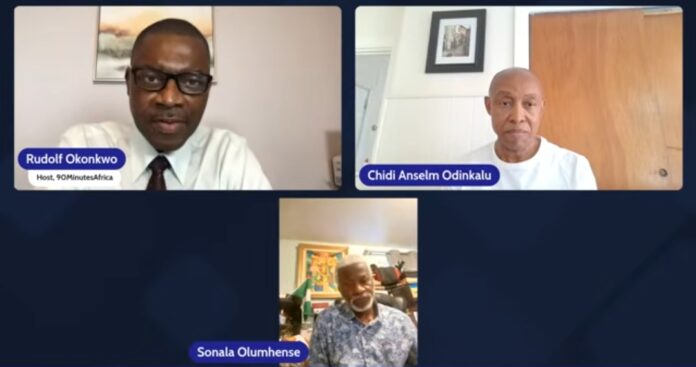
Odinkalu made the remarks during an interview with Rudolf Okonkwo on 90MinutesAfrica. He argued that the appointment of Emeakayi as Special Adviser on Community Security was inconsistent with the findings and recommendations of the Anambra State Truth, Justice and Peace Commission (TJPC), which he chaired.
The Igwes were brutally murdered in Onitsha on September 2, 2002, in an attack that shocked the legal community and became one of the most controversial unresolved cases in Anambra’s history. Twelve people were subsequently charged in connection with the murders, including Emeakayi, who was then Commissioner for Works in the administration of Governor Chinwoke Mbadinuju.
According to the legal scholar, the trial was repeatedly disrupted by alleged external interference. “Three judges withdrew from the case, citing pressure and political interference, before a fourth judge eventually granted Emeakayi bail in 2005,” Odinkalu said. The remaining suspects were subsequently set free during a jailbreak in Onitsha in February 2006.
Years later, when Soludo’s administration established the Truth, Justice and Peace Commission, Odinkalu said the commission decided to revisit the case. He explained that the commission discovered that the original case files had disappeared from the relevant institutions.
“We found out that the case files were missing and there was no record of this case in the courts nor in the Ministry of Justice,” the Professor in International Human Rights Law at The Fletcher School at Tufts University said.
According to him, the commission had to reconstruct the case records from information obtained from individuals who had previously worked on different aspects of the investigation and prosecution.
Odinkalu said the commission’s findings revealed that the courts had neither determined the case nor formally terminated it, and that the relevant files had effectively disappeared. They subsequently recommended that the prosecution be reopened and, according to Odinkalu, identified Emeakayi as a person who still had questions to answer concerning the killings.
The former NHRC chairman said he personally briefed Governor Soludo and handed him a memorandum specifically addressing the Igwe case. The governor assured him that his administration would act on the recommendation.
But, according to him, instead of seeing the case reopened, the governor appointed Emekeayi as one of his advisers.
In October 2024, Soludo appointed Emeakayi as Special Adviser on Community Security. Following Soludo’s re-election and inauguration for a second term, Emeakayi was again reappointed to the position.
For Odinkalu, the appointment raises fundamental questions about accountability and the exercise of political power.
“I cannot be complicit in the murder of a pregnant woman just in the name of loyalty to power,” he said, adding that no amount of political power was worth compromising the pursuit of justice.
He argued that the controversy went beyond Soludo’s personal political choices, warning that unresolved allegations involving a government appointee responsible for security could have implications for the governor’s legacy.
Odinkalu pointed out that there were two things at stake: “the question of ultimate accountability for the murder of the Igwes and the responsibility of the current government to avoid elevating someone whose alleged involvement had not been judicially resolved.”
He described Emeakayi’s appointment as a security adviser as a “scandal,” stressing that the allegations against him should first be subjected to due process rather than being ignored.
Odinkalu also raised broader concerns about the conduct of security operations in Anambra State.
“There are credible reports of extrajudicial killings at the headquarters of the state’s security outfit in Awka, which are similar to the security environment of 2001 and 2002, in which Emeakayi was closely connected,” the lawyer stated.
He also challenged the state government to examine its spending priorities, particularly the disparity between resources available to the Ministry of Justice and those allocated to the state security outfit overseen by Emekeayi.
According to Odinkalu, prosecutors in the state face logistical difficulties, including a lack of vehicles to attend court, while substantial resources are committed to the Agunechemba security outfit.
He argued that the weakening of institutions responsible for lawful accountability creates a dangerous imbalance in which security becomes increasingly detached from judicial oversight.
The criticism comes against the background of the state’s growing reliance on community-based security structures. Emeakayi has continued to play a prominent role in supervising Anambra’s security operations, spearheaded by the Agunechemba security outfit.
The interview also touched on the wider question of political violence and electoral manipulation in Nigeria.
Odinkalu argued that elections in Nigeria are often won by what he called election-day operations. He argued that these operations are a major avenue for manipulating elections, particularly through “violence and the manufacture of results that have no relationship with what occurred at the polling units.”
He called on opposition parties to cooperate in deploying polling agents nationwide, arguing that properly trained and committed agents are essential to protecting polling-unit results.
According to him, “opposition parties should collaborate on election-day monitoring, even if they are not going to field a common candidate, by sharing polling agents and resources.”
He also criticized the federal government and the All Progressives Congress (APC) for the growing threats of violence against opponents being issued daily by their agents. He argued that the threats of political violence reflect an absence of convincing records with which to campaign.
Odinkalu warned that inflammatory rhetoric from political actors could further destabilize an already fragile security environment and urged the Independent National Electoral Commission (INEC) and the police to respond more firmly to such threats of electoral violence.
The human rights lawyer also turned his criticism towards the National Peace Committee, chaired by Catholic Bishop Matthew Hassan Kukah.
Odinkalu accused the committee of becoming part of the problem rather than the solution by encouraging political actors to sign peace agreements without establishing measurable standards for compliance.
He argued that peace agreements would have little value if there were no mechanisms to monitor compliance and publicly denounce political actors who violated them.
For Odinkalu, accountability must apply equally to all political parties and candidates, regardless of their relationship with members of the peace committee.


