

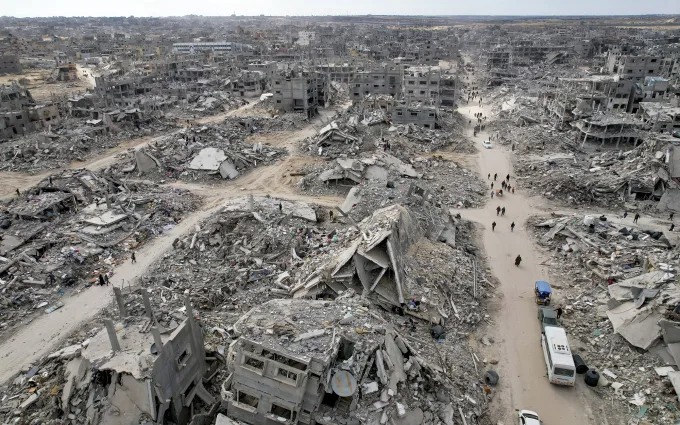
Something must be profoundly disturbing about the way Gaza, in Israeli-occupied Palestine, has become a spectacle, while its people endure a daily reality of grief and doom. The phrase “building a reverie on Palestinian blood” captures the moral dissonance of this moment where suffering is transformed into rhetoric, devastation folded into political narratives, and human loss is garnished as justification.
To observers, Gaza has become shorthand for an intractable conflict. Yet Gaza is not a symbol; is a place of over two million people, most confined within the narrow geography of the Gaza Strip, living under conditions that have oscillated between fragile normalcy and catastrophic violence for years. To speak of Gaza without centering its civilians is to participate in the criminal attempt to erase them.
The current devastation did not emerge in a vacuum. The October 7 attacks by Hamas were unacceptable and deserve condemnation. But condemnation alone cannot serve as a moral blank cheque for everything that followed October7. The subsequent military campaign by Israel has resulted in staggering civilian casualties, the killing of children and maiming others, the destruction of infrastructure, and the socioeconomic dislocation of the majority of Gaza’s population. Entire neighborhoods have been reduced to rubble. Hospitals, religious institutions and schools have struggled to function amid bombardment and shortages caused by Israeli occupation forces.
What concerns me most is not only the scale of destruction but the narrative scaffolding built around it. Political leaders, including Prime Minister Benjamin Netanyahu, frame the campaign as an existential necessity. Security is invoked as an overriding imperative. Yet security detached from proportionality and humanity risks becoming a justification for collective punishment. When language shifts from targeting militants to eradicating “human animals” or “total victory at any cost,” it dehumanizes an entire population.
This is where the reverie emerges—not as poetry, but as a kind of moral sleepwalking. In some quarters, Palestinian suffering is acknowledged only as an unfortunate byproduct, regrettable but secondary. In others, it is weaponized to score political points, detached from any genuine commitment to Palestinian self-determination or protection. Social media amplifies images of dead children and flattened homes, yet outrage often dissipates into performative gestures rather than sustained pressure for policy change.
The international community bears its share of responsibility. The United Nations has issued warnings about humanitarian catastrophe. Aid agencies have described famine-like conditions and the collapse of basic services. Meanwhile, debates at the International Criminal Court over potential war crimes underscore the gravity of the situation. But resolutions and investigations, while important, do not immediately halt bombs or feed families. They often feel like belated acknowledgments rather than preventive action.
The role of the United States is particularly pivotal. As Israel’s principal ally and military supporter, it has leverage that few others possess. Public statements urging restraint ring hollow when paired with continued arms transfers to Israel. If there is genuine concern for civilian life, it must manifest in conditional support and sustained diplomatic pressure for enforceable ceasefires and negotiations. Otherwise, expressions of concern risk becoming part of the same reverie through lamenting the bloodletting while enabling its continuation.
To be clear, none of this absolves Hamas of responsibility for embedding itself within civilian areas or for initiating violence that predictably invited massive retaliation. Nor does it deny Israel’s right to defend its citizens. But rights come with obligations. International humanitarian law is not a suggestion to be applied selectively; it is a framework designed precisely for moments of rage and fear. When adherence to it collapses, civilians pay the price.
The deeper tragedy is that cycles of vengeance entrench themselves with each new grave. Israeli families mourn loved ones killed or kidnapped. Palestinian families dig children from debris. Each side’s trauma becomes fuel for the next round of violence. In this atmosphere, empathy is treated as betrayal. To grieve Palestinian civilians is, in some circles, to excuse terrorism; to grieve Israeli victims is, in others, to endorse occupation. Such binary thinking impoverishes our moral imagination.
Building a reverie on Palestinian blood ultimately corrodes everyone. Rather sadly, it normalizes the spectacle of suffering and trains us to see casualty figures as statistics rather than names. It further allows leaders to speak of “collateral damage” without confronting the human cost embedded in those words.
If there is to be any path forward, it must begin with rejecting abstraction. Gaza is not, and shonot be treated as a chessboard. Its people are not bargaining chips. A sustainable peace will require confronting hard questions about occupation, governance, security guarantees, and political representation. It will require accountability for war crimes. And it will require the international community to move beyond expressions of concern toward consistent, principled action.
Until then, every bomb that falls risks reinforcing the same grim pattern of grief converted into rhetoric, blood collapsed into narrative, and human lives reduced to footnotes in a conflict that the world seems unwilling to end.
Magaji <Magaji778@gmail.com> writes from Abuja.


