

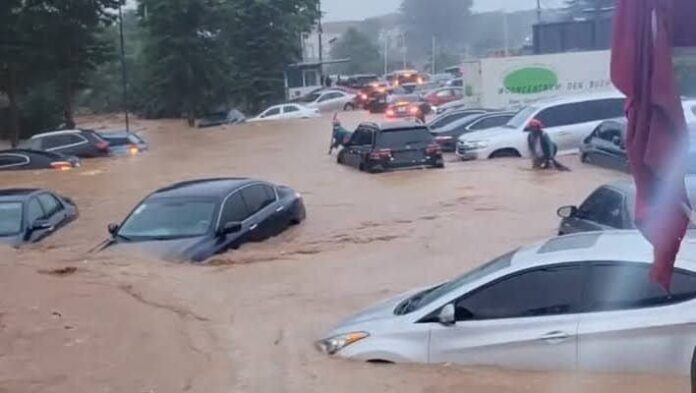
The FCT Stakeholders Forum for Development (FSTF) has urged relevant authorities to take immediate and decisive measures to curb flooding across the Federal Capital Territory.
The Chairman of the forum, David Kente, made the call on Wednesday in Abuja while briefing journalists on the group’s findings and concerns over recent flooding incidents in the territory.
FSTF, a coalition of landlords, business owners and investors, said the measures should include the regular desilting of drainage channels, strict enforcement against encroachment and a comprehensive review of the 1979 Abuja Master Plan.
Kente also urged the Minister of the Federal Capital Territory, Nyesom Wike, to ensure that development projects comply with due process and established planning standards to prevent residents from bearing the unintended consequences of infrastructure expansion.
“We are here today to address the recent devastating floods that have affected parts of Abuja and to contribute to the broader conversation around infrastructure, environmental management and governance in the FCT under Wike’s administration,” he said.
He noted that heavy rainfall in recent weeks had triggered flooding in several parts of the territory, raising concerns over drainage infrastructure, environmental management and urban planning.
According to him, some critics have attributed the flooding to alleged violations of the Abuja Master Plan, including encroachment on green areas, parks, drainage corridors, canals and waterways designed to support flood control and groundwater recharge.
“We acknowledge these concerns. Flooding is no longer an isolated incident. Communities that never experienced such levels of inundation are now vulnerable. Homes have been submerged, roads cut off and livelihoods disrupted,” Kente said.
He said the forum subsequently conducted an independent fact-finding assessment in some affected areas to identify the factors contributing to the recurring flooding.
Kente said the assessment revealed three major realities.
He explained that flooding in Abuja was not a new phenomenon, noting that the territory had experienced flooding incidents long before the current administration.
He also identified rapid urban expansion, the removal of drainage covers by scavengers and indiscriminate waste disposal as major human and systemic factors contributing to blocked waterways.
Kente further described the 1979 Master Plan as outdated, arguing that it no longer adequately reflects the population growth and infrastructure demands of a capital city with more than 3.5 million residents.
“The document that guides development in the FCT no longer reflects the demographic and infrastructural realities of a capital city of more than 3.5 million people. It requires urgent review and modernization,” he said.
Against this backdrop, Kente said FSTF had passed a vote of confidence in the Wike-led FCT Administration.
He said the territory had witnessed significant infrastructure development and governance reforms in less than three years, with major projects spread across Abuja and the satellite towns.
According to him, the administration has delivered major flyovers, expanded carriageways and newly paved roads while pursuing broader improvements in public infrastructure.
He said Wike had approached governance with the belief that infrastructure remained a critical driver of economic growth and development.
“Beyond roads, his administration has embarked on massive rehabilitation of public schools, provision of patrol vehicles to security agencies, construction of modern bus terminals and expansion of rural healthcare facilities.
“This reflects a deliberate effort to balance hard infrastructure with essential social services,” he said.
Kente described Wike as “Mr Project”, saying the minister had transformed the FCT into a major construction zone aimed at unlocking the territory’s commercial and social potential.


