

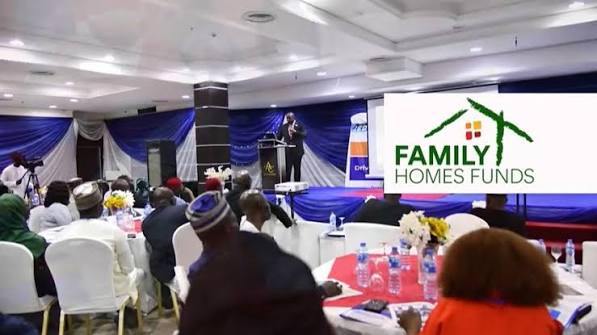
Family Homes Funds Ltd. (FHFL) says it plans to deliver 10,000 social housing units by 2030 under a nationwide programme designed to expand access to affordable housing, empower women and strengthen the construction workforce.
The initiative, contained in the institution’s Social Housing Implementation Plan obtained by the News Agency of Nigeria (NAN) at its Abuja headquarters on Friday, also targets the economic empowerment of 100,000 disadvantaged women and the training of 100,000 artisans in construction-related skills.
FHFL, Nigeria’s social housing finance institution, was established to expand access to affordable housing through innovative financing, strategic partnerships and sustainable housing development.
The institution finances affordable housing projects by collaborating with developers, governments and financial institutions to increase housing supply, reduce the nation’s housing deficit and strengthen the housing value chain.
According to the implementation plan, the Social Housing Programme will be executed in phases across key regions of the country based on identified housing needs and is expected to create sustainable communities while improving livelihoods.
FHFL said the initiative would combine innovative financing models, sustainable construction methods and strategic partnerships to make affordable housing more accessible to low- and middle-income Nigerians.
The document stated that public-private partnerships would play a central role in mobilising investment, facilitating access to land and strengthening institutional support for housing delivery.
To improve affordability, the programme will provide flexible housing finance options aimed at increasing homeownership among eligible households.
As part of its sustainability strategy, the institution said it would promote the use of Alternative Building Technology (ABT) and other low-carbon construction materials to reduce costs and minimise environmental impact.
Housing developments under the programme will also incorporate passive cooling systems, solar energy solutions and natural lighting to improve energy efficiency, while locally sourced building materials will be prioritised to support domestic industries and reduce the environmental footprint of construction activities.
Beyond housing delivery, FHFL said the programme is designed to promote inclusive economic development.
According to the implementation plan, 100,000 disadvantaged women will be empowered through employment, enterprise and other livelihood opportunities created by the programme.
In addition, 100,000 artisans will receive training in modern construction skills to strengthen the housing value chain, improve workforce capacity and expand employment opportunities nationwide.
The document also emphasised community participation, stating that host communities would be actively involved in project planning and implementation to encourage local ownership, sustainability and long-term project success.
It added that governance structures would be strengthened while livelihood initiatives would be integrated into housing developments to improve residents’ quality of life.
FHFL said the programme aligns with Nigeria’s national housing policies and the United Nations Sustainable Development Goals (SDGs).
To enhance affordability and scale up housing delivery, the institution said it would explore grants, subsidies and partnerships with development finance institutions.
According to FHFL, the initiative demonstrates its commitment to reducing Nigeria’s housing deficit through inclusive, environmentally sustainable and community-driven housing solutions.
The institution expressed confidence that the programme would stimulate economic empowerment, strengthen local capacity, create jobs and improve living conditions in participating communities.
FHFL’s mission is to expand access to affordable housing and create employment by leveraging innovative financing, technology, strategic partnerships and a skilled workforce to support sustainable housing development across Nigeria.
The institution also seeks to promote economic growth by supporting infrastructure development and enabling low- and middle-income Nigerians to own decent and affordable homes.
Source:NAN


