

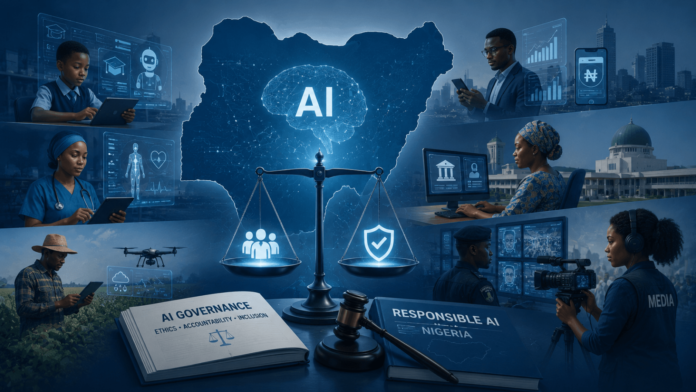
Technology and policy experts have called on the Federal Government to build on Nigeria’s rising global profile in artificial intelligence (AI) by driving job creation, attracting investment and accelerating economic growth.
The call follows Nigeria’s remarkable rise in the Global Index on Responsible AI (GIRAI), where the country climbed 42 places to emerge as Africa’s top-ranked nation and 38th globally.
Speaking with the News Agency of Nigeria (NAN) in Abuja on Monday, the experts described the achievement as a defining moment that positions Nigeria to cement its status as Africa’s technology hub.
Dr. Chidi Nwosu said the country’s dramatic rise reflects the strength of its digital governance and policy frameworks.
“Nigeria’s ascent is a clear indication that our policy frameworks are world-class. Moving from the lower ranks to becoming Africa’s leading ‘Bright Spot’ shows that the Ministry of Communications, Innovation and Digital Economy is getting it right,” he said.
According to Nwosu, the ministry has developed a regulatory framework that successfully balances innovation with digital safety, making Nigeria an attractive destination for advanced AI technologies.
He noted that the country’s latest ranking marks a sharp turnaround from previous years when fragmented digital policies hindered technological development.
Nwosu credited the progress to strategic government initiatives, including the National Artificial Intelligence Strategy (NAIS), the Three Million Technical Talent (3MTT) programme, the implementation of the Nigeria Data Protection Act (NDPA) and the General Application and Implementation Directive (GAID).
He said the policies have strengthened public trust by enhancing data protection, digital safety and human rights safeguards, earning Nigeria high scores on the global AI index.
Also speaking, data governance scholar and venture capital adviser, Prof. Amina Bello, described the ranking as a powerful signal to global investors, saying it presents Nigeria with a unique opportunity to attract foreign direct investment into its digital economy.
She, however, warned that strong policies alone would not be enough to sustain the country’s leadership in AI.
“This ranking is our green light to the global market, but policy alone cannot power the algorithms of tomorrow,” Bello said.
She urged the government to match its policy achievements with significant investments in digital infrastructure to transform the country’s AI success into a major economic driver capable of supporting its ambition of building a one-trillion-dollar economy.
Bello recommended the rapid expansion of local data centers, dedicated fiber-optic networks and other critical infrastructure needed for large-scale AI computing.
She also called for government funding to develop sovereign AI datasets and indigenous Large Language Models (LLMs) capable of understanding Nigerian languages such as Hausa, Yoruba and Igbo.
According to her, developing local AI models would enable Nigeria to control its digital future instead of depending heavily on foreign systems.
Bello further advocated sustained enforcement of data privacy laws, increased funding for the Nigeria Data Protection Commission (NDPC) and the expansion of digital skills programmes into underserved communities.
She added that protecting locally generated data from exploitation by multinational technology companies would strengthen Nigeria’s leadership in Africa while positioning the country as a major player in the global AI-driven Fourth Industrial Revolution.


 by driving job creation, attracting investment and accelerating economic growth.)