

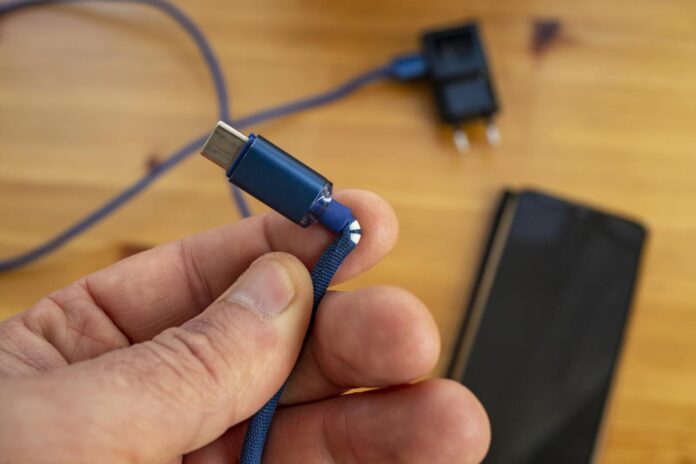
Charging cables, among the most widely used accessories in modern electronics, are more likely to fail due to everyday handling habits than the storage, according to engineers and materials experts.
Research conducted at the Center for Advanced Life Cycle Engineering at the University of Maryland shows that most cable failures occur at the junction where the cable meets the connector, rather than along the length of the wire.
Michael Pecht, founder of the research center, said laboratory testing did not identify improper wrapping as a significant cause of damage.
“We’ve never seen any failures from wrapping them up wrong,” Pecht said, referring to studies conducted for major electronics manufacturers.
This discovery challenges a widely held belief that loosely coiling cables in circular loops extends their lifespan. Instead, experts point to mechanical stress concentrated at the connector as the primary cause of failure.
Robert Hyers, head of mechanical and materials engineering at Worcester Polytechnic Institute, explained that the problem lies in how metals respond to repeated stress.
“On a microscopic level, bending beyond the elastic range makes the bonds between atoms break and reform,” Hyers said. “You get an accumulation of defects… then it snaps.”
This process is consistent with the scientific concept of metal fatigue, where repeated deformation weakens a material over time until it fails.
Common user habits increase
Experts identified several everyday behaviors that significantly shorten cable lifespan:
- Pulling the cable instead of the plug when unplugging
- Using devices while charging at sharp angles, especially in bed or on soft surfaces
- Stretching cables that are too short for the intended use
- Allowing weight or pressure to rest on the cable near the connector
Kyle Wiens, co-founder of repair advocacy organization iFixit, said most failures follow a predictable pattern.
“When cables break, it’s almost always where the cable meets the plug,” Wiens said.
In addition to user habits, cable quality affects durability.
Manufacturers have increasingly adopted braided designs, which use woven materials such as nylon to improve strength and reduce wear.
“The strength and shielding of the braids is going to protect it better,” Wiens said.
Practical recommendations
Based on laboratory findings and expert guidance, the following measures can extend cable lifespan:
- Handle cables by the connector when unplugging
- Avoid bending the cable sharply near the plug
- Use cables of appropriate length to prevent tension
- Keep weight and pressure off connected devices
- Consider higher-quality or braided cables.
Making small adjustments in daily use may reduce replacement frequency and lower both costs and electronic waste.


