

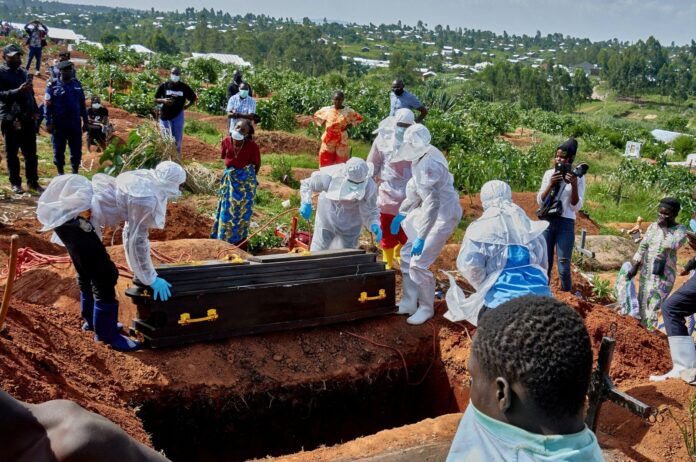
The United Nations has warned that the Ebola outbreak in the Democratic Republic of Congo (DRC) continues to spread, with nearly 3,500 deaths recorded across the country.
UN Special Ebola Coordinator Julien Harneis said in a statement on Tuesday that the deadly outbreak was expanding despite progress in some areas in containing the virus.
Harneis appealed for increased international support to strengthen the response, warning that inadequate resources could allow the epidemic to resurge.
“If we don’t have the resources, the epidemic will come back… it remains a deadly and massive epidemic,” he said.
According to the latest data as of Sept. 12 from the World Health Organization (WHO), 7,200 Ebola cases and nearly 3,500 deaths had been reported across 62 health zones.
Dr Olivier le Polain, Unit Head for Epidemiology and Analytics for Response at WHO, said the virus had spread to seven provinces, covering a vast geographical area.
“Although the response has been unprecedented in its scale, the epidemic continues to expand,” he said.
UN agencies and humanitarian partners have been working with Congolese authorities to contain the Ebola outbreak in Bundibugyo since the emergency was declared in mid-May.
However, responders face major logistical and security challenges in regions affected by years of violent conflict, poor infrastructure and limited development.
Harneis described difficult road conditions, saying some areas were virtually inaccessible because trucks became trapped in mud, while even access by small aircraft remained challenging.
He also cited violence against humanitarian responders as another major obstacle to the campaign.
He said cases had been recorded in Bunia, Ituri province, and Sud-Ubangi at the opposite end of the country, describing the distance between the affected areas as roughly equivalent to the distance from Geneva to Dublin.
Harneis said the $1.3 billion humanitarian response plan was only 49 percent funded, warning that the Ebola outbreak was worsening existing humanitarian challenges.
He said the crisis was contributing to rising hunger, reduced attendance at health centers, increased maternal mortality and disruptions to treatment for people living with HIV/AIDS.
The UN coordinator said the response had made progress by expanding bed capacity but warned that the gains could stall without additional specialized medical care.
“We’ve done a lot of positive work through the scaling up of bed capacity, but unless we get more specialized medical care, we will eventually come to a plateau,” he said.
Harneis urged countries to deploy international emergency medical teams immediately, stressing that additional technical and financial resources were critical to sustaining the response.
He said an additional $1 billion would be required to maintain the Ebola response beyond the first six months.
“There’s been some indication from Member States that they might be prepared to send those teams, but we need far greater support and dedication of those resources,” he said.
WHO’s le Polain said the outbreak would likely require “many, many months” of sustained response before it could be fully brought under control.
READ ALSO: NESREA Urges Industries to Adopt Clustering, Green Financing to Cut Pollution
He said infections were declining in some areas but increasing rapidly in others, particularly North Kivu, where weekly cases had doubled from about 100 to 200.
“We’re worried about particularly Butembo and Katwa,” he said, referring to a major axis in the northern part of North Kivu.


 continues to spread, with nearly 3,500 deaths recorded across the country.)