

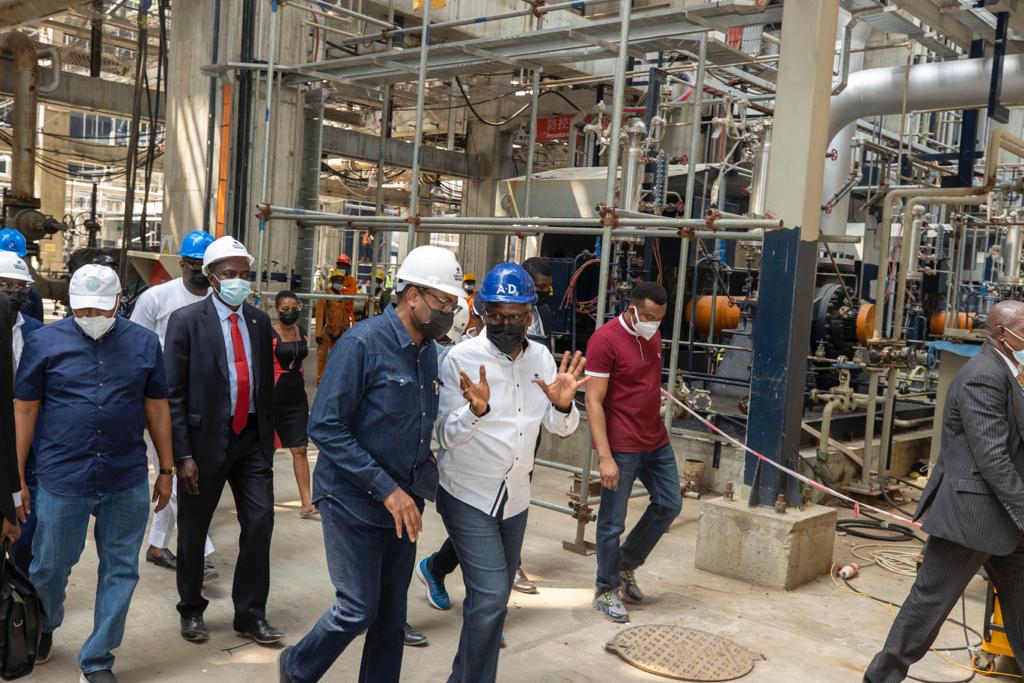
On Monday May 22, 2023, policymakers and captains of industries from across the world converged at the Lekki axis of Lagos state for the commissioning of the world’s Largest Single-Train 650,000 barrels-per-day petroleum refinery, built by Dangote Group. Going by commentaries, the refinery when become fully operational will give a boost to efforts by the Federal Government to make Nigeria self-sufficient in local refining of crude oil and save the scarce foreign exchange used in the importation of petroleum products.
Again, aside from the expert reports that the refinery can meet 100 per cent of the country’s requirement of all refined products: gasoline, 53 million litres per day; diesel, 34 million litres per day; kerosene, 10 million litres per day, and aviation jet, 2 million litres per day, with surplus of each of these products for export, also heartening is the awareness that the refinery is ‘laced’ with the 435 MW power plant that can also meet the total power requirement of Ibadan DisCo of 860,316 MWh, covering five states, including Oyo, Ogun, Osun, Kwara, and Ekiti.
While this huge feat by Alhaji Dangote and his group is being celebrated, the development on the other hand elicits two separate but related reactions.
Foremost, it calls on Africans that it is time to recover their moral and strategic ‘health’ to stand again for freedom, demand accountability from their leaders for poor decisions, missed judgment, lack of planning, lack of preparation and willful denial of the obvious truth about serious and imminent threats that are facing Africans. Dangote’s current milestone is a testament that the time is ripe for Africans to reject the false and horrendous reasons being offered to them by their leaders as an explanation for why the continent is not yet industrialized or developed.
Dangote is not a public office holder in the continent but his latest feat demonstrates a man with an understanding that considering the slow growing economy but scary unemployment levels in the continent, the only way to survive was to industrialize-that Africa as a continent will continue to find itself faced with difficulty accelerating the economic life cycle of its people until their leaders contemplate industrialization, or productive collaboration with private organizations that have surplus capital to create employment.
Take as another illustration, i noted in one of my pervious interventions that one of the popular demands during the fuel subsidy removal protest in January, 2012, under President Goodluck Ebele Jonathan’s administration in Nigeria,, was that the federal government should take measures to strengthen corporate governance in the Nigerian National Petroleum Corporation, NNPC, as well as in the oil and gas sector as a whole. This is because of the belief that weak structures made it possible for the endemic corruption in the management of both the downstream and upstream sectors of the oil and gas industry.
On his part, President Muhammadu in 2015 promised Nigerians a fair deal. But eight years, the three government-owned refineries in the country have not been able to function at full capacity as promised by the present administration for a myriad of reasons that revolve around corruption. Today, if there is anything that Nigerians wish that the FG should accomplish quickly, it is getting the refineries to function optimally as well as make the NNPC more accountable to the people. What happened under president Jonathan has become a child’s play when compared with the present happenings in Nigeria’s oil/gas and electricity sectors.
Broadly speaking, it is not by any standard a good commentary that after over 60 years of independence, African countries continually looks up to other continents for aid. This covertly tells a story of a continent lacking in capacity for taking responsibility for its actions and initiatives for values.
As an illustration, the Chinese development aid to Africa, going by reports, totaled 47% of its total foreign assistance in 2009 alone, and from 2000 to 2012, it funded 1,666 official assistance projects in 51 African countries.
Also rings of apprehension is the awareness that Africa is most-populated in the world with over 1.2 billion people, but sadly represents only 1.4% of the world manufacturing value added in the first quarter of 2020. This is further exacerbated by the fact that out of over 51 countries in Africa as a continent, only South Africa qualified as a member of BRICS, an acronym coined for an association of five major emerging national economies: Brazil, Russia, India, China and South Africa.
This piece is not alone on the economic and industrial backwardness of Africa as a continent. A book entitled: Technology and Wealth of Nations, in like manner chronicled the slanted and unsustainable effort different African governments made in the past to bring their nations out of technological woods, as well as outlined the way forward.
Separate from thoughtfully and masterfully examining the inspirable relationship between technological development and economic progress of nations, the book, deftly argues with facts that the point of sail of all economies is the introduction of the manufacturing sector or the industrial economy. The author establishes that Africa’s prolonged economic plight is centered on the two fundamental challenges of a manufacturing economy.
It traces Africa’s economic backwardness to its roots – a key problem that has kept our policy makers handicapped and our economies crippled. With documented facts on the institutionalized crippling policies and organized sequences of stagnating events of the colonial masters, the author asks: “Why is it that Europe, which hosted the industrial revolutions in the 17th and 18th centuries, did not permit technological education in Africa in about 50 years of colonization, and prefers to send aids afterwards?”
Of course, the above question in my views may not be lacking in merit considering the fact that Africa presently is dotted with projects built with aid from Europe, United States of America (USA) and lately, China.
Whatever the true situation may be, I believed and still believe that there exists something troubling technologically that characterizes Africa more as a dark continent.
On the way out of the continent’s technological debacle and the current wealth disparity among nations (industrial economies), experts believe that the current wealth disparity among nations (industrial economies) represented by highly industrialized Europe, North America and Japan on one hand and most developing (non-industrial economies) countries, in particular, those in sub-Saharan Africa, on the order is primarily the difference in the technical capability and capacity to produce and manufacture modern technologies and to use the technologies to produce and manufacture globally competitive industrial goods and to sustain the commanding tasks of science and technology in the economy.
The disparity it added, has since considerably widened and will continue to widen as long as the developing countries depend almost totally on industrial nations for the technologies and industrial inputs they need to sustain their economies.
Consequently, the only way to bridge the wealth gap is for the developing countries of the world to build their domestic endogenous capabilities and capacities to produce modern technologies and competitive industrial goods in their own economies. He concluded.
Catalyzing the process will again necessitate African leaders borrowing bodies from Asian tigers in order to raise Africa’s industrial soul.
Above all, this piece holds the opinion African leaders must at the present moment of our existence recognize clearly that; public order, personal and national security, economic and social programmes, and prosperity are not natural order of things but depends on the ceaseless efforts and attentions from an honest and effective government that the people elect. They must collectively recognize also that it takes a prolonged effort to administer a country well and change the backward habits of the people.


