

An historian and a professor at Northwest University in Chicago profoundly posited: ”History does not repeat itself. We make new mistakes”. I have thought that over deeply, and would like us to think this over too. See for ourselves if this is true. I find it to be true. History does not repeat itself. We live in Cyberspace now. We own the internet space and some other recent inventions.
Unsurprisingly, Cardinal John Onaiyekan’s recent critique of the federal government echoes a recurring historical pattern in Nigeria where religious leaders confront civilian administrations for economic hardship, only to face swift rebukes from the presidency accusing them of bias or breaching confidentiality.
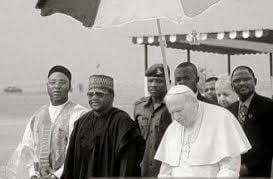
Interestingly, some years ago, about twenty-seven or so: Pope John Paul II, the head of the Catholic Church and sovereign of Vatican City, visited the then military Head of State, General Abacha and delivered a similar message which was also dismissed by the Late Head of State.
We’re all a living witnesses to the eventualities after that visit. The Catholic Bishops are like the forerunners of God. You can’t play God. It is absolutely important to be circumspect, wise and listen to the voice of God.
Similarly, Cardinal John Onaiyekan exemplifies the intersection of moral authority and political governance, serving as an outspoken voice on national affairs, a mediator in interfaith relations, and a critic of state power.
His recent public disclosures regarding a closed-door meeting with the Nigerian presidency highlight the delicate and often tense friction between institutional authority and religious conscience.
President Bola Tinubu’s remark that “all is fair in politics” during a meeting with Catholic bishops sparked swift public concern, with critics like Cardinal John Onaiyekan warning that such an a-win-by-all-means attitude threatens democratic rules and national stability.
This statements: “all is fair in politics”, body languages, previous undemocratic tendencies and actions. I dare say; that, there is conflict of interest which has the potential to facilitate electoral malpractices and cast doubt on the credibility of the entire process.
In essence, electoral malpractices in Nigeria stem from a fundamental conflict of interest where political actors and institutions tasked with upholding democratic integrity are simultaneously incentivized to manipulate outcomes for personal or partisan survival.
THREATS OF DO-or-DIE POLITICAL
Electoral Violence: Treats votes as a battleground, causing fear, harm, and loss of life.
Weakened Trust: Destroys faith in fair voting and public institutions.Exclusion: Leaves out youths, women, and poor citizens from true leadership.
BELOW ARE SOME IMPORTANT ACCOUNTS
“In God’s name and in the name of the poor masses of this nation, I beg all those who are now running the affairs of the nation to sincerely examine their consciences before God, and seek divine guidance in all that they do. One thing that is obvious to all is that we cannot continue along the present path of stagnation, confrontation and general tension in the land. The Lord has been kind and patient with our land. May we not try his patience beyond limits!”
– Excerpt from Onaiyekan’s homily at the Mass of his installation as Archbishop of Abuja in June 1994, upbraiding the Abacha regime for the post-June 1993 crisis in the nation.
Some prophets have never been afraid of calling Caesar to order.
Fast-forward, on the 31/07/26 at an interview with the ARISE NEWS; Cardinal John Onaiyekan warned that Nigeria’s 2027 elections face severe credibility threats because the current administration is allegedly determined to retain power by any means, rendering citizen votes potentially meaningless despite procedural fairness.
KEY CONCERNS RAISED BY ARCHBISHOP ONAIYEKAN
Win-at-All-Costs Mentality: The government possesses vast state resources and is deploying them to secure victory, moving past healthy political competition into absolute control.
Flawed Electoral Commission Appointments: The practice of the president appointing election officials creates systemic bias and public distrust, as standard party members often fill these independent roles.
Value of Votes: True democracy fails when administrative power and institutional control outweigh the actual choices made by citizens at the ballot box. Required Reforms for Credible Elections
Independent Leadership: Removing the power of the president to appoint the leadership of the electoral commission and transferring it to a neutral, independent entity.
Systemic Restructuring: Rebuilding institutional frameworks so that election umpires demonstrate impartiality through actions rather than empty verbal assurances.
Performance Focus: Urging the government to prioritize solving real national problems—such as the economy, corruption, and insecurity—rather than focusing entirely on political survival.
In conclusion; the avoidable challenge is for us not have history repeating itself because those events change, science advances and culture grows and shrinks, humans repeat errors thus repeating history over and over again.
Citizen Richard ODUSANYA. Public Affairs Enthusiast and Good Governance Advocate


