

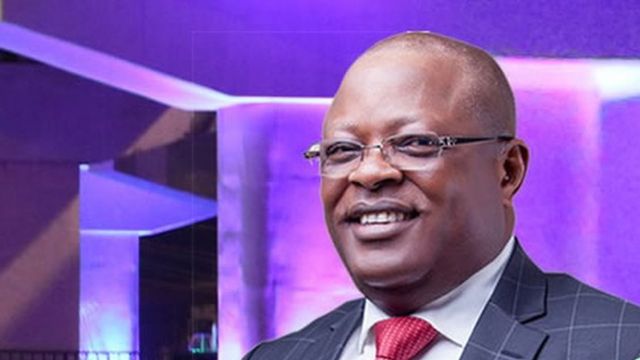
In every democracy, public office is a sacred trust. Those who occupy public positions are entrusted with resources that belong to the people, and they are expected to answer questions from the very citizens they serve. Accountability is therefore not an act of charity by public officials; it is a constitutional obligation.
The foregoing is why recent encounters involving the Minister of Works, David Umahi, have raised an important question that deserves sober national reflection: “Can no Nigerian hold Umahi to account as a public servant?”
The question is not about whether the minister is competent. Neither is it about denying that significant road infrastructure projects are ongoing across the country. Rather, it is about whether criticism, scrutiny and uncomfortable questions have become unacceptable whenever they concern the minister.
During a media briefing on the Lagos-Calabar Coastal Highway project, Laila Johnson-Salami, a female journalist from Arise News, reportedly asked the minister a question that resulted in a sharp public rebuke. Many who watched the exchange believed that the response was unnecessarily harsh and diverted attention from the substance of the question.
Earlier, veteran broadcaster Rufai Oseni had also experienced an unpleasant exchange while seeking clarification from the minister over issues relating to road projects. Instead of a straightforward engagement with the concerns raised, the interaction itself became the story.
More recently, Labour Party’s presidential candidate in the 2023 election, Peter Obi, questioned what he perceived as the Federal Government’s emphasis on constructing new highways while many existing federal roads remain in deplorable condition. Rather than limiting the response to the merits or otherwise of the argument, the conversation quickly shifted toward challenging Obi to a debate.
Similarly, Senator Adams Oshiomhole recently questioned the rationale behind prioritizing certain new projects over the rehabilitation of deteriorating federal roads. The minister reportedly replied that Oshiomhole should have built such roads during his tenure as governor of Edo State.
Beyond these public exchanges, another development has further intensified concerns about the shrinking space for accountability. The Southern Kaduna Peoples Union (SOKAPU) recently alleged that Minister Umahi issued verbal threats against its National President, Engr. Tabara Samuel Kato, following the union’s decision to institute a ₦20 billion fundamental rights lawsuit over the death of 26-year-old nurse Mary Habila. According to SOKAPU, the minister, during a WhatsApp call, allegedly warned that he would “teach you a lesson you will never forget” and that he would “deal with you.” The union has publicly condemned the alleged remarks as an abuse of power and an attempt to intimidate its leadership from pursuing justice through lawful means. While the minister has consistently denied any wrongdoing in relation to Mary Habila’s death, supported calls for a forensic autopsy, and maintained that police investigations have been transferred to Abuja, the allegations by SOKAPU further reinforce concerns about how criticism, legal action and demands for accountability are being received.
Whether these allegations are ultimately substantiated or not, they underscore the importance of public office holders responding to scrutiny through transparency, due process and restraint rather than conduct that could be perceived as intimidating those seeking answers.
Viewed individually, each of these incidents may appear isolated. Taken together, however, they project an image that every criticism of the minister must be met with confrontation rather than clarification. That is not how democratic accountability should function.
Public servants should not expect unanimous praise. In fact, criticism is one of the prices of leadership. Every minister, governor, president or chairman who manages public funds must expect journalists, opposition politicians, civil society organizations and ordinary citizens to ask difficult questions. The appropriate response is not to question the right of the critic to ask. It is to answer.
The media’s constitutional role is to hold those in authority accountable. Journalists are not expected to ask only comfortable questions. Their responsibility is to seek explanations on behalf of the public, particularly regarding projects financed by taxpayers’ money.
Likewise, opposition politicians exist to question government policies and priorities. Their criticisms may sometimes be politically motivated, but that does not automatically invalidate the issues they raise. What matters is whether government can convincingly respond with facts, evidence and sound reasoning.
Perhaps the greatest irony in this entire conversation is that Senator Adams Oshiomhole is not even a member of the opposition. He belongs to the same ruling All Progressives Congress (APC) as Minister David Umahi. Yet, when he questioned the wisdom of prioritizing new road projects over the rehabilitation of existing federal highways, his intervention underscored an important democratic principle: accountability transcends party affiliation. Oshiomhole’s criticism demonstrates that demanding explanations from public officials is neither an act of disloyalty nor partisan hostility. Rather, it is a fundamental responsibility of anyone committed to good governance. If a senior APC senator can publicly interrogate the decisions of a fellow APC minister, it reinforces the fact that accountability should never be reduced to an opposition agenda. Public office is held in trust for all Nigerians, and every public servant, regardless of political party, should be prepared to explain and defend decisions made with public resources.
Even ruling party lawmakers occasionally question ministers. Such oversight strengthens governance rather than weakens it. History shows that great public officials distinguish themselves not merely by the projects they execute but also by their willingness to defend those projects through reasoned engagement.
Former ministers and public officials who earned lasting respect understood that accountability requires patience. They recognized that answering repeated questions, even uncomfortable ones, comes with public office.
In fact, no minister, regardless of his achievements, should appear to place himself beyond questioning.
The Ministry of Works today supervises one of the largest infrastructure budgets in Nigeria. It oversees projects worth trillions of naira. Nigerians therefore have every right to ask why one project is prioritized over another, why certain roads receive attention while others deteriorate, whether procurement processes meet required standards, whether timelines are realistic, and whether taxpayers are getting value for money. These are legitimate governance questions, not personal attacks.
Indeed, robust accountability can strengthen rather than diminish the minister’s reputation. If his decisions are well-founded, then every question presents another opportunity to explain government policy, provide data and win greater public confidence.
Unfortunately, when criticism is met with sharp personal responses, the focus shifts away from the substance of government achievements to the tone of official engagement. That serves neither the minister nor the administration.
Nigeria’s democracy cannot flourish if public questioning is interpreted as disrespect. A democracy where journalists fear asking questions, where opposition figures are discouraged from scrutinizing government decisions, where civil society organizations are intimidated for seeking judicial redress, or where citizens hesitate to express legitimate concerns is one that gradually weakens the very principles upon which accountable governance rests.
Holding public officials accountable should never be mistaken for hostility. Likewise, public officials should never interpret every criticism as an attempt to undermine them personally.
Minister Umahi has earned widespread recognition for his energy, technical knowledge and ambitious infrastructure drive. Many Nigerians acknowledge his commitment to delivering major road projects. Those accomplishments deserve fair recognition.
However, accomplishments do not exempt anyone from scrutiny. In fact, the greater the responsibility entrusted to a public official, the greater the obligation to answer questions from the public.
Ultimately, this conversation extends beyond David Umahi. It concerns every public office holder in Nigeria.
If ministers become increasingly intolerant of scrutiny, what message does that send to other government officials? Will commissioners, agency heads, local government chairmen and directors also begin to regard public questioning as an affront? That would be dangerous for democratic governance. The real test of leadership is not how one responds to applause but how one responds to criticism.
A confident public servant welcomes scrutiny because accountability validates performance. A transparent government does not fear questions because facts speak louder than emotions.
So, the question bears repeating: “Can no Nigerian hold Umahi to account as a public servant?” The answer should be an unequivocal “yes”. Every Nigerian has that right. Journalists have that right. Opposition politicians have that right. Lawmakers have that right. Civil society organizations have that right. Ordinary citizens have that right. Even those who choose to seek answers through the courts have that right. And no democracy can thrive if those rights are diminished, discouraged or treated as acts of insubordination. Accountability is not an inconvenience of public office; it is its very foundation.


