

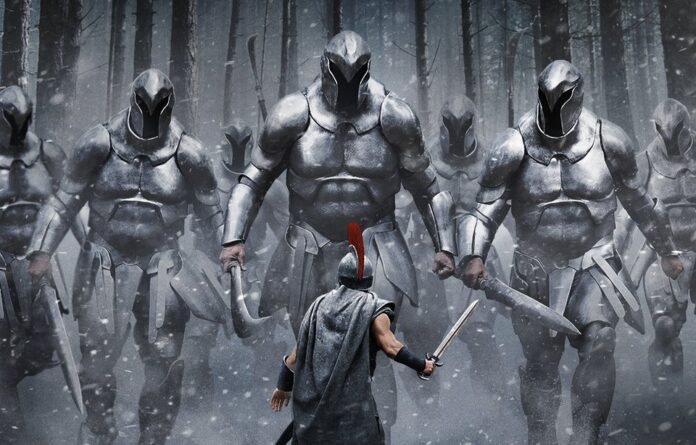
If you want to understand what Christopher Nolan actually did with The Odyssey (2026), if you truly want to look past the marketing and feel the cold, wet salt of it, then you have to look at the sheer, terrifying friction of how it was made.
Released July 17, 2026, with a staggering runtime of 173 minutes (almost 3 hours!!) and a well spent $250M budget, @odysseymovie isn’t just a clean, glossy Hollywood blockbuster. It is a grueling, slow-burning Gothic horror masquerading as a Bronze Age myth.
Produced alongside his longtime partner, Emma Thomas, under their Syncopy Inc. banner, Nolan has crafted something that feels less like a movie and more like a physical relic dragged out of the ocean.
The Frame and the Fury: Stripping the Myth Bare
Nolan’s adaptation begins not with a grand battle, but with a quiet, arresting frame: a solitary man standing in a dimly lit, smoky banquet hall, beginning to tell a story. It’s a direct nod to the oral traditions of Homer’s original epic poetry, the Odyssey, establishing right away that this film is about the weight of memory, the fragility of truth, and how we shape our traumas into legend.
From there, Nolan completely strips away the glamorous, idealized varnish of classic Hollywood sword-and-sandal films. This is a story about the devastating aftermath of a ten-year war. It is a visceral, unflinching metaphor for post-war disillusionment, depression, survival guilt, and the paralyzing effects of PTSD.
Odysseus’s long voyage is less about conquering monsters and more about a broken, hollowed-out commander trying to reclaim his humanity and return to a civilian life that may no longer exist for him spiritually.
The iconic mythological encounters- the Cyclops Polyphemus, the sorceress Circe, the alluring Sirens, and the nymph Calypso- are rendered with psychological dread and physical grit. The monsters are terrifyingly real, represented through masterful practical puppetry and claustrophobic framing rather than polished green-screen trickery.
The Weight of the Real: Why Nolan Rejects the Digital Myth
Most modern epics are built in air-conditioned rooms by programmers staring at green screens, but Nolan doesn’t operate in that world. He wants his actors to feel the heavy, unforgiving reality of the earth, because that is the only way to capture true, unvarnished human exhaustion on screen.
The production used the Draken Harald Hårfagre, a real, historically constructed wooden modern Viking ship capable of navigating treacherous open-ocean waters.
Nolan refused to use a mock-up ship on a gimbal in a studio. The ship had to be completely seaworthy, physically sailing thousands of miles from Morocco to Greece to Sicily as the production moved locations. To Nolan, the physical “weight” of the ship battling the actual tide was far more crucial than textbook Bronze Age design.
When Critics online protested that Odysseus’s ship looked more like a towering Viking longship than a historically accurate Bronze Age galley, Nolan’s team revealed they were physically utilizing the Draken Harald Hårfagre, a real, fully seaworthy wooden longship, because the physical weight of a real vessel fighting actual ocean currents was infinitely more valuable to the film’s gritty reality than textbook historical perfection.
Imagine the staging of the legendary Trojan Horse: In any other director’s hands, this would be a towering CGI marvel. Instead, Nolan built a massive, multi-ton physical horse-shaped wooden structure and dragged it half-submerged through the crashing, freezing surf of the beach.
When you see the Greek soldiers cramped inside, struggling for breath as the tide rushes in and breathing through literal straws to survive, those aren’t actors hitting marks, that’s real, claustrophobic panic and sweat.
To capture the midnight destruction of Troy without the plastic, artificial glare of modern movie lights, Hoyte van Hoytema custom-engineered hundreds of portable LED rigs tuned to mimic the exact, erratic flicker of real firelight, allowing Nolan to shoot in a raw, 360-degree space that preserved the pitch-black, terrifying void of the ancient world.
The production didn’t sit in a studio tank; they embarked on a grueling, over-six-country trek. They went to the volcanic, alien black sands of Iceland; the arid, wind-swept expanses of Al-Dakhla in Western Sahara and Morocco; the rugged, historic ruins of Sicily, Italy; the ancient coasts of Greece; the open, uncooperative, freezing waters of the North Sea in Scotland, and the deep water tanks of Malta; including very specialized, massive practical sets constructed on the Universal Pictures lot.
Nolan built full-scale, historically accurate Greek triremes and dropped his cast directly onto the open ocean. When you see Odysseus’s crew pulling those massive wooden oars, fighting seasickness, vomiting, and with the genuine fury of the waves, you are watching real physical labor. You can’t program that kind of weariness into a computer.
The Pure Analog Truth: 100% IMAX 70mm
For decades, filmmakers have used IMAX cameras for selective, high-octane action sequences. Nolan decided to do what has never been done before: he shot The Odyssey ENTIRELY on IMAX 70mm film cameras.
Picture this:
[ THE DIGITAL PIPELINE ] ─> Sensor ─> Hard Drive ─> Instant Monitor Playback
[ THE NOLAN PIPELINE ] ─> IMAX 70mm Film ─> Metal Can ─> Shipped to Lab ─> Developed Dailies
This isn’t just a technical flex; it dictates the entire energy on set. Because they are shooting on physical, heavy, incredibly loud film reels, there is NO instant digital playback. There are no monitors for actors to crowd around.
Furthermore, because IMAX cameras are notoriously loud, sounding like a lawnmower running right next to the actors, Nolan and the production had to engineer brand-new 70mm camera system called the “Keighley” and a sound-muffling enclosure (the “blimp”), specialized quiet camera housings to capture the actors’ intimate dialogue without drowning them out.
The “Blimp”: Historically, true IMAX cameras were too loud for filming dialogue on set. Nolan’s team developed a specialized housing for the massive cameras to finally capture synchronized sound without needing to loop dialogue in post-production.
Because of the massive scale and mechanical requirements of projecting these film reels (which can weigh 500 lbs and stretch over 10 miles), only around 40 theaters worldwide are equipped to show it in true analog 15-perforation, 70mm IMAX format.
The movie’s exact 173-minute runtime was actually dictated by pure mechanical gravity, pushed right to the absolute physical limit of the projector consoles, which cannot hold or spin a platter longer than 180 minutes without structurally shattering the machinery.
Nolan and his master cinematographer, Hoyte van Hoytema, shoot with absolute, razor-sharp intent, seal the physical film cans, and ship them off to a laboratory for development. It requires an almost religious level of trust. The actors have to deliver perfection in the moment, knowing there is no safety net of “checking the monitor” to see how it looked.
The result on the giant screen is a hyper-textured, breathtaking depth of field where every grain of sand, every tear, and every drop of ocean spray feels close enough to touch.
Staging the Flesh: The Cast Under the “god” of the Set
On a Christopher Nolan set, there is a distinct, almost sacred atmosphere. Phones are strictly banned. There are no chairs. You are either actively creating, or you are getting out of the way.
Because Nolan doesn’t use email or smartphones, his direction is incredibly intimate, direct, and demanding. He doesn’t send scripts digitally; he personally flies across the globe to hand-deliver highly classified, un-copyable red paper scripts directly to his actors, sitting in the room while they read it.
This absolute devotion to the craft is why his cast looks at him with a mix of reverence and awe, willingly subjecting themselves to intense physical transformations:
Matt Damon (Odysseus): Damon delivers a towering, fractured performance. Nolan refused to use artificial prosthetics or fake beards under the unforgiving gaze of the IMAX lens. Damon spent an entire year growing a thick, wild, natural beard to capture the physical toll of a decade at sea. He starved his body down to a lean, sinewy 167 pounds, embodying a brilliant strategist who is slowly being hollowed out by survival guilt and PTSD.
Anne Hathaway (Penelope): Instead of a passive, weeping queen waiting at home, Hathaway’s Penelope is a masterclass in silent, boiling rage. She plays a political survivor navigating a terrifying, continuous bacchanal of greedy suitors invading her palace, carrying the weight of her household with a razor-sharp dignity.
Lupita Nyong’o (Helen of Troy / Clytemnestra): In an absolutely brilliant casting stroke, Nyong’o plays a dual role. By casting her as both Helen (the spark that lit the war) and Clytemnestra (the bitter wife waiting to murder Agamemnon upon his return), Nolan creates a haunting, thematic echo about the price women pay in the wake of men’s violent crusades.
Zendaya (Athena): Rather than a floating, glowing CGI deity, Zendaya’s Athena is staged with a fierce, grounded, and intensely strategic presence. She appears to Odysseus not as a magical savior but as a gritty, driving conscience that pushes him to endure.
Robert Pattinson (Antinous): Reuniting with Nolan, Pattinson is a revelation as the lead suitor. He plays Antinous not as a loud, cartoonish villain, but as a sleek, treacherous, sociopathic aristocrat who makes your skin crawl with a single, calculating look of pure entitlement.
Tom Holland (Telemachus): Holland sheds any trace of his youthful, boyish charm to play Odysseus’s son. He portrays a prince crushed under the massive, haunting shadow of a legendary father who might just be a ghost. With less than 15 years between him and Anne in real life, this is one of the most significant metaphors in this story.
Samantha Morton (Circe): Morton’s Circe is pure psychological body-horror. She doesn’t wave a magic wand to turn men into beasts; she literally kneads, sculpts, and molds their physical flesh like raw clay.
Bill Irwin (Polyphemus): The Cyclops is a haunting, Goya-inspired creation whose staggering, awkward physical movements evoke as much tragic empathy as they do terror.
Travis Scott (The Bard): In a brilliant stroke of genius, Nolan cast the artist to perform the rhythmic, spoken-word oral poetry of the ancient world. By doing so, Nolan directly links the roots of epic storytelling to modern rap, bridging a 3,000-year gap in a single, mesmerizing sequence.
The Bottom Line
With its massive scale, The Odyssey is a monumental risk that paid off entirely because of its refusal to compromise.
Backed by a thunderous, drum-heavy score by Ludwig Göransson that crescendos into pure sonic violence during the film’s final battle, the movie is a masterpiece of sensory immersion.
It is a film about the toxic, lingering aftermath of war, a story where the monsters are real, but the true horror is the quiet, agonizing journey of trying to find your way back to the person you used to be.
Nolan isn’t just a director, he’s the last madman keeping the physical soul of cinema alive. From bending reality in Inception and Interstellar to capturing the terrifying flash of Oppenheimer, his entire career has been a war against digital shortcuts, building massive, concrete monuments out of real sweat, real exhaustion, and heavy 70mm film.
By stripping away the digital noise and forcing his cast to battle the real, physical elements of our earth, Christopher Nolan didn’t just adapt a myth; he built an altar to the dying art of pure, analog cinema.
EXTENDED ARTICLE AVAILABLE AT https://x.com/arinzechukwum_/


