

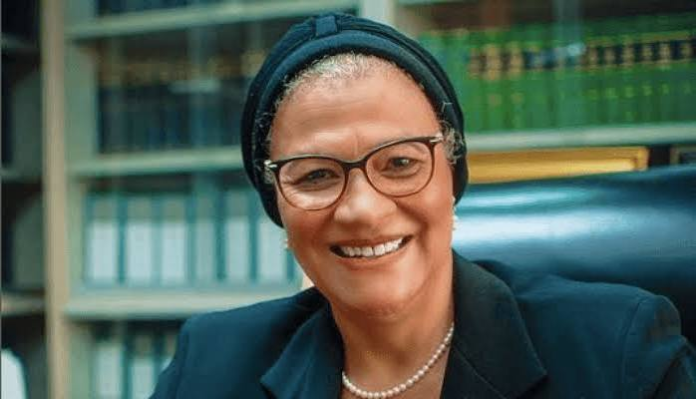
Retired Supreme Court Justice Amina Augie has urged politicians to respect their parties’ constitutions and strengthen internal democracy to prevent avoidable political disputes from ending up in court.
Augie made the call on Tuesday in Bauchi while speaking as a panelist alongside the National Chairman of Ghana’s National Democratic Congress (NDC), Johnson Nketia, at a democracy dialogue organized by the Goodluck Jonathan Foundation (GJF).

The dialogue was themed, “Beyond Elections: Can Political Parties and the Judiciary Alone Save African Democracy?”
The former Supreme Court justice said adherence to internal party rules would help prevent intra-party disputes from escalating into election petitions and further burdening the courts.
She said courts did not deliberately seek political cases but were often drawn into them when politicians violated party guidelines or failed to resolve internal conflicts.
“Left to us in the judiciary, if you keep us out of the matrix, we can even rest,” Augie said.
She expressed concern over the lack of discipline within political parties, saying politicians often created avoidable crises and subsequently relied on the courts to resolve them.
Augie warned that persistent political disputes could overwhelm the judiciary and undermine public confidence in the courts.
She stressed that judicial officers must recognize that public trust was fundamental to the authority and effectiveness of the judiciary.
READ ALSO: NHRC Urges Nigerians to Reject Identity Politics Ahead of 2027
“The independence of the judiciary has nothing to do with benefiting the judge; it is a right of the citizen.
“A citizen has the right to go to court and expect that the judge applying the law knows the law, has read the case, and will do the job according to what is seen,” she said.
However, Nketia disagreed with the suggestion that the judiciary should remain outside politics, arguing that courts have a constitutional responsibility to check and restrain the exercise of political power.
He said political parties and citizens would naturally turn to the judiciary when democratic rules were violated.
“I very much disagree with the suggestion that the judiciary should have nothing to do with politics. In fact, it is the opposite, because we call on the judiciary to come and intervene.
“The judiciary has a function to check and restrain the exercise of power in society, so no aspect of the life of society should be out of bounds for the judiciary,” Nketia said.
Responding to questions on landmark electoral rulings in Africa, including the annulment of presidential elections in Kenya and Malawi, Nketia said courts must remain the ultimate arbiters when electoral bodies fail to comply with legal requirements.
“If you are required to conduct elections according to certain laws, it is the duty of the judiciary to find out whether the election meets the standards required by the law.
“If it doesn’t meet the standards, they will save the whole country by declaring that the election should be canceled. The outcome of elections is essentially the decision of the voters,” he said.
Earlier, President of the Court of Appeal, Justice Monica Dongban-Mensem, commended the foundation for organizing the dialogue, describing its theme as timely given the democratic challenges confronting the continent.
Represented by Justice Mistura Bolaji, Dongban-Mensem said Africa’s evolving political, technological and socio-economic landscape required continuous discussions on the relationship between political institutions and the judiciary.
“The strength of democratic governance is anchored in strong and robust institutions, dedicated adherence to constitutionality, respect for the rule of law, and an enduring commitment to justice, accountability, and the peaceful resolution of disputes,” she said.
She highlighted the distinct constitutional responsibilities of political institutions and the judiciary, describing the judiciary as an impartial interpreter of the law, guardian of constitutional order and protector of citizens’ rights and liberties.
Dongban-Mensem said political parties, on the other hand, remained critical vehicles for democratic participation, political representation and leadership development.
Despite their different mandates, she noted that both institutions had a shared responsibility to preserve democratic legitimacy and sustain public confidence in governance.


