

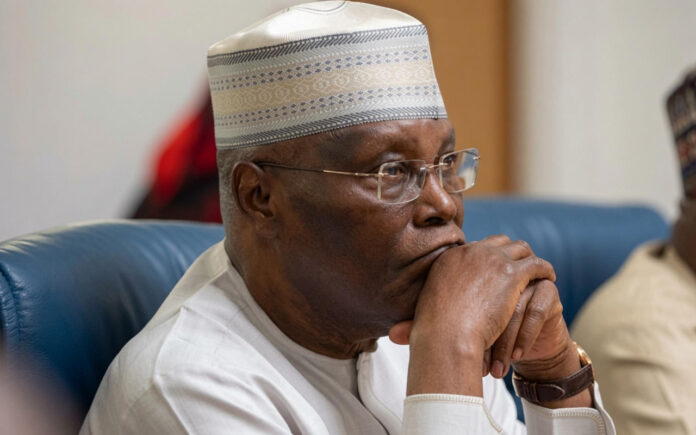
Former vice president, Atiku Abubakar, has finally voiced what millions of Nigerians have suspected for two decades: that former President Olusegun Obasanjo has never forgiven him for standing in the way of the infamous third-term project! Whether the claim is accepted as the whole truth or only part of it, it breathes fresh life into one of the darkest chapters of Nigeria’s democratic history.
The third-term saga was never an ordinary political disagreement; it was a battle for the soul of Nigeria’s democracy. At issue was a simple but sacred constitutional provision that no elected president should govern beyond the two terms prescribed by law. Yet, powerful forces allegedly sought to bend the Constitution to satisfy the ambition of one man. Nigerians, civil society groups, the media and courageous legislators rose in unison to resist the plot. Top on the lost of the biggest voices and most visible faces of that resistance was Atiku Abubakar.
If Atiku’s recent remarks accurately reflect the principal source of Obasanjo’s never-ending hostility, they help to explain why several efforts to reconcile both men have r proved elusive. Political disagreements are common in democracies, but disputes over constitutional limits and the transfer of power often leave enduring scars long after the immediate conflict has ended. Yes, political rivalries come and go, but resentment born out of the defence of constitutional democracy carries far greater significance. Indeed, political observers have, for long, believed that the disagreement between the two titans cuts deeper than ordinary political competition. Essentially, it was all about saving the soul of Nigeria and, specifically, whether Nigeria would remain a republic governed by laws or become another state where constitutions are trampled upon and rewritten at the behest of those in power.
Supporters of Obasanjo will rightly point to his administration’s accomplishments. Under his leadership, Nigeria secured historic debt relief, expanded telecommunications, strengthened macroeconomic management and restored a measure of international credibility after years of military rule. These achievements deserve their place in history but, if truth be told, no amount of economic reform can erase the stain left by the third-term controversy. Nations remember leaders not only for what they built but also for the precedents, positively or negatively, that they attempted to install. The mere thought that a democratically elected president sought to elongate his constitutional stay in office was enough to cast a long shadow over an otherwise consequential presidency.
Ironically, the greatest legacy of the third-term saga may not belong to those who promoted it but to those who defeated it. Nigeria’s democracy survived because institutions, lawmakers and ordinary citizens refused to surrender constitutional governance on the altar of personal ambition. Their collective resistance sent a powerful message to the effect that presidents are temporary, but the Constitution must endure. Atiku’s latest remarks therefore deserve attention, not because they revive an old feud, but because they remind Nigerians how fragile democracy can be.
History teaches that democracies seldom collapse overnight; rather, they are weakened when constitutional safeguards are treated as trashable and violable principles. The third-term controversy was one such moment of danger, as it exposed a recurring weakness in Nigerian politics which, basically, is the tendency to personalise national issues. Whether one supports Obasanjo or Atiku is neither here nor there; the more important question is whether present and future leaders have learned that constitutional limits are inviolable boundaries to respect. If the answer remains hazy, then Nigerians have learnt nothing from the lessons of the botched 2006 third-term agenda.
If Atiku’s resistance to tenure elongation is, indeed, the reason for the lingering hostility between the duo, then he will find that many Nigerians are prepared to judge him favourably. Still, the ghost of the third-term agenda has never truly laid to rest and, even today, the issue has continued to dominate political conversations and public suspicion. Atiku has, once again, given it a voice. The burden is now on the country’s political class to ensure that such a dangerous experiment is never revisited.
We cannot shy away from the fact that democracies do not die solely through coups and revolutions; they also die when leaders begin to believe that constitutions exist to serve them, rather than that they existing to serve the Constitution.
Magaji <Magaji778@gmail.com> writes from Abuja


