

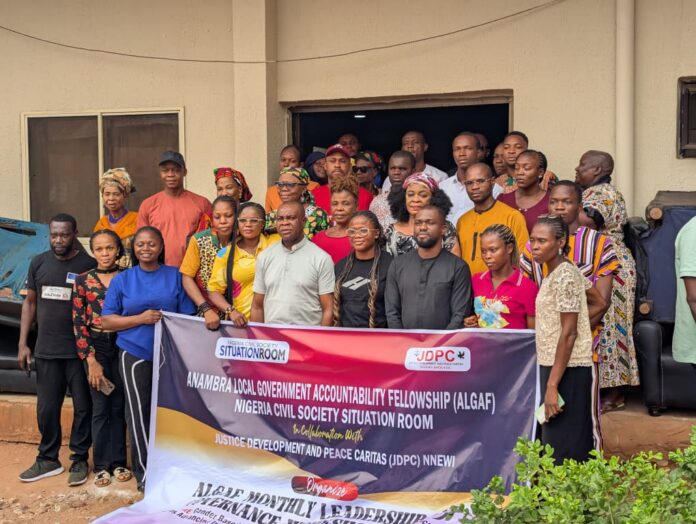
The Justice Development and Peace Caritas (JDPC), Nnewi Chapter, Anambra state has identified active participation of citizens as a critical driver of efficient and accountable local government administration in the State and across Nigeria.
Director, JDPC, Nnewi, Rev Fr Ben Okolo stated this during the Anambra Local Government Accountability Fellowship (ALGAF) Monthly Leadership and Governance Workshop (MLGW), organised by JDPC Nnewi in collaboration with the Nigeria Civil Society Situation Room, with funding support from the UK Foreign, Commonwealth and Development Office (FCDO).
The January edition of the workshop had as its theme, “Gender-Based Violence and Power Mapping for Strategic HDI Advocacy Towards Advancing Inclusive Local Governance at Community Levels in Anambra State.”
Fr Okolo commended the UK FCDO and the Nigerian Civil Society Situation Room for their sustained support of the fellowship, noting that the initiative was designed to strengthen grassroots governance through informed civic engagement.
He recalled that the fellowship began with the careful selection of fellows, followed by targeted training focused on advocacy approaches, coordination strategies, and local government administration.
“We strategically identified key issues in our local government areas and conducted trainings on research methodology, advocacy strategies, public speaking, persuasive communication, storytelling, policy analysis, social media advocacy, rights-based advocacy, and disability rights laws,” he said.
According to him, the Monthly Leadership and Governance Workshops serve as platforms for continuous learning, peer review, and strategic visibility of governance challenges identified by fellows at the local government level, with expert resource persons facilitating structured and interactive sessions.
“As we continue in this fellowship, let us keep pushing for greater inclusivity in our society — politically, economically, religiously, and otherwise,” Fr Okolo urged.
Presenting a paper titled “Gender, Human Rights and Civic Participation: Advancing Inclusive Local Governance from the Community Level,” civil society activist and Executive Director, Gender Perspective and Social Development Centre (GPSDC), Eucharia Anekwe, highlighted the strong link between gender equity, human rights, and effective local governance.
Anekwe argued that inclusive governance at the grassroots requires deliberate efforts to dismantle gender-based barriers and institutionalise human rights-based approaches within local government systems.
“Local governments are duty bearers responsible for respecting, protecting, and fulfilling the rights of citizens within their jurisdictions,” she said.
The GPSDC boss outlined key human rights principles guiding local governance, including participation and inclusion, equality and non-discrimination, accountability, and transparency.
“Information on policies, budgets, and decisions must be accessible to all citizens, irrespective of gender, age, disability, or social status,” Anekwe stressed.
Another resource person, Dr Onyeka Ebenebe, spoke on “Stakeholders and Power Mapping for Strategic Human Development Index (HDI) Advocacy at the Local Government Level,” advising ALGAF fellows to equip themselves with accurate data and relevant information when engaging local government officials, describing power mapping as a crucial advocacy tool.
“You must identify power influencers who can help you reach duty bearers, determine the right timing and platforms for engagement, and understand the temperament of those you are engaging,” Ebenebe counseled.
The Programme Manager of JDPC Nnewi and ALGAF Team Lead, Onyekachi Ololo charged the fellows to remain committed to the core objective of the fellowship.
“The ultimate goal is to revive local government administration and make it people-oriented. This cannot happen without active citizen involvement,” he noted.
Ololo reminded the fellows of their responsibility to administer survey forms to community members to capture citizens’ experiences with local government officials, noting that the findings could inform future advocacy and policy interventions.
“If we can convincingly present the people’s views across the state, it may lead to another meaningful intervention,” he added.


