


The Anambra State House of Assembly has called on Governor Chukwuma Soludo to direct the Anambra State Internal Revenue Service (AIRS), relevant ministries and the 21 local government chairmen to harmonise taxes and levies collected across the state to end multiple taxation and the exploitation of traders and business operators.
The call followed growing complaints by traders and business owners over overlapping taxes, conflicting levies and alleged illegal revenue collections in markets and commercial centres across the state.
The House made the resolution through a motion sponsored by the member representing Ogbaru Constituency One, Noble Igwe, who warned that multiple taxation was imposing undue financial burdens on small and medium-scale businesses, discouraging investment and increasing the cost of doing business.
Igwe observed that various ministries, departments and agencies of the state government, alongside local government administrations, were independently collecting different levies, creating confusion over approved rates, payment schedules and authorised revenue collection channels.

He said the absence of a coordinated revenue administration system had also created opportunities for illegal collectors and touts to exploit business operators, thereby undermining public confidence in the state’s revenue system.
Contributing to the debate, the member representing Aguata Constituency Two, Tony Muobike, described the motion as timely, saying the House had a responsibility to protect residents from undue exploitation.
Muobike recalled that the Assembly had last year passed the Anambra State Taxes, Levies and Presumptive Tax List 2025, which, among other provisions, introduced harmonisation and anti-roadblock rules restricting tax and levy collections to approved schedules and prohibiting illegal collections.
He, however, regretted that the relevant government agencies had apparently failed to implement the provisions of the law, resulting in continued duplication of taxes by state and local government authorities.
“This motion would compel the state government to take necessary action and address the hardship being experienced by traders and other business operators,” he said.
Also contributing, the member representing Anambra East Constituency, Obi Nweke, said multiple taxation could cripple businesses, insisting that the major challenge was not the absence of enabling laws but poor implementation.
Nweke called for the establishment of a committee to ensure proper harmonisation of taxes, warning that some revenue collectors often introduced new names for levies that were essentially the same charges.
He said, “Government must clearly identify the taxes payable to each tier of government to prevent confusion and protect ordinary residents from bearing the consequences of a disorganised revenue collection system.”
READ ALSO: South Africa Summons Fani-Kayode Over Diplomatic Row With Nigeria
On his part, the member representing Nnewi North Constituency, Augustine Ike, cited a recent protest by traders at Nkwo Nnewi Market over multiple taxation, which he said took about three days to resolve.
Ike disclosed that traders who were expected to pay a stallage fee of N35,000 were also being charged an additional N17,000 as a penalty, even though the payment window had not elapsed. He added that many traders complained of paying several levies whose purposes they did not understand.
He said harmonising the taxes would enable traders to know exactly what they were required to pay and protect them from arbitrary charges.
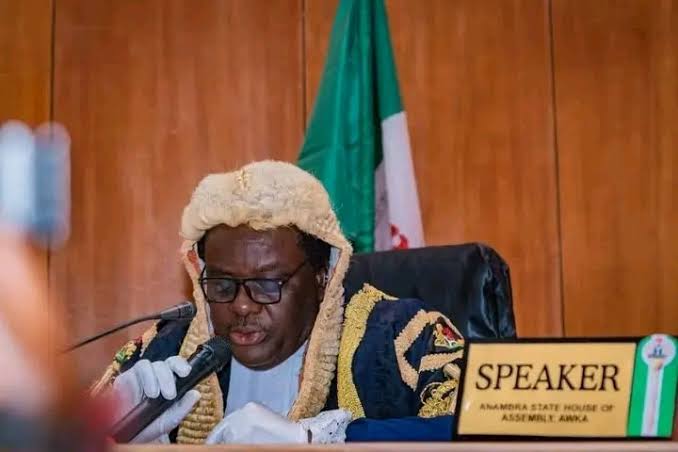
In his remarks, the Speaker of the House, Somtochukwu Udeze, said he had received several complaints about multiple taxation, particularly conflicts arising from revenue collections by state and local government authorities.
Udeze assured that the Assembly would deploy its oversight functions to address the problem, directing relevant committees to examine the complaints and ensure that residents’ interests were adequately protected.
He stressed the need for the state government and local government authorities to harmonise their revenue collection processes to eliminate multiple taxation and reduce the financial burden on individuals and businesses.
The proposed harmonisation, according to the lawmakers, would not only protect business operators from exploitation but also improve the ease of doing business, curb revenue leakages and strengthen public confidence in the state’s fiscal administration.