

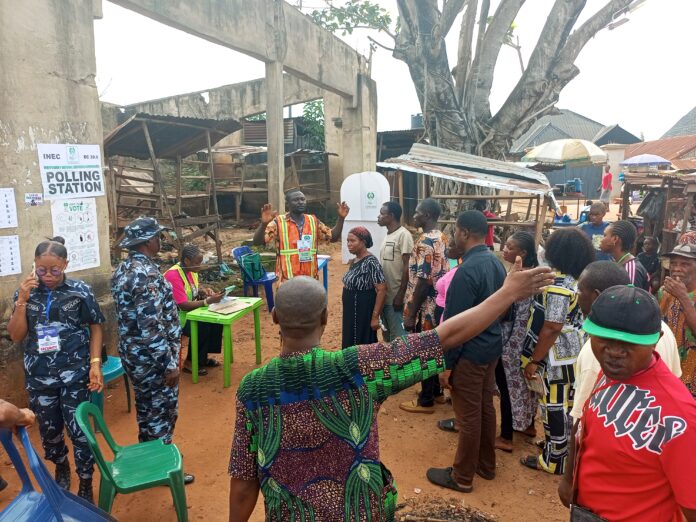
Despite the numerous irregularities that characterised the conduct of the November 8 Anambra Governorship Election, a non-governmental organization, Kimpact Development Initiative, KDI, insists it is not enough to alter the outcome of the election.
The group stated the position in its final assessment of the election, during which it was an accredited observer, and engaged across the pre-election, election and post-election phases, through the Strengthening Electoral Accountability Project (SEAP), supported by the UK Foreign, Commonwealth and Development Office (FCDO).
Under the project, the group intervened in four critical areas, including the Nigeria Election Violence Education and Resolution (NEVER), Ballot Integrity Project (BIP), Political Finance Monitoring and Citizen Participation through Technology.
In a post-election press conference, the KDI identified issues around vote-buying; election-related violence and post-election security incidents; undue interference by political party agents, as well as malfunctioning of the Bi-modal Voter Accreditation System, BVAS, among others.
The group noted that while these findings highlight areas requiring procedural strengthening, the inconsistencies identified are minute in scale and insufficient to alter the overall outcome of the election.
It expressed the hope that the INEC would use the review as an opportunity to deepen transparency, reinforce public trust, and strengthen Nigeria’s electoral results-management architecture ahead of future polls.
“The Anambra governorship election demonstrated areas of operational progress, particularly in the high functionality rate of BVAS devices, and the early publication of polling unit results on the INEC Result Viewing Portal. These gains indicate that elements of Nigeria’s electoral reforms are taking root.
“However, the election also exposed persistent structural and procedural weaknesses that collectively undermine electoral integrity. The election reflects a system that can deliver credible outcomes when its mechanisms function properly, but remains hindered by gaps in enforcement, training, coordination, and accountability.
“Addressing these weaknesses is essential to strengthening public trust and upholding Nigeria’s democratic process,” it said.
The KDI recommended that the INEC should up its Operational Readiness and Logistics to strengthen pre-election logistics planning to ensure more consistent poll opening times across all polling units, as well as improve coordination between RACs and presiding officers to reduce delays linked to movement, incomplete materials, and route confusion.
On polling unit setup and ballot secrecy, the group advocated the enforcement of mandatory polling unit layouts that prioritise ballot secrecy, and deployment of supervisory officers with explicit responsibility to ensure that secrecy is maintained before voting begins.
It further called for the conduct a full audit of registered voter data to resolve discrepancies across pre-election figures, LGA collation announcements, and EC8A entries on IReV.
On the part of security agencies, the group suggested the adoption of a transparent deployment model informed by early warning and risk assessments and improved coordination between officers and INEC officials to ensure clear communication on when intervention is required.
“There is also the need to enhance inter-agency coordination to prevent clashes such as the shooting between soldiers and police after the election.
“Internal accountability mechanisms should also be strengthened for officers who misuse force or fail to act when violations occur.
“There is also the need for the National Assembly to amend the Electoral Act to clarify and expand the powers of security personnel to intervene immediately in cases of vote buying, intimidation, and obstruction, without requiring direct instruction from presiding officers. This will prevent the passive enforcement gap observed during the election.
“Civil Society Organisations (CSOs) and Election Observer Groups should intensify targeted campaigns on ballot secrecy, the dangers of vote trading, and how these practices weaken the electoral process,” the group suggested in the statement.


