spot_img
spot_imgspot_img
October 7, 2026 - 9:11 PM

Afreximbank Advances the AfCFTA at 2nd Russia-Africa Economic Forum

—

With the prevalent dependency of African economies on external supply of fertilizers and grains and up to 30% of cereals imported from Russia, ensuring that critical trade flows continue uninhibited, remains the priority of Afreximbank and its African member states.
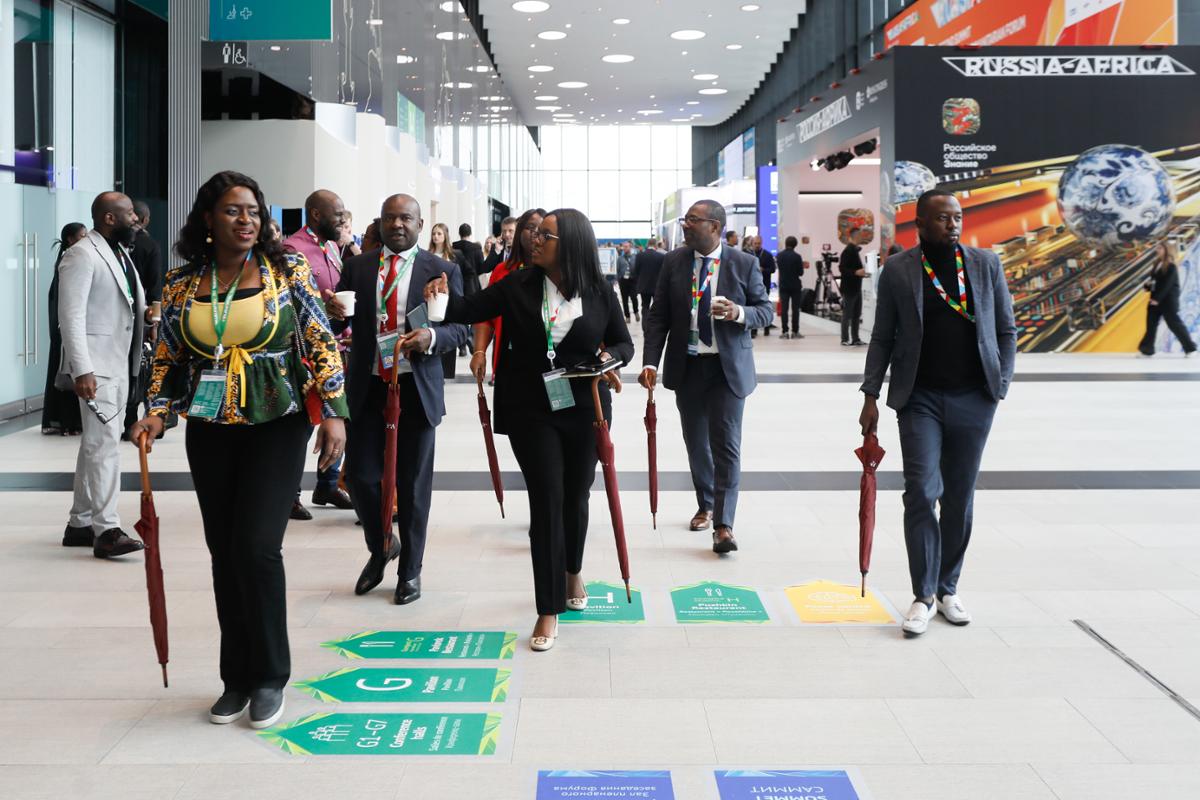
The lingering global food security challenges and the critical role trade with Russia plays in guaranteeing Africa’s food security was at the core of discussions for Afreximbank at the second Russia African Economic and Humanitarian forum which held at St. Petersburg from the 27th to the 29th of July, 2023.
Addressing the summit, Professor Benedict Oramah, President and Chairman of the Board of Directors of the Bank, said in his remarks that “Afreximbank is working with the African Union Commission, the United Nations System and Russian partners to use the Africa Trade Exchange (ATEX) e-commerce platform to facilitate seamless flow of goods and payments in any currencies chosen by sellers and buyers in a transparent manner. The platform pools Africa’s demand for grains and fertilizers, and the Bank has placed an aggregate credit limit of $3 billion to support these transactions.”
“Beyond the food security priorities and in line with the Bank’s mandate, Afreximbank and the Russian Export Centre are collaborating to promote trade and investments in other critical sectors, with focus placed on activities that will help integrate the African economy and advance the implementation of the African Continental Free Trade Agreement (AfCFTA),” continued the President.
Afreximbank offers a portfolio of solutions to support investments in agriculture, industrial parks and critical infrastructure, in partnership with the Russian Export Centre, and supports African investors seeking to explore opportunities in Russia.
Trade flows between Africa and Russia reached almost $20 billion in the four years to 2021, as against about $10 billion in 2015, despite the COVID-19 pandemic and other significant global crises, bringing it closer to the target of $40 billion by 2026. It is expected that the trade flows could double over the next four years.
Russian companies are actively redirecting shipments from tradition export markets to Africa and their industrial exports to African countries could grow by more than 40% this year, First Deputy Industry and Trade Minister Vasily Osmakov said.
“Due to the fact that traditional, comfortable markets on which it is simpler to work have closed, we and industry are orienting ourselves toward new markets, key among which, of course, is the African market. Particularly when it comes to machine building in all its manifestations, chemicals, metal products and so on,” Osmakov said at the Russia-Africa forum.
“The growth of specifically our industrial exports to Africa could exceed 40% for the year,” Osmakov said.
The acting head of the Federal Customs Service, Ruslan Davydov also said that African countries’ share of Russia’s total visible trade turnover has grown to 3.7% this year from 2.3% in 2022.
According to the Deputy Industry and Trade Minister, Vasily Osmakov, Russia’s main exports to African countries at the moment are fertilizer, forest products and metal products. He added by explaining that the government would be adjusting measures of support to the needs of exporters to African markets.
“This export market needs its own recipes for support, logistics support – subsidies for logistics costs, special subsidized credit programs. And right now we are adapting instruments specifically for new markets, for entering new African markets, within the context of International Cooperation and Exports national project. In other words, we are increasing the level of subsidies for logistics costs, we’re making support for loans specifically more preferential,” Osmakov said.
Russia has completed the preparation of the regulatory framework for the creation of a Russian Industrial Zone in Egypt and expects to start building infrastructure by the end of this year. Russia needs to prepare a comprehensive strategy for promoting Russian products in African markets. The creation of an industrial zone in Egypt will give Russian companies access to the entire African market.
Industrial zone residents also receive benefits for the import of equipment and materials, the opportunity to receive an income tax deduction, and are exempt from property taxes. This is a comprehensive and systemic approach determining robust developing trade with African partners.
Russia and Egypt signed the intergovernmental agreement on creating the Russian Industrial Zone in the Suez Canal economic zone as far back as 2018.
“It is important that cooperation with Africa has reached a new level in recent years. We intend to continue to develop it: to promote trade and investments, deepen cooperation,” Putin said in his greetings to the participants and guests of the Russia-Africa summit.
The first Russia-Africa Economic Forum held in Sochi in 2019 had committed to systematically pursue stronger trade and investment ties between Russia and Africa and to reset socio-economic relations, in addition to moving the two-way trade to $40 billion by 2026.
Similar to the first such event in 2019, the summit was held under the motto: “For Peace, Security and Development.” The second Russia-Africa Summit, attended by top political and business leaders from Russia and Africa, along with an economic and humanitarian forum, took place in the Russian city of St. Petersburg on July 27-28.
0 0 votes
Article Rating
Subscribe
Notify of
0 Comments
Oldest
Newest Most Voted

Share post:

Subscribe

Latest News

More like this
Related

BREAKING: 20 NYSC Prospective Corps Members Freed After Kidnappers Demand N50m Each

Twenty prospective members of the National Youth Service Corps...

Improve welfare of Nigerian Teachers 

I was and I am a teacher. I was a Parents Teachers Association hired teacher at Oba Akinbiyi High School (II), Mokola, Ibadan in 1997. Apart from that stint, I also taught briefly at a private secondary school during my National Youth Service at Asaba, Delta State as well as at another private secondary school at Akowonjo area of Lagos state around 2001 / 2002. My late father, Deacon Isaac Oyeniyi Ojo taught for about 40 years across several primary schools in Oyo and Osun sates and retired as a headmaster in 1995. At present, I don’t just teach but train people across various democratic institutions namely election management bodies (INEC and SIECs), political parties, media, national and state legislative assemblies, police, and civil society organisations. Information gleaned from the website of UNESCO says “World Teachers’ Day is held annually on 5 October to celebrate all teachers around the globe. It commemorates the anniversary of the adoption of the 1966 ILO/UNESCO Recommendation concerning the Status of Teachers, which sets benchmarks regarding the rights and responsibilities of teachers, and standards for their initial preparation and further education, recruitment, employment, and teaching and learning conditions. In 2026, the Day marks the 60th anniversary of the Recommendation concerning the Status of Teachers.” In Nigeria, this year's celebration focused on five interconnected pillars: innovation, mobility, Artificial Intelligence, inclusion, and professional excellence. The Minister of State for Education, Prof. Suwaiba Ahmad, announced that the selection process for the 2026 World Teachers' Day awards was digitised to promote transparency, accountability, and efficiency. The celebration includes a symposium, a march-past featuring state flags and cultural attire, and the recognition of 14 awardees, including the first, second, and third best teachers receiving prestigious car gifts, while the best Federal Unity College received a bus. Other prizes include laptops. In commemoration of the World Teachers Day, Dr. Akin Ayeni and I were guests on a breakfast programme on Ekiti 91.5 FM, Ado Ekiti last Monday where we dissected the plights of Nigerian teachers and proffered solutions to them. The host was Ademola Adeleke. I enumerated some of the plights of Nigerian teachers to include: Low wages, insecurity, quackery, inadequate classrooms, lecture theatres, libraries and laboratories, high turnover of staff especially in private schools, high workloads, disrespects from parents, students and even government. I made a proverb on the programme. Elo ni teacher ngba, ti o ntuto s’owo ka’wo osu (meaning, how much does a teacher earn that he or she needs to use saliva to count salary). This was a random joke even among teachers when they used to collect their salary in cash. This day, they receive their wages via online money transfer. The proverb however is meant to drive home the paltry nature of the salaries and wages of teachers cum lecturers. I recall the sticker produced by Academic Staff Union of Universities many years ago which has the inscription “My take home pay cannot take me home”. That’s very instructive. On issue of insecurity, according to Daily Trust of October 1, 2022, “The registrar of the Teachers Registration Council of Nigeria, Professor Josiah Ajiboye, said attacks on schools by insurgents have claimed the lives of more than 2,295 teachers in the North East between 2009 and 2022.” The PUNCH in its June 5, 2026 online edition reported that “An estimated 603 students and teachers have been kidnapped in seven mass abductions across schools in Nigeria between March 2024 and May 2026 under President Bola Tinubu, despite the N145bn Safe Schools Initiative.” Recall that on May 15, 2026, a total of 46 persons – seven teachers and 39 students – were abducted from Community High School Ahoro-Esinele and Yawota Baptist Nursery and Primary School in Oriire Local Government Area of Oyo State. Thankfully, most of them were rescued though two teachers were murdered by the bandits.  Michael Oyedokun, was reportedly beheaded, while John Olaleye, was shot dead during the attack. It is noteworthy that some university lecturers have also been abducted in the past. The heavy workloads and low wages have resulted into brain drain and high turnover of teaching staff across our academic institutions. Many education graduates don’t want to teach. The lecturers in tertiary institutions are leaving in droves for greener pasters abroad. Many teachers today take the job as a last resort when better options are not available. Many of the private schools recruit untrained teachers. They side step the federal government policy of having every teacher certified by Teachers Registration Council of Nigeria. Recall that the TRCN regulates the teaching profession in Nigeria by setting standards, accrediting teacher education programmes, registering qualified teachers, and enforcing professional ethics.  It establishes national minimum standards for teacher education and monitors teacher training institutions, including Colleges of Education, university faculties, polytechnic schools of education, and the National Teachers Institute. Unlike in the 20th century when teachers in Nigeria were widely respected and seen as mini-God, in contemporary times, there have been situation where pupils and students openly abuse teachers, bully them and even beat them up. Some irresponsible parents have even gone to school to harass and molest teachers for caning or meting out corporal punishments to their wards and children. Thus, many teachers now work in an atmosphere of fear. Mrs. Comfort Fasunwon is a multiple award-winning teacher in Ondo State, here is an excerpt from what she wrote on her Facebook wall in commemoration of the 2026 World Teachers Day “To my fellow teachers, today.  Teaching is not always easy. There are days when the workload is heavy, resources may be limited, and the results of our efforts may not be immediately visible. Yet we continue to show up, teach, encourage, correct, inspire and believe in our students. Sometimes, the greatest reward of a teacher is not a certificate or trophy. It is seeing a child who once struggled begin to understand. It is watching a student grow in confidence. It is meeting a former student years later and hearing the words, “Ma or sir, you made a difference in my life.” My plead to government at all level as well as private schools’ owners is to ensure that their schools are well resourced and staff welfare is made paramount. Professionalism should be their watchwords. Teachers’ rewards shouldn’t be in heaven; a foretaste of that should be here on earth. Best wishes to fellow teachers and nation builders. Remember the popular song that says “Anyone who hates teachers will homeschool his or her  child” I.G: @jideojong  

Over 22,000 Arms Recovered Across Nigeria in 10 Years – NCCSALW

The National Centre for the Control of Small Arms...

NBA Calls for End to Torture, Deaths in Nigeria’s Detention Centres

The Nigerian Bar Association (NBA) has called for tougher...
Join us on
For more updates, columns, opinions, etc.
WhatsApp
0
Would love your thoughts, please comment.x
()
x