

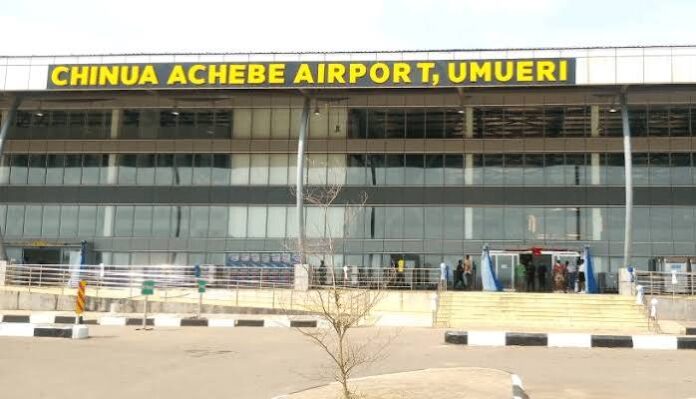
The Managing Director of Chinua Achebe Airport, Umueri, Martin Nwafor, has urged airlines operating from the facility to review their ticket prices to attract more passengers to the route.
Nwafor made the appeal on Wednesday while speaking with journalists in Umueri, Anambra East Local Government Area of Anambra State.
He identified the wide gap between fares at Chinua Achebe Airport and nearby airports as a major reason for low passenger patronage.
According to him, the airport currently handles eight scheduled flights daily operated by two airlines, with additional non-scheduled flights from private jets.
Nwafor also appealed to passengers from Anambra and neighboring states to patronize the airport, saying increased passenger traffic would strengthen its revenue base and support further development.
He said the airport needed more flights but noted that its relatively high ticket prices compared with neighboring airports continued to put it at a disadvantage.
“I am not an airline operator, but I know there is a pricing method which is informed by the interplay of demand and supply.
“So, I am calling on the two airline operators using this airport, who incidentally are from Anambra, to look at the disparity in ticket pricing,” he said.
Nwafor said a ticket to a nearby airport could cost about N115,000, while passengers traveling through Chinua Achebe Airport could pay as much as N200,000.
He said the price difference discouraged passengers from using the airport but noted that discussions with the airlines had begun yielding improvements.
“We have been talking recently, and it is closing up, and more passengers are coming here,” he said.
The airport manager explained that the facility generates passenger-related revenue mainly from travelers departing from the airport, as passengers arriving there pay their passenger service charges at their point of origin.
Airport Over 90% Complete at Inauguration
Nwafor said the airport was aeronautically complete and fully operational, although some ancillary facilities, including hangars, shops and malls, remained available for private investment.
He said the airport was more than 90 percent complete when it commenced commercial flight operations and had since overcome some initial operational limitations through continuous improvements.
According to him, the aeronautical infrastructure ensures the safe landing and take-off of aircraft and remains the airport management’s top priority.
“There is no compromise in the aeronautical aspect of the airport; here, if an airport is not ready, an aeroplane will not land there,” he said.
Nwafor explained that the airport initially operated smaller aircraft carrying about 50 passengers because it relied on Visual Flight Rules (VFR), which restricted the use of larger aircraft.
He said the installation of the Instrument Landing System, including the Doppler Very High Frequency Omnidirectional Radio Range equipment, had helped improve operations.
Although the system was initially not fully calibrated, he said continued upgrades had enabled the airport to overcome some restrictions.
Nwafor added that the airport could now handle night flights, particularly during the December travel period when passenger traffic typically increases.
He also highlighted the airport’s taxi services, saying the facility had an adequate number of taxis that had undergone security screening to protect passengers.
He said the taxis were clearly identified alongside their vehicles to ensure safer transportation for travelers.


