

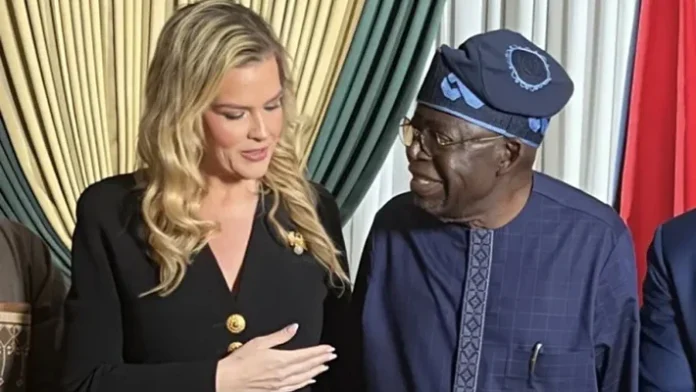
When photographs emerged this week showing American political strategist Diana London seated inside the Presidential Villa in Abuja alongside President Bola Tinubu, the backlash on Nigerian social media was swift and predictable. Many Nigerians wondered why an American political operative enjoyed immediate, intimate access to the seat of power while local journalists frequently struggles to secure a sit-down with the President.
The optics grew even murkier as details from United States Foreign Agents Registration Act (FARA) filings surfaced. Media reports cited documents showing multi-million-dollar lobbying retainers linked to Nigerian government channels, specifically a $4.5 million arrangement routed through Aster Legal on behalf of the Office of the National Security Adviser to conservative Washington firm DCI Group, with London’s own firm receiving $375,000 in retainers.
Though London denied receiving $4.5 million directly and insisted she was in Nigeria to film a documentary, the controversy has reopened a familiar, uncomfortable wound in Nigerian public life: why do Nigerian politicians consistently overlook homegrown public relations and public affairs professionals, particularly those chartered and regulated by the Nigerian Institute of Public Relations (NIPR)?
By law, the NIPR is not a voluntary social club; it is a statutory body established by Decree No. 16 of 1990 (now Cap N114, Laws of the Federation of Nigeria). Under the NIPR Act, the Institute is empowered to set professional standards, enforce a strict Code of Conduct, and regulate public relations practice across the country.
In theory, anyone managing public perception, strategic communications, or government image-making in Nigeria is expected to operate within its ethical and regulatory framework. In practice, however, Nigeria’s political class routinely treats local PR and public affairs specialists as an afterthought whenever high-stakes reputation management is required.
In a similar vein, the practice runs contrary to the spirit of Nigeria’s local content policy, which seeks to prioritize indigenous expertise, create employment opportunities for Nigerian professionals, and retain economic value within the country.
Accordingly, the Federal Government, its ministries, departments and agencies, as well as state and local governments and their respective institutions, should demonstrate commitment to this policy by engaging qualified, home-based public relations strategists and communications professionals to manage their public image, policy communication, stakeholder relations and reputation management.
Government institutions across the three tiers of government should not merely preach local content; they should reflect it in their procurement decisions and professional engagements, particularly in a field where Nigeria has a pool of trained and experienced practitioners.
There are several reasons for this persistent preference for foreign image-makers, though few of them flatter the nation’s political leadership.
First is the enduring allure of foreign validation. For decades, successive Nigerian administrations have operated under the assumption that external perception matters more than domestic trust, and that only a Western accent or a Washington Beltway address carries weight in international corridors.
When the goal is to influence lawmakers in Washington or reshape narratives around security and diplomatic designations, hiring a U.S.-registered lobbyist under FARA has a clear, practical logic: American lobbyists are legally permitted and structurally positioned to lobby American officials on Capitol Hill.
Yet, that practical reality does not explain why foreign lobbyists are brought to Abuja to stage-manage domestic political optics, praise local economic reforms on X, and occupy seats often inaccessible to Nigerian reporters. When a foreign strategist is showcased at the Presidential Villa to tell Nigerians that their economy is being “revolutionized,” the exercise ceases to be international diplomacy and becomes a poorly disguised domestic PR stunt.
Second is the question of accountability and regulatory convenience. Practitioners registered with the Nigerian Institute of Public Relations (NIPR) are bound by domestic laws and a professional disciplinary tribunal. They live in the country, understand the nuances of the Nigerian electorate, and face lasting reputational consequences at home if they peddle half-truths or engage in unethical spin.
Foreign consultants, by contrast, operate outside the NIPR’s jurisdiction. Once their retainers are wired and their social media posts are deleted, as happened when scrutiny mounted over London’s past legal history and lobbying ties, they can simply board a flight back to Washington, leaving the presidency to manage the fallout.
Third is a chronic undervaluation of local expertise. Nigeria boasts a deep pool of seasoned public affairs strategists, crisis communicators, and policy advocates who understand both local realities and global diplomacy.
Had the government engaged credible, NIPR-certified strategic communicators to design its international outreach, even in partnership with vetted Washington firms where legally necessary, the messaging might have avoided the disjointed rollout, conflicting denials, and public relations missteps witnessed during the episode.
Spending millions of dollars in scarce foreign exchange on opaque foreign contracts while sidelining statutory domestic institutions sends a troubling signal. A government cannot preach economic patriotism, local content, and institutional reform while outsourcing its own voice to foreign operatives.
Until Nigerian politicians begin to trust and utilize the accredited professionals regulated by the NIPR, they will continue to pay premium dollar rates for foreign publicity that backfires at home.


