

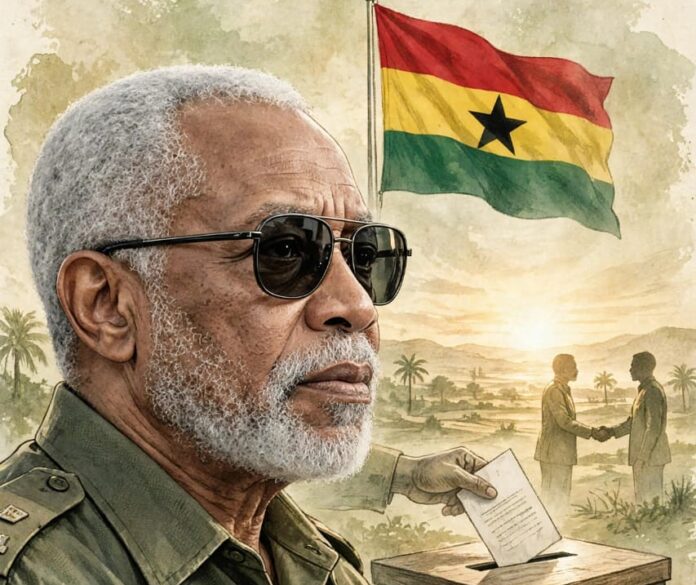
After our tribute to the late former Ghanaian President Jerry John Rawlings, a senior friend, a retired officer who knows history first-hand, sent me a serious correction. He asked me not to be named, and I honour that. But I must honour his truth, because WITNESS must never whitewash.
He reminded us of the hard truths we must not forget: that Rawlings came by the gun on June 4, 1979, that the Armed Forces Revolutionary Council executed eight senior military officers including three former Heads of State — Afrifa, Acheampong, and Akuffo — by firing squad in the name of house-cleaning, that his AFRC and Provisional National Defence Council years were marked by accusations of jailing dissidents, extra-judicial actions, media censorship and suppression of dissent, that his long grip on power from 1981 to 1993 drew persistent charges of autocracy, and that even his celebrated anti-corruption government was touched by scandal, including the Quality Grains Affair and the trials of his former finance officials.
He is right. History must record both sides.
Let me therefore say it plainly, so that WITNESS is not misunderstood: WE DO NOT CELEBRATE THE FIRING SQUAD. We do not celebrate the gun. We do not celebrate repression. What we learn from Rawlings is not his method, but his lesson. If we copy his method, we will have learned nothing. If we learn discipline without blood, and probity without repression, then his life will have taught us something.
And that lesson is best seen not in Rawlings himself, but in what Ghana became after him.
Ghana learned to let the ballot speak. In 2016, President John Dramani Mahama lost election as an incumbent President. He did not cling to power. He did not send soldiers to the streets. He did not annul the result. He did not incite his supporters to burn the nation. He relinquished power peacefully and went home. And in another election circle, in 2024, the same Mahama came back and won again — through the ballot, not the bullet.
That is succession. That is maturity. That is the beautiful example Ghana now gives to Africa: that you can lose and live to win again, because the system is bigger than the man. That is what democracy is supposed to be — not a do-or-die affair, but a contest where defeat is not death, and victory is not vengeance.
Contrast this with those African leaders who chose the other road and ended in ignominy.
Charles Taylor of Liberia — once a warlord-president, ended as a convicted war criminal in a prison cell in The Hague, serving a 50-year sentence for crimes against humanity. Laurent Gbagbo of Côte d’Ivoire — refused to accept defeat in 2010, plunged his nation into bloodshed that killed thousands, and ended before the International Criminal Court. They chose power over peace, and power destroyed them. Their names are now lessons in what not to do.
Rawlings, for all his faults, in the end laid down power and let Ghana try democracy. Ghana kept trying, election after election, until losing and winning became normal. That is his true legacy — not the gun, but the ground he left for the ballot to grow.
Nigeria must learn this now, as we approach 2027. We do not need another gun. We need another conscience.
We need leaders like our founding fathers — Dr Nnamdi Azikiwe, Sir Ahmadu Bello, Chief Obafemi Awolowo and Sir Abubakar Tafawa Balewa — who believed Nigeria was bigger than any one man’s ambition, and who would not destroy Nigeria to win a post. They competed fiercely, but they did not burn the house to own it.
We need leaders like President Goodluck Jonathan, who in 2015 proved to the world that no ambition is worth the blood of any Nigerian, when he conceded defeat to General Muhammadu Buhari and handed over power peacefully. That single act saved Nigeria from a catastrophe, and it remains the highest standard of statesmanship in our Fourth Republic.
That disposition — to lose with dignity, to win with humility, to serve with probity — is what Nigeria needs in 2027. We need competent, compassionate, financially prudent leaders who put accountability and systemic functionality above personal gain. We need leaders who understand that the fuel price, the food price, the insecurity in our villages, and the flight of our doctors and lecturers are not just statistics — they are the cries of a people who deserve better.
Let Ghana’s succession be our lesson. Let Taylor and Gbagbo be our warning. Let Azikiwe, Bello, Awolowo, Balewa and Jonathan be our example.
Discipline without blood. Probity without repression. Power without bloodshed. That is the Nigeria WITNESS stands for.
Richard Olanrewaju ODUSANYA is Convener and Author of WITNESS 2026/2036 and author of _NIGERIA NEEDS A NEW NATIONAL MODEL.


