

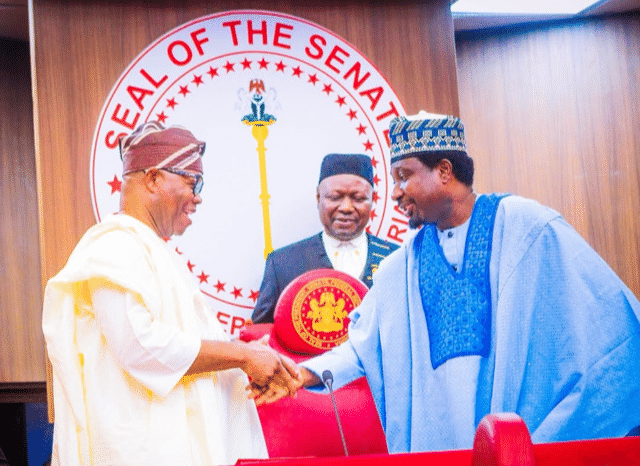
The Senate has taken the first legislative step towards transforming the National Institute for Legislative and Democratic Studies (NILDS) into a regional university serving Nigeria and the wider West African sub-region.
The proposed legislation, titled the West African University of Legislative Studies (Establishment) Bill, 2026 (SB. 1087), passed its first reading during plenary on Wednesday.
The bill is sponsored by the Deputy President of the Senate, Senator Barau I. Jibrin, who also serves as the First Deputy Speaker of the ECOWAS Parliament.
The legislative move comes two days after Barau announced his intention to sponsor the bill while representing Senate President Godswill Akpabio at the 10th Convocation Ceremony of the NILDS–University of Benin (UNIBEN) postgraduate programmes in Abuja.
According to a statement issued by his Special Adviser on Media and Publicity, Ismail Mudashir, the proposed institution will be known as the West African University of Legislative Studies (WAULS).
READ ALSO: Boko Haram Terrorists Attack Kills Five in Adamawa Communities
Barau said the initiative would build on NILDS’ existing infrastructure and academic capacity to strengthen legislative practice, democratic governance and regional integration across the Economic Community of West African States (ECOWAS).
He noted that Nigeria’s hosting of key regional institutions, including the ECOWAS Parliament, the ECOWAS Commission and the ECOWAS Court of Justice, positioned the country as a suitable location for a regional institution dedicated to legislative capacity building.
“Going by the quality of infrastructure this great institute has acquired over the years, there is a need for it to be transformed into a full-fledged university,” Barau said.
“As the First Deputy Speaker of the ECOWAS Parliament, Nigeria has always played a fatherly role within the ECOWAS community. This would be a way of extending our role in uniting the people of West Africa by bringing in legislators from all ECOWAS member states to study here.”
The lawmaker expressed optimism that the National Assembly would pass the bill and that President Bola Tinubu would grant presidential assent after the completion of the legislative process.


