

Nigeria’s Minister of State for Foreign Affairs, Amb. Sola Enikanolaiye, has emphasised the country’s role in strengthening global engagement with Africa through strategic partnerships, investment and economic cooperation.
Enikanolaiye spoke at the Berlin Global Dialogue 2026 during a high-level panel on “Foreign Policy by Other Means: Trade, Technology, and Geopolitical Power”, at the Policy Lab on Infrastructure and Investment.
Mr Raphael Oni, Special Assistant on Digital Media and Public Diplomacy to the minister, disclosed this in a statement on Friday in Abuja.
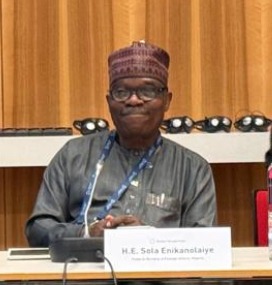
Enikanolaiye said Africa’s evolving engagement model was anchored on sovereignty, commitment to African priorities, mutual respect and shared prosperity.
He said Nigeria’s vision for reformed engagement with the continent centred on sovereignty, strategic autonomy, domestic resource mobilisation and bankable infrastructure projects.
“Africa has come to this conversation with great assets, substantial opportunities and determination to shape its own development based on partnership with the rest of the world,” he said.
The minister observed that diplomacy was shifting from rigid political alliances towards pragmatic, flexible and transaction-focused strategies, citing a recent policy lab organised in Abuja by a foreign embassy.
He said the government’s responsibility was to create an enabling environment for private enterprise, citing Nigeria’s stabilising role through the Economic Community of West African States Monitoring Group (ECOMOG) in Liberia and Sierra Leone, which helped Nigerian banks expand their regional operations.
Enikanolaiye reaffirmed Nigeria’s commitment to strategic autonomy, explaining that the principle allowed the country to pursue its national interests regardless of the ideological orientation or political affiliations of different blocs.
On natural resources, he said government policy required investors to establish local processing industries, with strict oversight to protect the environment and host communities.
“We learned from our experience in the Niger Delta. We are now doing things differently to give rights to local communities where minerals are found,” he said.
He identified reliable electricity, efficient intermodal transport systems, and adequate digital connectivity as critical infrastructure needs to expand production and create opportunities for Africa’s growing youth population.
The minister also highlighted revenue generation through metering systems as a major investment opportunity for foreign investors in Africa’s power sector.
According to him, African governments have reformed outdated laws to attract investment, with support from macroeconomic stabilisation and deregulation.
He stressed that reducing investment risks required well-prepared projects, predictable regulations, transparent procurement processes and credible risk-sharing mechanisms.
Enikanolaiye cited Africa’s average economic growth rate of 4.3 per cent, against an ambition of seven per cent, while noting progress towards the proposed ECO regional currency.
He described Nigeria’s single-window trade system and the Pan-African Payment and Settlement System (PAPSS), launched in January 2026, as critical mechanisms for expanding intra-African trade.
He said intra-African trade accounted for about 16 per cent under the African Continental Free Trade Area (AfCFTA), stressing the need for countries to strengthen commercial ties.
“We need to trade more among ourselves to develop competitive advantages,” he said.
The minister also called for reforms to the international credit rating system, welcomed the establishment of the African Credit Rating Agency and emphasised that Africa’s artificial intelligence ambitions depended on a stable electricity supply.
READ ALSO: Hungary Pledges Stronger Ties with Nigeria in Education, Humanitarian Development
Meanwhile, Enikanolaiye and Nigeria’s Ambassador to Germany, Sen. Ita Enang, met with Lesotho’s Foreign Minister, Limpho Tau, to discuss deeper bilateral cooperation and the possibility of establishing a diplomatic presence for Lesotho in Abuja.
Tau commended Nigeria’s historic contribution to African liberation struggles and invited Nigerian industrial leaders, including the Dangote Group, to explore investment opportunities in Lesotho.
He said the meeting would help advance cooperation through the African Union Development Agency-New Partnership for Africa’s Development (AUDA-NEPAD).


