


The evidence does not say upright birth is universally “superior” or that lying down is inherently unsafe.
The strongest research supports freedom to move and choose positions, especially for people without epidurals. With an epidural, the evidence is more complicated. (ACOG)
The big question is why do we make women give birth lying down? Why has it become so normal?
There is something almost strange about the picture most of us have grown up seeing: a woman in labour, flat on a hospital bed, usually on her back, while everyone around her tells her when and how to push.
It looks so normal that you might assume the human body was designed for it.
It wasn’t always this way.
For much of human history, women have given birth in a huge variety of positions — squatting, kneeling, standing, sitting, leaning forward, or on their hands and knees. And across the animal kingdom, many mammals instinctively adopt positions that allow them to remain upright, mobile or otherwise free to adjust their bodies during birth.
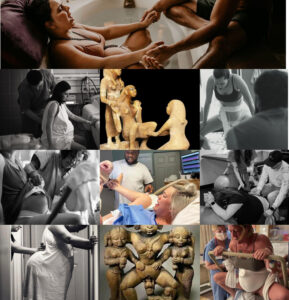
That doesn’t prove that standing is automatically better. But it does raise an interesting question: why did lying down become so normal for humans?
Modern obstetrics actually gives us part of the answer: it is simply easier for the person assisting the birth to monitor, examine, and intervene when the mother is on a bed. The position can be convenient for the medical team. (Iris)
But here’s where modern research gets interesting.
The World Health Organization recommends that women without an epidural should be supported to choose their own birth position, including upright positions. It specifically notes possible reductions in episiotomies and assisted births, while also acknowledging possible increases in second-degree tears and blood loss, with much of the evidence being low-certainty. (Iris)
A Cochrane review involving 30 randomised trials and 9,015 women found that, among women giving birth without an epidural, upright positions were associated with slightly shorter pushing stages, fewer assisted deliveries and fewer episiotomies. But there were also possible increases in second-degree tears and blood loss. (Cochrane)
The first stage of labour tells a similar story. Another Cochrane review found that women who remained upright and mobile had, on average, a shorter first stage of labour by about 1 hour and 22 minutes, although the researchers cautioned that the quality and consistency of the evidence varied. (Cochrane)
There is also a physiological reason doctors don’t encourage prolonged flat-on-the-back positioning without thought: the supine position can contribute to supine hypotension and more frequent fetal heart-rate decelerations. ACOG therefore says women should generally be allowed to change positions during labour when medically appropriate. (ACOG)
But there is an important twist.
“Natural” does not automatically mean “better.”
For women with epidurals, the evidence is different. A major trial found that upright positioning did not necessarily improve the chance of spontaneous vaginal birth, and some research has actually found advantages to recumbent positions in this group.
So perhaps the biggest lesson isn’t “never give birth lying down.”
It is this:
Why should one position be treated as the default when the evidence says women can safely benefit from having a choice?
The body changes throughout labour. The baby changes position. The mother’s comfort changes. Sometimes standing makes sense. Sometimes squatting does. Sometimes lying on the side is best. Sometimes medical circumstances require something else entirely.
Birth isn’t a performance where everyone has to use the same posture.
And perhaps modern medicine is finally moving back toward something surprisingly simple: instead of forcing the mother to fit the position, let the position fit the mother — when it is medically safe to do so. (ACOG)
Note: This article is an informed opinion based on available medical research and published evidence. It is intended for general educational and discussion purposes only and should not be considered medical advice, a substitute for professional medical guidance, or a source for making personal healthcare decisions. For medical or pregnancy-related concerns, always consult a qualified healthcare professional.
Sources (https://x.com/arinzechukwum_/
- American College of Obstetricians and Gynecologists (ACOG). Approaches to Limit Intervention During Labor and Birth — Committee Opinion No. 766. Obstetrics & Gynecology, 2019.
- World Health Organization (WHO). WHO Recommendations: Intrapartum Care for a Positive Childbirth Experience. Geneva: WHO, 2018.
- Cochrane Pregnancy and Childbirth Group. Upright versus lying down position in the second stage of labour. Cochrane Database of Systematic Reviews, 2017.
- Cochrane Pregnancy and Childbirth Group. Maternal positions and mobility during first stage labour. Cochrane Database of Systematic Reviews.
- World Health Organization (WHO). WHO Labour Care Guide: User’s Manual. Geneva: WHO, 2021.


