

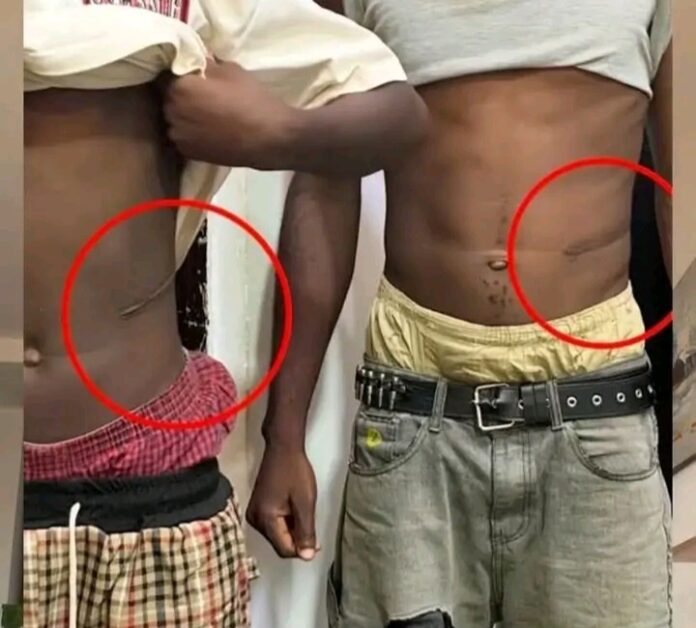
Few days ago, VeryDarkMan raised fresh alarm over an alleged kidney-trafficking network operating around the Mararaba–Masaka axis, including Auta Balefi in Karu Local Government Area of Nasarawa State.
According to reports based on his findings, a young man approached him claiming that one of his kidneys had been removed without his consent following a hospital visit.
VDM said medical examinations reportedly showed that the man’s left kidney was absent, prompting further efforts to unravel how and where the organ was removed.
The revelation took an even more disturbing turn when VDM reported that the young man’s friend, who reportedly took him to the hospital, was arrested and found to also have a missing kidney.
The Activist further noted that the friend had allegedly sold his own kidney for N7 million and that information gathered during the investigation suggested that several other people living in the area may have similarly sold their kidneys.
A claim that has so far sparked widespread concern across social media and renewed questions about the possible exploitation of economically vulnerable residents in the Karu corridor.
However, the wider allegations remain subject to investigation, and there is yet to be a publicly established official finding confirming the existence of an organised kidney-harvesting syndicate in Auta Balefi.
For many young people living around Karu, Mararaba, Masaka and the sprawling communities bordering Abuja, the dream is not complicated.
It is a decent job.
A room they can call their own.
A business that can survive beyond one market day.
Enough money to send home to parents, pay school fees, settle debts and, perhaps, buy a phone or motorcycle that makes life a little easier.
But amid the familiar struggle to make ends meet, a darker question is increasingly haunting the communities: How desperate must a person become before a part of his own body begins to look like a way out?
That question has returned to the spotlight following a fresh wave of claims on social media alleging that young people in parts of Karu Local Government Area of Nasarawa State have been selling their kidneys for money.
The claims have generated fear and outrage, with social media users circulating allegations that large numbers of young residents in the Karu–Mararaba axis have lost kidneys to a clandestine trade.
However, while the sweeping figures circulating online have not been independently verified by the police or medical authorities, the disturbing reality is that the allegation did not emerge from an entirely empty space.
There is a documented history of suspected kidney brokerage and organ trafficking around the Karu–Mararaba corridor and its links to Abuja.
And behind that history are young Nigerians whose economic desperation allegedly made an irreversible decision appear, at least temporarily, like a solution.
A kidney for a way out
In 2023, investigations into an alleged underground kidney market around Mararaba and Masaka brought the issue into public consciousness.
One case involved a 16-year-old boy from Masaka in Karu Local Government Area who was reportedly lured by a friend into selling his kidney.
He was said to have received about N1 million in instalments.
The money may have sounded enormous to a teenager from a struggling household.
But an organ is not a phone that can be replaced when it breaks.
It is not a piece of clothing that can be discarded when it becomes old.
It is part of the body.
Once removed, it does not return.
The case became one of several accounts that drew attention to an alleged network of brokers connecting vulnerable people with prospective recipients and medical facilities.
Investigations published at the time described Mararaba as part of an emerging underground market in which poverty, brokers and demand for organs intersected.
The disturbing question was not merely who was selling kidneys?
It was why were people willing to sell them?
The mathematics of desperation
For a young unemployed man struggling to survive, N1 million or N2 million can look like a fortune.
It can mean rent.
It can mean settling debts.
It can mean starting a small business.
It can mean sending money to a family that has been calling for help.
And that is precisely what makes the alleged kidney trade so troubling.
The people most vulnerable to organ brokers are not necessarily people who wake up one morning wanting to lose an organ.
They may be people who have run out of options.
The pattern was illustrated in November 2025 when the Nasarawa State Police Command announced the arrest of a 40-year-old suspected organ broker in Lafia and the rescue of four prospective victims.
According to the police, the men — aged between 20 and 32 — had allegedly been promised N2 million each for their kidneys.
The suspect had reportedly paid an initial N500,000 and taken the men for medical evaluation.
One of the prospective donors was moved to Abuja after passing an initial screening but was later rescued after developing a blood-pressure problem.
The case offers a chilling glimpse into how such alleged operations can work.
There is the recruiter.
There is the vulnerable person.
There is the promised money.
There are medical tests.
There is a prospective recipient.
And somewhere between them all is a human being being reduced to the value of an organ.
Karu’s uncomfortable proximity to Abuja
Karu’s location makes the story even more complicated.
The sprawling urban corridor sits immediately beside the Federal Capital Territory and has absorbed thousands of people seeking cheaper accommodation and economic opportunities outside Abuja.
Mararaba, Masaka and surrounding communities have grown into densely populated settlements where people live, work and commute between Nasarawa and Abuja every day.
It is a place of opportunity.
But it is also a place where economic vulnerability can be difficult to hide.
The same streets carrying workers into Abuja every morning also carry young people looking for jobs, casual labourers looking for daily income and families struggling with rising living costs.
That vulnerability has attracted other forms of criminal exploitation.
In May 2026, the Nigeria Police Force announced the rescue of 30 Malian nationals from a trafficking network operating in Mararaba and Karu. Police said the victims had allegedly been lured with promises of employment and migration opportunities before being held under exploitative conditions. Thirteen suspects were arrested.
Around the same period, NAPTIP also reported rescuing 15 people from a suspected trafficking operation in Karu and Keffi allegedly operating under the cover of an online marketing business.
These cases do not prove the current kidney-selling claims.
But they reveal something important about the environment in which such claims resonate: Karu has repeatedly featured in investigations involving the exploitation of vulnerable people.
The most frightening part may not be the rumours
Perhaps the most troubling aspect of the current frenzy is the possibility that fact and rumour are becoming mixed together.
A social media post claiming that “nearly all” young people in parts of the Abuja–Nasarawa axis have sold their kidneys is frightening.
But frightening claims still require evidence.
There is a danger in allowing unverified figures to spread unchecked.
Residents who have never sold an organ may suddenly become afraid that their neighbours have.
Families may panic.
Young people may be stigmatised.
And legitimate medical professionals or hospitals could be unfairly accused without evidence.
Yet dismissing the entire conversation as social-media hysteria would be equally dangerous.
The documented cases show that the underlying problem deserves serious investigation.
The real story may therefore lie somewhere between the viral exaggeration and the official silence.
How many people have actually been recruited?
How many were screened?
How many underwent surgery?
Who are the brokers?
Where were the operations allegedly performed?
Who paid for them?
Were consent procedures followed?
Were any minors involved?
And perhaps most importantly:
How many victims are living today with the consequences of a decision they made when they were desperate?
Those are questions that only a proper investigation can answer.
After the money disappears
There is another side of the kidney story that rarely receives enough attention.
The money does not last forever.
A young man may receive a large payment today and wake up months or years later with no savings, no stable job and one less kidney.
The immediate problem may have disappeared.
The poverty may not have.
That is the cruel arithmetic of organ exploitation.
A person sells something that cannot be replaced in exchange for money that can disappear.
The broker moves on.
The recipient receives the organ.
The medical transaction — if it occurred illegally — is completed.
But the donor remains with the consequences.
This is why the issue should not be reduced to sensational headlines about a “kidney market.”
At its heart, it is a story about human vulnerability.
The silence around the victims
There is also a human cost that cannot be measured in naira.
Imagine a young man returning home after surgery and telling his family nothing.
Imagine the questions when he begins to experience pain.
Imagine explaining to a future spouse that one kidney was removed years earlier because he needed money.
Imagine the regret when the money is gone.
Imagine a mother discovering that the child she struggled to raise had been persuaded to surrender part of his body to survive.
These are not statistics.
They are families.
And they are precisely why the present controversy deserves more than social-media outrage.
It deserves investigation.
Who is making money?
Perhaps the most important question is also the simplest:
If desperate young people are selling kidneys, who is buying?
A market cannot exist without demand.
And an organ does not move from a vulnerable donor to a recipient without a chain of people facilitating the transaction.
That chain may include recruiters, brokers, intermediaries and potentially corrupt actors.
Police investigations have already established, in at least one Nasarawa case, that a suspected broker allegedly negotiated a payment of N6.5 million with a prospective client while intending to pay the donors N2 million each. The suspect also allegedly admitted to having previously procured a donor for another client.
That revelation changes the narrative.
The young man at the bottom of the chain may receive millions less than the people facilitating the transaction.
He assumes the physical risk.
Someone else may control the money.
Someone else may find the recipient.
Someone else may profit from his desperation.
Beyond Karu
The kidney controversy should therefore trigger a broader conversation about poverty and organ trafficking in Nigeria.
It should also force authorities to look beyond individual arrests.
Police and NAPTIP investigations need to identify the networks behind the recruiters.
Health authorities need to strengthen scrutiny of suspicious transplant arrangements.
Hospitals and medical professionals must be held to the highest standards of consent and documentation.
Parents and community leaders need to pay closer attention to sudden disappearances, unexplained trips, suspicious “medical appointments” and young people being promised unusually large sums of money.
And young people themselves need to understand one brutal fact:
A kidney is not a quick loan.
Once surrendered, it cannot be recovered when the money runs out.
The question Karu must now answer
For now, the most sensational claims circulating online remain allegations requiring verification.
But the documented cases are serious enough to demand answers.
Karu should not become known as a place where poverty is measured in kidneys.
Mararaba should not become synonymous with an underground organ market.
And young Nigerians should not be forced to choose between hunger today and health tomorrow.
The disturbing question facing the authorities is therefore not simply whether the viral claims are true.
It is whether there are more victims who have not yet been found.
Because somewhere behind every alleged transaction is a person.
Someone who had a name.
Someone who had a family.
Someone who had plans.
Someone who needed money badly enough to believe that losing part of his body might be the price of getting another chance at life.
And that may be the real story behind the kidney controversy gripping Karu: not organs being sold, but desperation being bought.


