

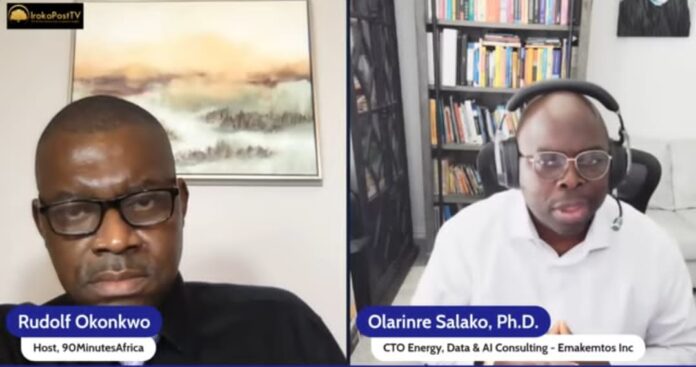
Speaking during an interview with Rudolf Okonkwo on 90MinutesAfrica, Salako argued that although President Tinubu has a long history as a pro-democracy activist and opposition figure, his actions in office appear inconsistent with those democratic credentials.
According to him, the President’s June 12, 2025, Democracy Day address to the National Assembly illustrated this contradiction. While Tinubu rejected accusations that he intends to transform Nigeria into a one-party state by citing his role in the struggle for democracy, he also expressed satisfaction with the current state of disarray within the opposition.
Salako argued that this apparent contradiction suggests that the President is benefiting politically from a weakened opposition rather than encouraging a competitive democratic environment. He likened the situation to wanting “an Iyaloja without a market,” a metaphor implying his desire to hold power without meaningful competition.
According to the newspaper columnist, the opposition bears part of the responsibility for their current predicament by failing to appreciate President Tinubu’s political style.
“The opposition will be foolish to think they can defeat President Tinubu without working together,” the energy expert said, describing the President as “a very pragmatic politician.”
He maintained that while the opposition remains divided, Tinubu continues to benefit from their lack of coordination and strategic cooperation.
Salako also criticised what he described as attempts by the administration to use the Cybercrime Act to suppress media freedom. He noted that President Tinubu himself benefited significantly from an independent press while he was in opposition.
He warned that any effort to restrict press freedom could ultimately prove counterproductive, pointing out that political power is temporary and that media institutions outlive governments.
The political analyst also raised ethical concerns regarding the reported allocation of houses to judges in the Federal Capital Territory (FCT).
He argued that because the Minister of the FCT, Nyesom Wike, serves under President Tinubu, such actions are ultimately attributable to the President.
Salako questioned why the Federal Ministry of Justice had not developed institutional welfare programmes for judicial officers, similar to the interest-free loan scheme reportedly introduced by the Federal Ministry of Education for university workers. He further expressed concern that judges appeared not to view the acceptance of such housing allocations as an ethical issue.
Salako offered a critical assessment of Nigeria’s democratic system, arguing that it falls short of Abraham Lincoln’s famous description of democracy as “government of the people, by the people, for the people.”
He cited allegations of vote-buying, election manipulation and judicial intervention in electoral outcomes as reasons for his conclusion that Nigeria’s democracy remains unhealthy.


